Factoring algebraic expressions using the distributive property | Algebra I | Khan Academy
TL;DR
Factoring expressions involves breaking down the expression into its factors, which can be numbers or other expressions.
Transcript
- In earlier mathematics that you may have done, you probably got familiar with the idea of a factor. So for example, let me just pick an arbitrary number, the number 12. We could say that the number 12 is the product of say two and six; two times six is equal to 12. So because if you take the product of two and six, you get 12, we could say that t... Read More
Key Insights
- 😑 Factoring involves breaking down an expression into its factors, which are the components that can be multiplied together to obtain the original expression.
- #️⃣ Prime factorization is the process of breaking down a number into its prime factors, which are the prime numbers that can be multiplied together to obtain the original number.
- 😑 Factoring expressions in algebra can involve factoring out common terms or even fractions.
- 😑 Factoring can be used to simplify expressions, solve equations, and find common factors.
- ◀️ Factoring is the reverse of the distributive property.
- 💁 Factored form is used to write expressions in a simplified form by breaking them down into their factors.
- #️⃣ Factoring can be done with numbers, variables, or a combination of both.
Install to Summarize YouTube Videos and Get Transcripts
Explore YouTube Video Summarizer or Get YouTube Transcript Extractor
Questions & Answers
Q: What is factoring in algebra?
Factoring in algebra is the process of breaking down an expression into its factors, which are the components that can be multiplied together to obtain the original expression.
Q: How is factoring related to the concept of factors in mathematics?
Factoring in algebra builds upon the concept of factors in mathematics. Factors are the numbers or expressions that can be multiplied together to obtain the original number or expression.
Q: What is prime factorization?
Prime factorization is the process of breaking down a number into its prime factors, which are the prime numbers that can be multiplied together to obtain the original number.
Q: How can you factor an expression like (6X + 30)?
To factor the expression (6X + 30), you can observe that both terms are divisible by 6. By factoring out 6, you are essentially undoing the distributive property and can write it as 6(X + 5).
Summary & Key Takeaways
-
Factoring is the process of breaking down an expression into its factors, which are the components that can be multiplied together to obtain the original expression.
-
In earlier mathematics, factors were used to break down numbers, and the concept of prime factorization involved breaking a number into its prime factors.
-
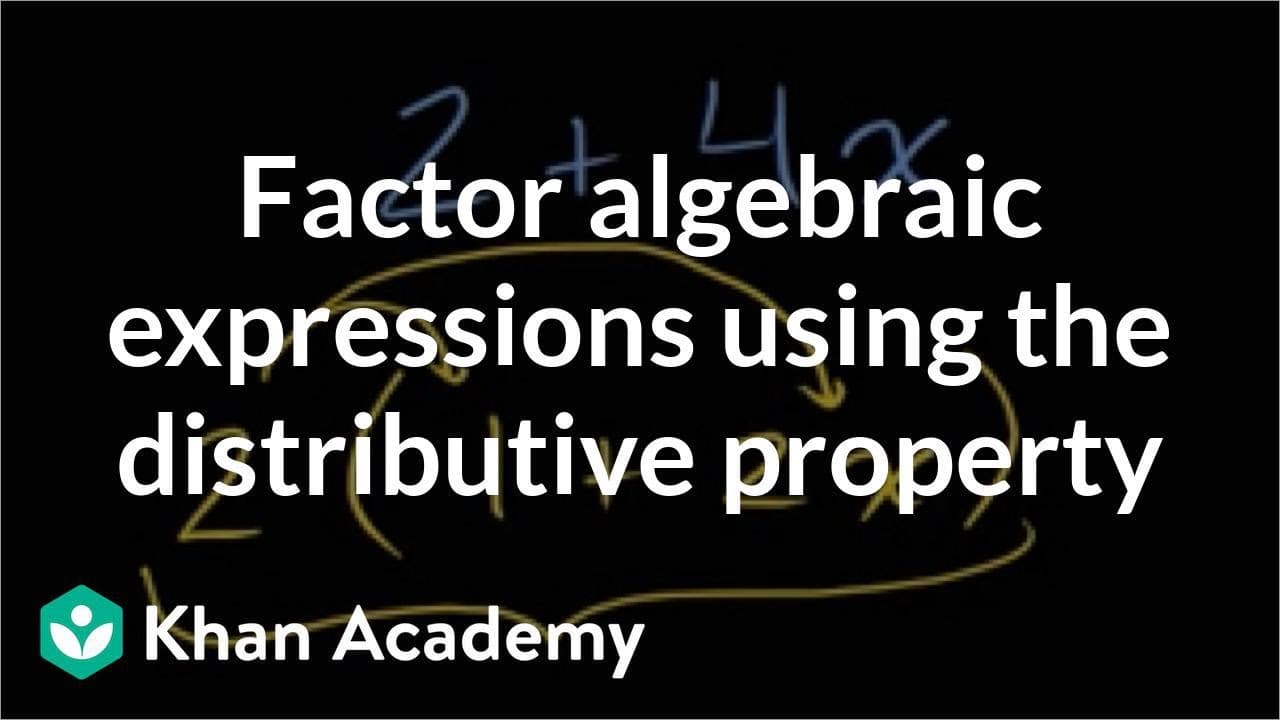
In algebra, the process of factoring involves breaking down an expression into its individual factors, either numbers or other expressions, like (2 + 4X) can be factored as 2(1 + 2X).
Read in Other Languages (beta)
Share This Summary 📚
Summarize YouTube Videos and Get Video Transcripts with 1-Click
Try YouTube Summary with ChatGPT & Claude or YouTube Transcript Generator
Explore More Summaries from Khan Academy 📚



Summarize YouTube Videos and Get Video Transcripts with 1-Click
Try YouTube Summary with ChatGPT & Claude or YouTube Transcript Generator