How to Calculate Velocity and Acceleration on a Wave
TL;DR
To calculate the instantaneous velocity and acceleration of points on a transverse wave, observe their movement relative to neighboring points. During maximum displacement, velocity is zero while acceleration can be upward or downward depending on the surrounding points. The total distance traveled by point P over a complete wave period is twice the amplitude of the wave.
Transcript
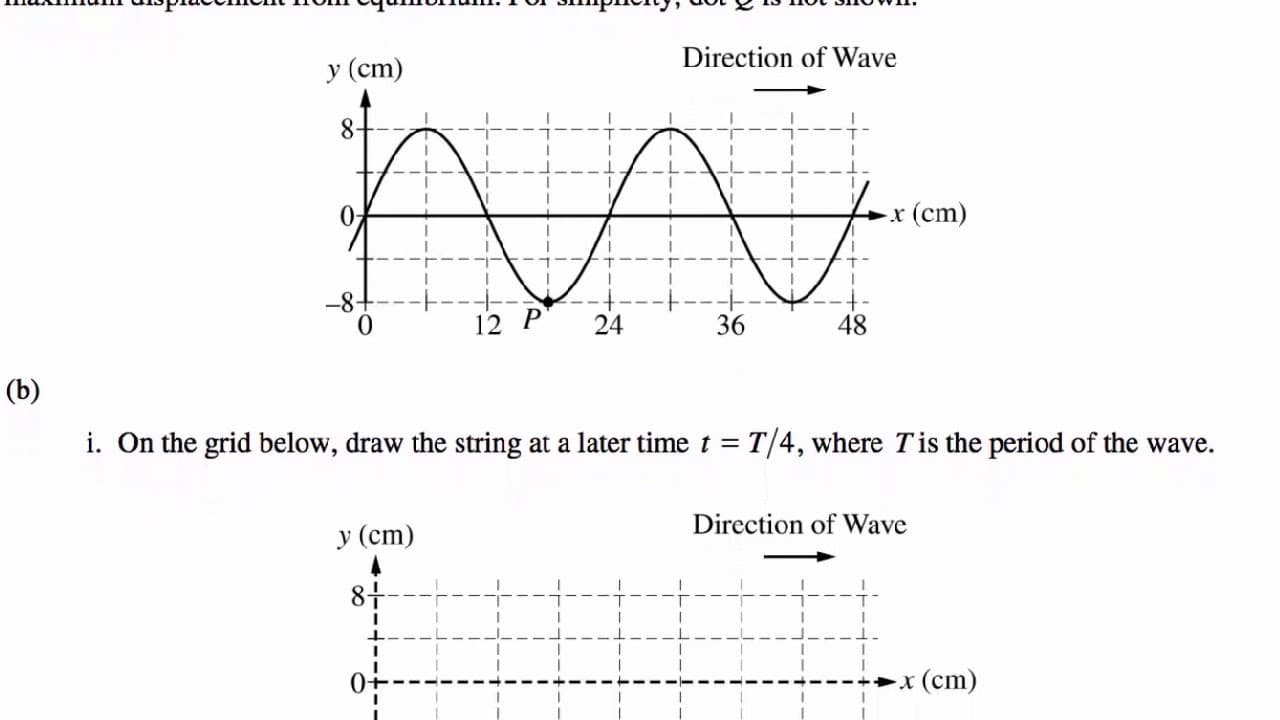
- [Instructor] We are told a transverse wave travels to the right along a string, they draw it right over here. Two dots have been painted on the string. In the diagrams below, those dots are labeled P and Q, so that's these dots here. The figure below shows the string at an instant in time. At the instant shown, dot P has maximum displacement and ... Read More
Key Insights
- 😥 The direction of instantaneous velocity for a point on a transverse wave depends on the direction of motion of neighboring points and whether the point is at the maximum displacement.
- 😥 Net acceleration in certain regions of a transverse wave can cause a change in the direction of velocity for points within those regions.
- 😥 Point P can be located at a given time by measuring its distance from a reference point or calculating its position based on the wavelength or period of the wave.
Install to Summarize YouTube Videos and Get Transcripts
Explore YouTube Video Summarizer or Get YouTube Transcript Extractor
Questions & Answers
Q: How can we determine the direction of instantaneous velocity for a point on a transverse wave?
To determine the direction of instantaneous velocity, we need to consider the motion of neighboring points on the wave. If a point is moving upward, its velocity vector will point upward, and if it's moving downward, the velocity vector will point downward. At the point of maximum displacement, the velocity is zero.
Q: What is the relationship between acceleration and velocity on a transverse wave?
In certain regions of the wave, such as the region around point P, there is a net upward acceleration. This means that even if a point has a downward velocity, its velocity is gradually decreasing, and it will eventually change direction and have an upward velocity. Similarly, in other regions of the wave, there may be net downward acceleration or transition points where the acceleration changes direction.
Q: How can we determine the position of point P on the string at a given time?
The position of point P can be determined by measuring its distance from a reference point or by calculating its position based on the wavelength or period of the wave. In the example given, point P is initially located at 18 centimeters on the string and moves upward over a quarter of the period.
Q: What is the difference between displacement and distance traveled for point P over a full period?
Displacement refers to the change in position of point P, measuring the distance between its initial and final positions. In this case, the displacement is zero because point P returns to its initial position. However, the distance traveled refers to the total distance covered by point P, which is equal to twice the maximum displacement.
Summary & Key Takeaways
-
The content explains how to determine the direction of instantaneous velocity for points P and Q on a transverse wave on a string.
-
It also demonstrates how to identify the direction of instantaneous acceleration for points P and Q by considering the net acceleration in their respective regions.
-
The content concludes by explaining how to determine the distance traveled by point P over a full period of the wave.
Read in Other Languages (beta)
Share This Summary 📚
Summarize YouTube Videos and Get Video Transcripts with 1-Click
Try YouTube Summary with ChatGPT & Claude or YouTube Transcript Generator
Explore More Summaries from Khan Academy 📚



Summarize YouTube Videos and Get Video Transcripts with 1-Click
Try YouTube Summary with ChatGPT & Claude or YouTube Transcript Generator