Why water skitters off sizzling surfaces – and how to stop it
TL;DR
Researchers have developed a new method to eliminate the Leidenfrost effect, improving cooling efficiency.
Transcript
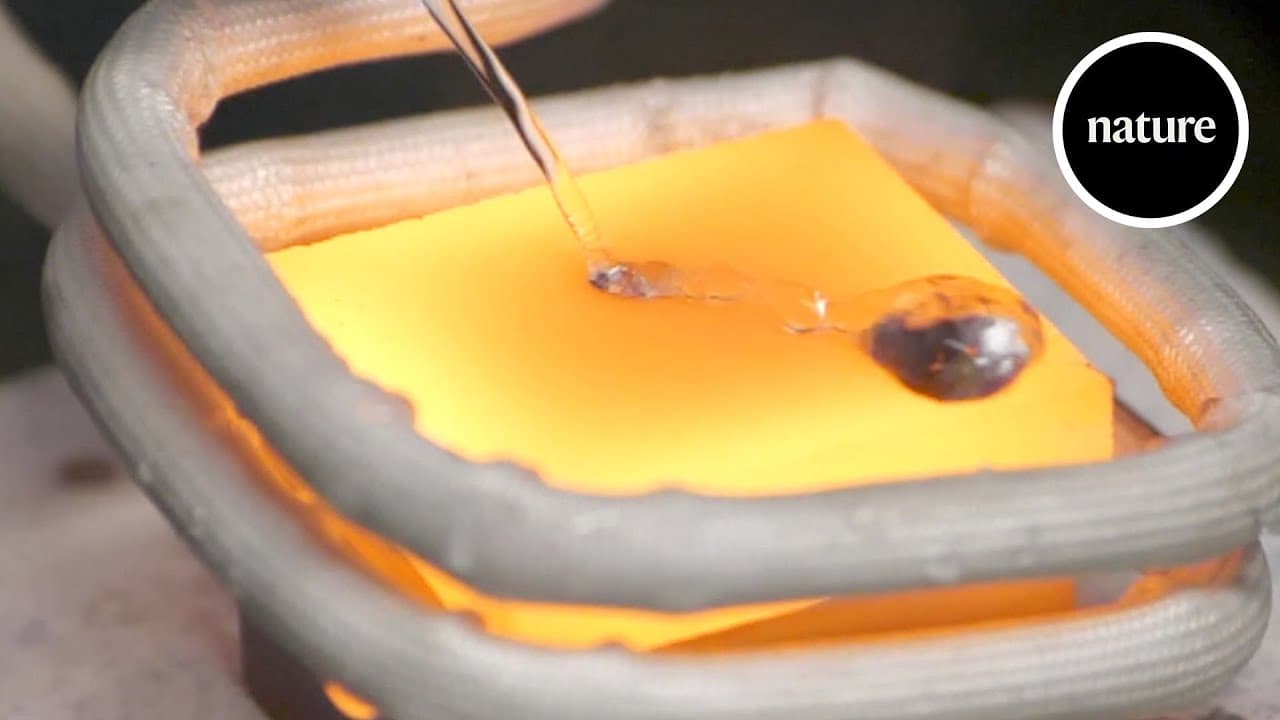
hot surfaces and liquids don't mix drop water on a really hot surface and instead of evaporating the droplets start to skitter around this is called the leidenfrost effect and it can be a problem if you're trying to use water to cool down systems prone to overheating that's why zuang kai wang and his colleagues in hong kong have found a clever way ... Read More
Key Insights
- ✋ The Leidenfrost effect has significant implications for thermal management in high-temperature industrial processes, where proper cooling is crucial.
- 🥵 Conventional solutions like grooved surfaces have limitations in efficiency and temperature range, as they cannot entirely eliminate the vapor layer at extreme heats.
- ✋ The structured thermal armor with a membrane represents a breakthrough in materials science, potentially enabling high-temperature applications to avoid the Leidenfrost effect.
- 🤗 Testing showed that the innovative armor could function effectively in environments exceeding typical operating temperatures, thus opening possibilities for next-generation cooling solutions.
- 🈸 The study emphasizes the importance of interdisciplinary approaches, combining materials engineering, thermal dynamics, and practical applications in industrial settings.
- 😎 Effective thermal management can lead to more efficient operations, increased safety, and reduced energy consumption in facilities relying on cooling systems.
- ❓ Potential future advancements could involve exploring alternative materials for the thermal armor to enhance performance and broaden its applicability across various technologies.
Install to Summarize YouTube Videos and Get Transcripts
Explore YouTube Video Summarizer or Get YouTube Transcript Extractor
Questions & Answers
Q: What is the Leidenfrost effect, and why is it a problem for cooling systems?
The Leidenfrost effect occurs when a water droplet hits a surface significantly hotter than its boiling point, causing it to form vapor underneath instead of directly contacting the surface. This vapor layer prevents efficient evaporation and cooling, which can lead to overheating in liquid-based cooling systems, such as those in manufacturing or nuclear power plants.
Q: How did Zhuang Kai Wang's team address the challenges posed by the Leidenfrost effect?
Wang and his colleagues developed a "structured thermal armor" that features a special membrane embedded in textured grooves. This membrane efficiently wicks water into the grooves, allowing water to spread and evaporate instead of bouncing off the hot surface, effectively overcoming the insulating vapor layer created by the Leidenfrost effect.
Q: What materials and temperatures can the structured thermal armor withstand?
During tests, the structured thermal armor effectively eliminated the Leidenfrost effect up to 1200 degrees Celsius. However, at that temperature, the steel material began to melt. Wang believes that using different materials could allow for even higher temperature applications without droplets bouncing, maintaining effective cooling.
Q: In which industries could the structured thermal armor be applied?
The structured thermal armor has versatile applications across various sectors, including nuclear power plants, aerospace, and turbine engines. Its design aims to enhance cooling efficiency in high-temperature environments where traditional methods are limited, thus improving safety and effectiveness in these industries.
Summary & Key Takeaways
-
The Leidenfrost effect occurs when a water droplet hits a hot surface, forming vapor that insulates the droplet and hinders efficient evaporation. This phenomenon can complicate cooling operations in overheating systems like manufacturing and power plants.
-
Zhuang Kai Wang and his team created a "structured thermal armor" that incorporates a special membrane to absorb and spread water over a surface, successfully counteracting the Leidenfrost effect even at extreme temperatures.
-
The innovative design of the armor has potential applications in various industries, including nuclear power and aerospace, providing a more effective solution for thermal management in high-temperature settings.
Read in Other Languages (beta)
Share This Summary 📚
Summarize YouTube Videos and Get Video Transcripts with 1-Click
Try YouTube Summary with ChatGPT & Claude or YouTube Transcript Generator
Explore More Summaries from nature video 📚




Summarize YouTube Videos and Get Video Transcripts with 1-Click
Try YouTube Summary with ChatGPT & Claude or YouTube Transcript Generator