Arithmetic Instructions in 8085 Microprocessor
TL;DR
Learn about the different arithmetic instructions in microprocessors, including addition, subtraction, increment, decrement, and bcd conversion.
Transcript
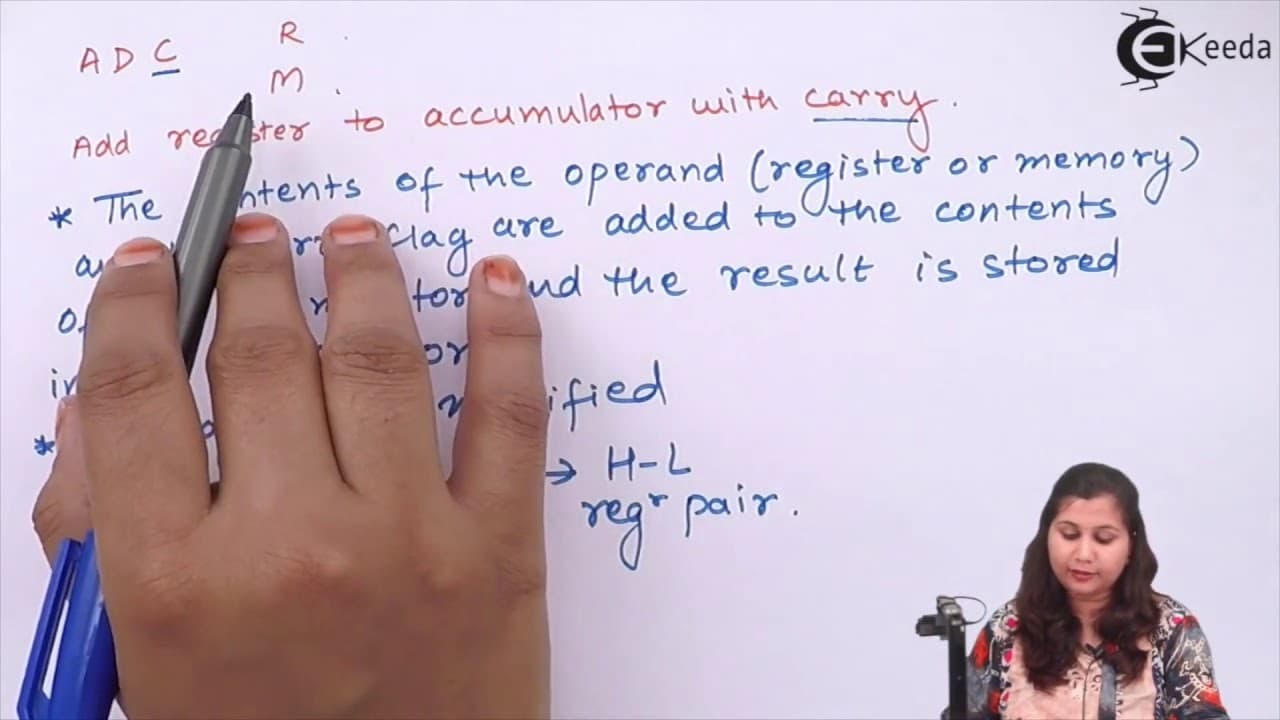
let us study that what instructions come under this category in this category the instructions which perform the arithmetic operations they are included arithmetic operations like addition subtraction increment and decrement the first instruction under this category is a d d edition the operand of this instruction can be a register or it can be a m... Read More
Key Insights
- 🍵 Arithmetic instructions in microprocessors handle addition, subtraction, increment, decrement, and bcd conversion.
- 🖐️ The accumulator plays a central role in arithmetic instructions, with one operand stored in the accumulator.
- 🤘 Arithmetic instructions modify flags such as sign, zero, parity, auxiliary carry, and carry to reflect the results of the operations.
- 👨💻 The DAA instruction is used for converting binary numbers to binary coded decimal (BCD) notation.
- ®️ INX and DCX instructions are used to increment and decrement register pairs, respectively.
- 🎏 The auxiliary carry flag affects the execution of the DAA instruction, enabling specific adjustments in BCD conversion.
Install to Summarize YouTube Videos and Get Transcripts
Explore YouTube Video Summarizer or Get YouTube Transcript Extractor
Questions & Answers
Q: What is the purpose of arithmetic instructions in microprocessors?
Arithmetic instructions are used to perform mathematical operations such as addition, subtraction, increment, decrement, and bcd conversion in microprocessors.
Q: How are arithmetic instructions related to the accumulator?
In arithmetic instructions, one operand is stored in the accumulator, and the other operand can be a register or a memory location. The result of the operation is stored in the accumulator.
Q: Which flags are modified during arithmetic operations?
The flags that are modified during arithmetic operations include the sign flag, zero flag, parity flag, auxiliary carry flag, and carry flag. These flags reflect the result of the arithmetic operation.
Q: What is the purpose of the decimal adjust accumulator (DAA) instruction?
The DAA instruction is used for converting the contents of the accumulator from binary to binary coded decimal (BCD) notation. It adjusts the values of the accumulator to represent two four-bit BCD digits.
Q: How are register pairs incremented or decremented in microprocessors?
Register pairs can be incremented or decremented using the INX (increment) and DCX (decrement) instructions. These instructions modify the contents of the register pairs by one.
Q: How does the auxiliary carry flag affect the execution of arithmetic instructions?
The auxiliary carry flag is used in the decimal adjust accumulator (DAA) instruction. If the auxiliary carry flag is set, certain values are added to the lower and higher order bits during the BCD conversion process.
Summary & Key Takeaways
-
Arithmetic instructions in microprocessors perform operations such as addition, subtraction, increment, decrement, and bcd conversion.
-
These instructions involve manipulating the contents of the accumulator, registers, and memory locations.
-
Flags such as sign, zero, parity, auxiliary carry, and carry are modified to reflect the results of the arithmetic operations.
Read in Other Languages (beta)
Share This Summary 📚
Summarize YouTube Videos and Get Video Transcripts with 1-Click
Try YouTube Summary with ChatGPT & Claude or YouTube Transcript Generator
Explore More Summaries from Ekeeda 📚






Summarize YouTube Videos and Get Video Transcripts with 1-Click
Try YouTube Summary with ChatGPT & Claude or YouTube Transcript Generator