Comparing P-value from t statistic to significance level | AP Statistics | Khan Academy
TL;DR
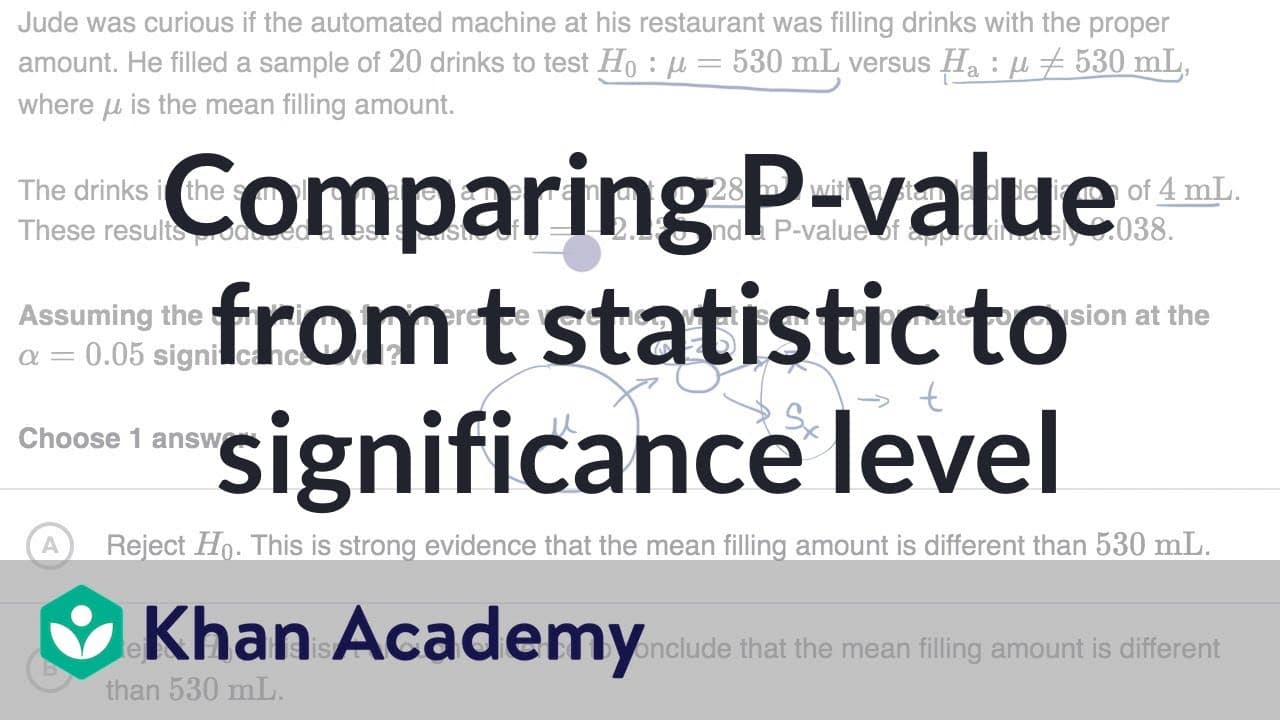
The automated machine at the restaurant was tested with a sample of 20 drinks, resulting in a mean amount of 528 milliliters and a P-value of 0.038. The null hypothesis is rejected, suggesting that the true mean filling amount is different than 530 milliliters.
Transcript
- [Instructor] Jude was curious if the automated machine at his restaurant was filling drinks with the proper amount. He filled a sample of 20 drinks to test his null hypothesis, which is the actual population mean for how much drink there was in the drinks, per drink is 530 milliliters, versus his alternative hypothesis is that the population mean... Read More
Key Insights
- 🍸 The hypothesis test aims to determine if the automated machine fills drinks with the proper amount.
- 🙂 The sample mean of 528 milliliters is slightly below the hypothesized mean of 530 milliliters.
- 😃 The obtained t-statistic of -2.236 indicates a significant deviation from the null hypothesis.
- 💪 The resulting P-value of 0.038 suggests strong evidence against the null hypothesis.
- ❓ Rejecting the null hypothesis implies that the true mean filling amount is different from 530 milliliters.
- 😀 The choice to reject the null hypothesis is supported by comparing the P-value to the significance level.
- 🟰 The alternative hypothesis suggests that the mean filling amount is not equal to 530 milliliters.
Install to Summarize YouTube Videos and Get Transcripts
Explore YouTube Video Summarizer or Get YouTube Transcript Extractor
Questions & Answers
Q: What is the purpose of testing the null hypothesis in this scenario?
The null hypothesis tests if the true mean filling amount of the drinks is 530 milliliters. It provides a reference point for comparison with the alternative hypothesis.
Q: How is the test statistic calculated in hypothesis testing?
The test statistic, in this case, a t-statistic, is computed using the sample mean, sample standard deviation, and sample size. It measures the difference between the sample mean and the hypothesized population mean.
Q: What does the P-value represent in hypothesis testing?
The P-value is the probability of obtaining a result as extreme or more extreme than the observed sample mean, assuming the null hypothesis is true. A low P-value suggests strong evidence against the null hypothesis.
Q: Why is a significance level of 0.05 commonly used in hypothesis testing?
A significance level of 0.05 represents a 5% chance of observing the obtained results if the null hypothesis is true. This threshold is often used to determine if the evidence is strong enough to reject the null hypothesis.
Summary & Key Takeaways
-
Jude tested the automated machine at his restaurant by sampling 20 drinks to determine the true mean filling amount.
-
The sample mean was 528 milliliters with a standard deviation of four milliliters.
-
The obtained results, including a test statistic of -2.236 and a P-value of 0.038, led to the rejection of the null hypothesis.
Read in Other Languages (beta)
Share This Summary 📚
Summarize YouTube Videos and Get Video Transcripts with 1-Click
Try YouTube Summary with ChatGPT & Claude or YouTube Transcript Generator
Explore More Summaries from Khan Academy 📚



Summarize YouTube Videos and Get Video Transcripts with 1-Click
Try YouTube Summary with ChatGPT & Claude or YouTube Transcript Generator