MTEL Math Practice Test: 28-30
TL;DR
Determine the remaining gallons in a smaller pool when a larger pool is fully drained using pump rates.
Transcript
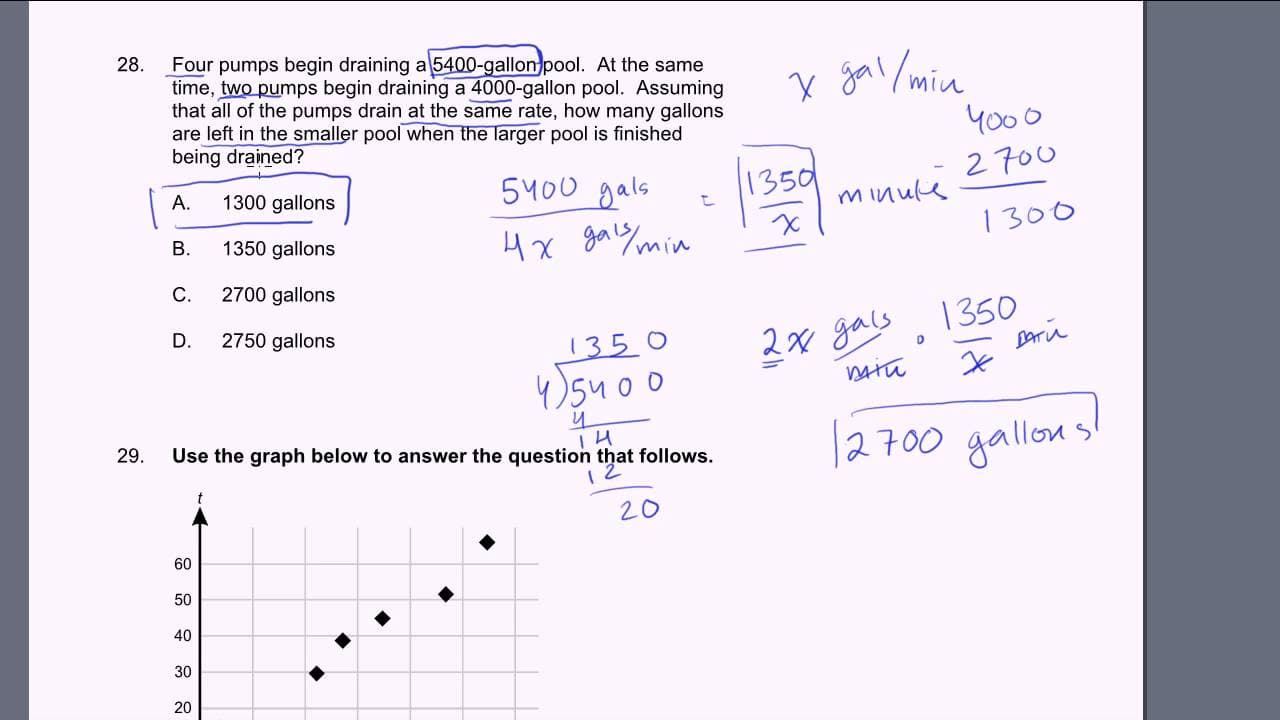
We're on problem 28. Four pumps begin draining a 5,400 gallon pool. At the same time, two pumps begin draining a 4,000 gallon pool. Assuming that all of the pumps drain at the same rate, how many gallons are left in the smaller pool-- so the 4,000 gallon pool-- when the larger pool is finished being drained. And notice they didn't tell us how fast ... Read More
Key Insights
- ☠️ Pump rates are essential in determining the time taken and amount drained from pools.
- ☠️ Assuming equal pump rates simplifies calculations and allows for accurate analysis.
- ⛽ Calculation of remaining gallons involves subtracting the amount pumped out from the initial volume of the pool.
Install to Summarize YouTube Videos and Get Transcripts
Explore YouTube Video Summarizer or Get YouTube Transcript Extractor
Questions & Answers
Q: How many gallons are left in the smaller pool when the larger pool is fully drained?
There are 1,300 gallons left in the smaller pool when the larger pool is fully drained. This is calculated by subtracting the amount pumped out (2,700 gallons) from the initial volume of 4,000 gallons.
Q: What is the significance of assuming that all pumps drain at the same rate?
Assuming all pumps drain at the same rate allows for easier analysis and calculation of the problem. It simplifies the equation and enables the determination of the remaining gallons accurately.
Q: How is the time taken to drain the larger pool calculated?
The time taken is calculated by dividing the volume of the pool (5,400 gallons) by the combined rate at which the four pumps drain (4x gallons per minute). This gives the result of 1,350/x minutes to drain the larger pool.
Q: How is the amount drained from the smaller pool calculated?
The amount drained is calculated by multiplying the rate at which the two pumps drain (2x gallons per minute) by the time taken to drain the larger pool (1,350/x minutes). This gives the result of 2,700 gallons drained from the smaller pool.
Summary & Key Takeaways
-
The problem involves four pumps draining a 5,400 gallon pool and two pumps draining a 4,000 gallon pool simultaneously.
-
Assuming all pumps drain at the same rate, calculations are made to find the time it takes to drain the larger pool and the amount drained from the smaller pool.
-
Using the pump rates, it is determined that 2,700 gallons have been pumped out of the 4,000 gallon pool, leaving 1,300 gallons remaining.
Read in Other Languages (beta)
Share This Summary 📚
Summarize YouTube Videos and Get Video Transcripts with 1-Click
Try YouTube Summary with ChatGPT & Claude or YouTube Transcript Generator
Explore More Summaries from Khan Academy 📚



Summarize YouTube Videos and Get Video Transcripts with 1-Click
Try YouTube Summary with ChatGPT & Claude or YouTube Transcript Generator