Undetermined coefficients 3 | Second order differential equations | Khan Academy
TL;DR
This video explains how to solve a nonhomogeneous linear differential equation with constant coefficients using a polynomial particular solution and the general solution of the homogeneous equation.
Transcript
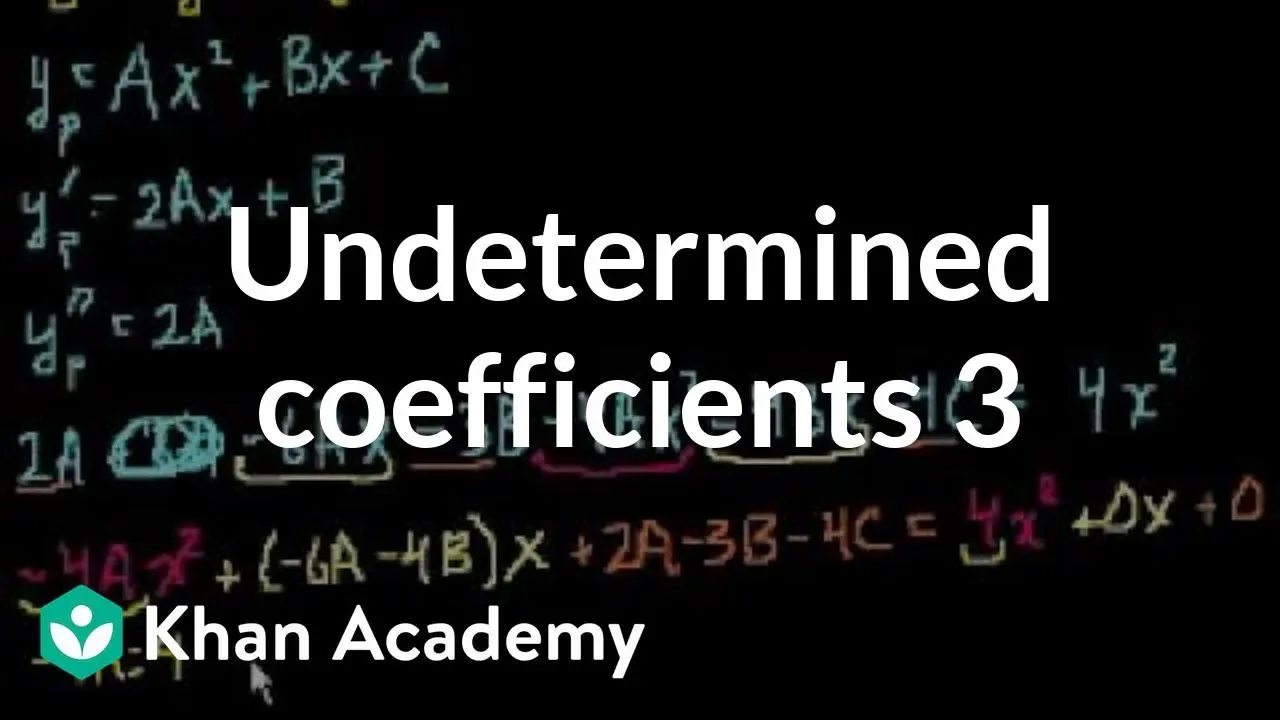
Let's do another example of solving a nonhomogeneous linear differential equation with a constant coefficient. And the left-hand side is going to be the same one that we've been doing. The second derivative of y minus 3 times the first derivative minus 4 times y is equal to-- and now instead of having an exponential function or a trigonometric func... Read More
Key Insights
- ❓ Nonhomogeneous linear differential equations with constant coefficients can be solved by finding the particular solution.
- 💁 Guessing the form of the particular solution based on the nonhomogeneous part is a common technique.
- 🍉 The coefficients of the particular solution can be determined by substituting the guess into the original equation and equating corresponding terms.
Install to Summarize YouTube Videos and Get Transcripts
Explore YouTube Video Summarizer or Get YouTube Transcript Extractor
Questions & Answers
Q: How do you determine the particular solution for a nonhomogeneous linear differential equation?
The particular solution can be determined by guessing a form that matches the nonhomogeneous part of the equation. In this case, since the nonhomogeneous part is a polynomial, a polynomial guess is made.
Q: How are the coefficients of the particular solution calculated?
The coefficients of the particular solution are calculated by substituting the guess into the original equation and equating corresponding terms. This creates a system of equations that can be solved to find the values of the coefficients.
Q: What is the general solution of the homogeneous equation?
The general solution of the homogeneous equation is obtained by solving the equation without the nonhomogeneous part. In this case, it is found to be C1e^(4x) + C2e^(-x), where C1 and C2 are constants.
Q: How is the complete solution obtained?
The complete solution is obtained by combining the particular solution with the general solution of the homogeneous equation. This sum forms the general solution of the nonhomogeneous equation.
Summary & Key Takeaways
-
The video demonstrates solving a nonhomogeneous linear differential equation with constant coefficients, focusing on finding the particular solution.
-
A polynomial is chosen as a guess for the particular solution, and the coefficients are determined by substituting it into the original equation and equating corresponding terms.
-
The coefficients are solved for, and the particular solution is combined with the general solution of the homogeneous equation to obtain the complete solution.
Read in Other Languages (beta)
Share This Summary 📚
Summarize YouTube Videos and Get Video Transcripts with 1-Click
Try YouTube Summary with ChatGPT & Claude or YouTube Transcript Generator
Explore More Summaries from Khan Academy 📚



Summarize YouTube Videos and Get Video Transcripts with 1-Click
Try YouTube Summary with ChatGPT & Claude or YouTube Transcript Generator