Metric system: units of distance | 4th grade | Khan Academy
TL;DR
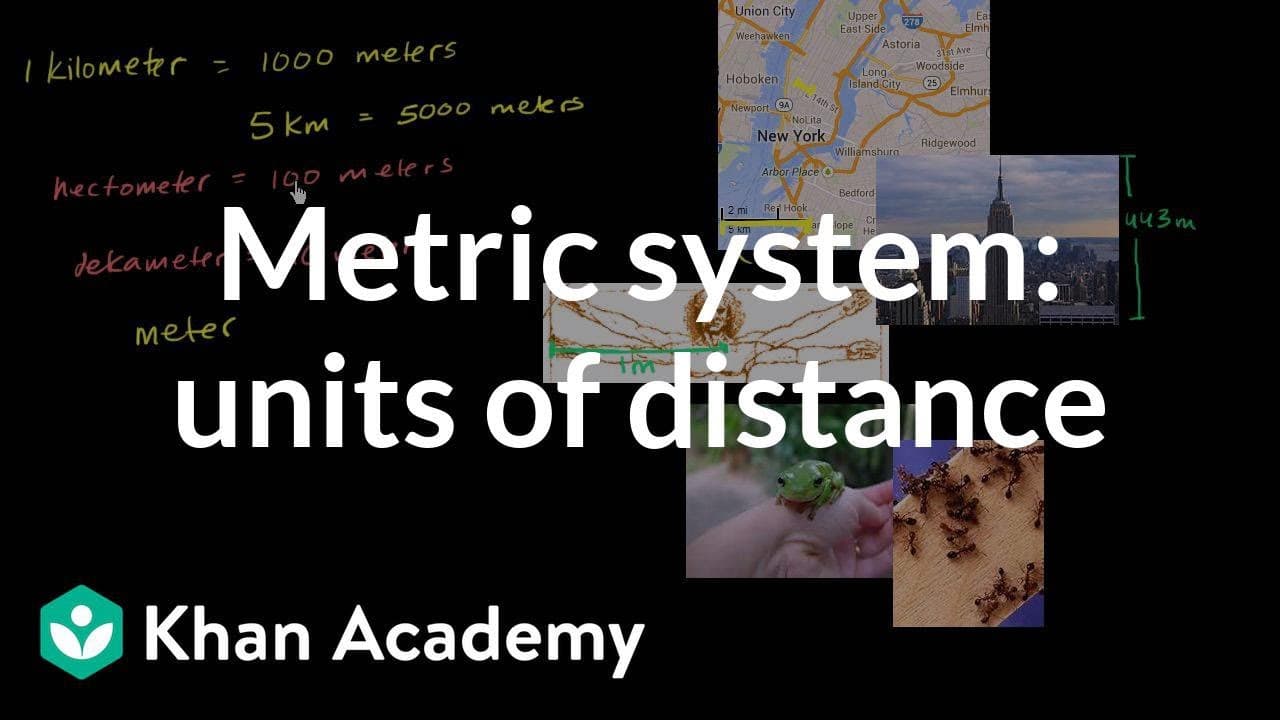
The metric system uses the meter as the base unit for distance, with prefixes like kilo, hecto, deka, deci, and centi to describe larger or smaller distances.
Transcript
The base unit for distance in the metric system is the meter. And to get a sense of how long a meter is, the average human being is between 1.5 and 2 meters tall. So 1.5 meters would be a not-so-tall person, but 2 meters would be quite tall. In fact, if you're 2 meters tall or above 2 meters tall, you might want to consider basketball. So, for exam... Read More
Key Insights
- 🤒 The meter is the base unit for distance in the metric system, and its size can be visualized by comparing it to the height or wingspan of a human being.
- 🤒 The metric system provides prefixes like kilo, hecto, and deka to describe distances larger than a meter.
- 🤒 The Empire State Building, a skyscraper, can be measured in meters.
- 🛩️ The metric system also has less commonly used units like decimeter, centimeter, and millimeter for smaller distances.
- 🔇 The prefixes used in the metric system are not only applicable to distance but also used in other areas of measurement like volume.
- 📈 Understanding the prefixes of the metric system is useful for converting between different units of distance.
- 👻 The metric system allows for easy scaling and conversion by using multiples and divisions of the base unit.
Install to Summarize YouTube Videos and Get Transcripts
Explore YouTube Video Summarizer or Get YouTube Transcript Extractor
Questions & Answers
Q: How tall is a meter compared to a human being?
The average human being is between 1.5 and 2 meters tall, with 1.5 meters being considered not-so-tall and 2 meters being quite tall.
Q: What are some larger objects that can be measured with a meter?
The height of skyscrapers, such as the Empire State Building, can be measured in meters. The Empire State Building, for example, is 443 meters tall.
Q: What are some prefixes used to describe distances larger than a meter?
The metric system uses prefixes like kilo, hecto, and deka. For example, a kilometer is equal to 1,000 meters.
Q: What are the units used to describe distances smaller than a meter?
The metric system has units like decimeter, centimeter, and millimeter for smaller distances. For example, a centimeter is 1/100 of a meter.
Summary & Key Takeaways
-
The meter is the base unit of distance in the metric system and is comparable to the height of an average human being.
-
For larger distances, the metric system uses prefixes like kilo to describe distances within and between cities.
-
The metric system also has less commonly used units like decimeters and centimeters for smaller distances.
-
The prefixes in the metric system are also used in other areas of measurement, such as volume.
Read in Other Languages (beta)
Share This Summary 📚
Summarize YouTube Videos and Get Video Transcripts with 1-Click
Try YouTube Summary with ChatGPT & Claude or YouTube Transcript Generator
Explore More Summaries from Khan Academy 📚



Summarize YouTube Videos and Get Video Transcripts with 1-Click
Try YouTube Summary with ChatGPT & Claude or YouTube Transcript Generator