Impedance vs frequency
TL;DR
AC analysis involves using sinusoidal signals and Euler's equation to determine impedance values for different electrical components.
Transcript
- [Voiceover] In this video we're gonna continue talking about AC analysis and the concept of impedance as the ratio of voltage to current and an AC situation, and just as a reminder of the assumptions we've made for AC analysis we've assumed that all of our signals are of the form of some kind of a sinusoid like that, cosine is the typical one we ... Read More
Key Insights
- 💁 AC analysis in electrical engineering involves analyzing signals in the form of sinusoids and using Euler's equation to decompose them into complex exponentials.
- ⚾ Impedance values for different components are determined based on their physical properties and can change with frequency.
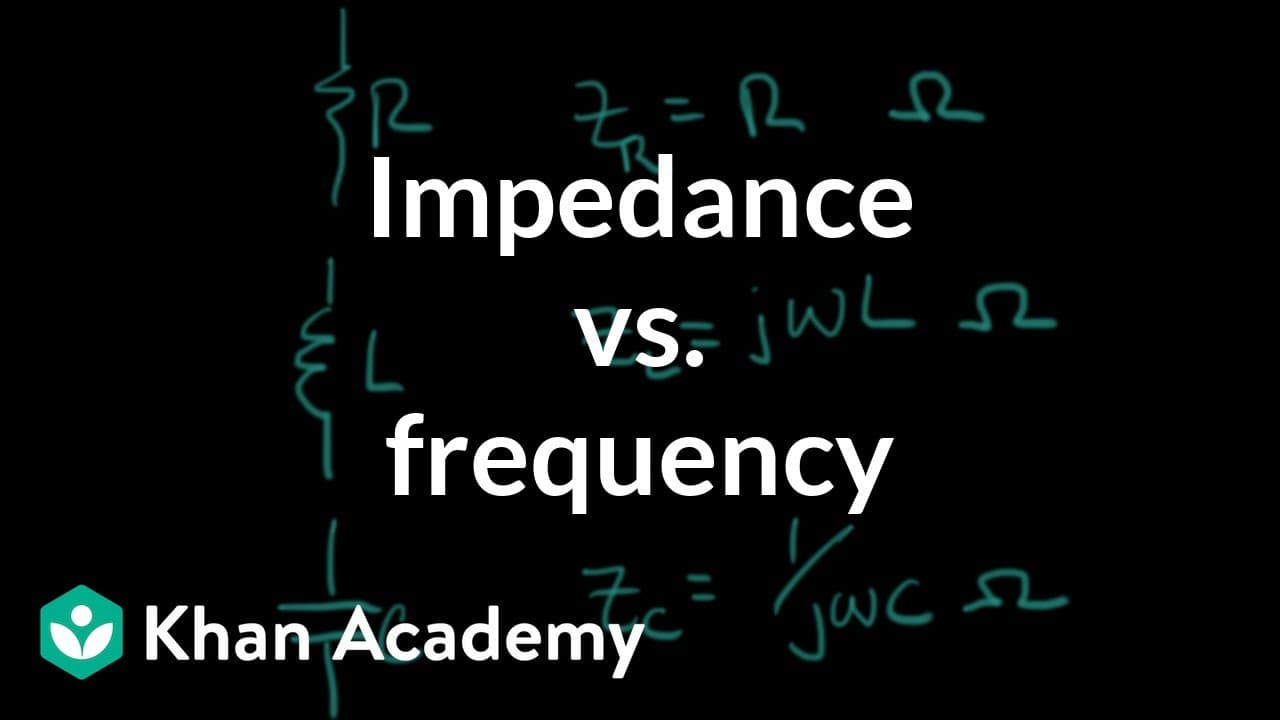
- 🔰 In the case of a resistor, the impedance is simply the resistance (R), while for an inductor it is J omega L and for a capacitor it is 1 over J omega C.
- 📭 Inductors act like shorts at low frequencies and open circuits at high frequencies, while capacitors act like open circuits at low frequencies and shorts at high frequencies.
- 🍰 The behavior of electrical components at different frequencies is described using slang terms such as "inductor looks like a short at low frequency" or "capacitor is a short circuit at high frequency".
- 💨 These terms are based on the qualitative understanding of impedance values and provide a practical way to describe the behavior of components in electrical engineering.
Install to Summarize YouTube Videos and Get Transcripts
Explore YouTube Video Summarizer or Get YouTube Transcript Extractor
Questions & Answers
Q: What assumptions are made for AC analysis?
AC analysis assumes signals are sinusoids and uses Euler's equation to decompose them into complex exponentials.
Q: What is the impedance of a resistor?
The impedance of a resistor is equal to its resistance (R).
Q: How does the impedance of an inductor change with frequency?
The impedance of an inductor is J omega L, with low frequencies resulting in low impedance and high frequencies resulting in high impedance.
Q: What is the behavior of a capacitor at high frequencies?
At high frequencies, the impedance of a capacitor becomes very low, making it behave like a short circuit.
Summary & Key Takeaways
-
AC analysis assumes signals are sinusoids and uses Euler's equation to decompose them into complex exponentials.
-
The impedance for a resistor is simply its resistance (R), while for an inductor it is J omega L and for a capacitor it is 1 over J omega C.
-
Impedance values change with frequency, with inductors acting like shorts at low frequencies and open circuits at high frequencies, while capacitors act like open circuits at low frequencies and shorts at high frequencies.
Read in Other Languages (beta)
Share This Summary 📚
Summarize YouTube Videos and Get Video Transcripts with 1-Click
Try YouTube Summary with ChatGPT & Claude or YouTube Transcript Generator
Explore More Summaries from Khan Academy 📚



Summarize YouTube Videos and Get Video Transcripts with 1-Click
Try YouTube Summary with ChatGPT & Claude or YouTube Transcript Generator