After Charlottesville, how do we cover an immoral president?
TL;DR
Trump's response to Charlottesville challenges journalistic neutrality.
Transcript
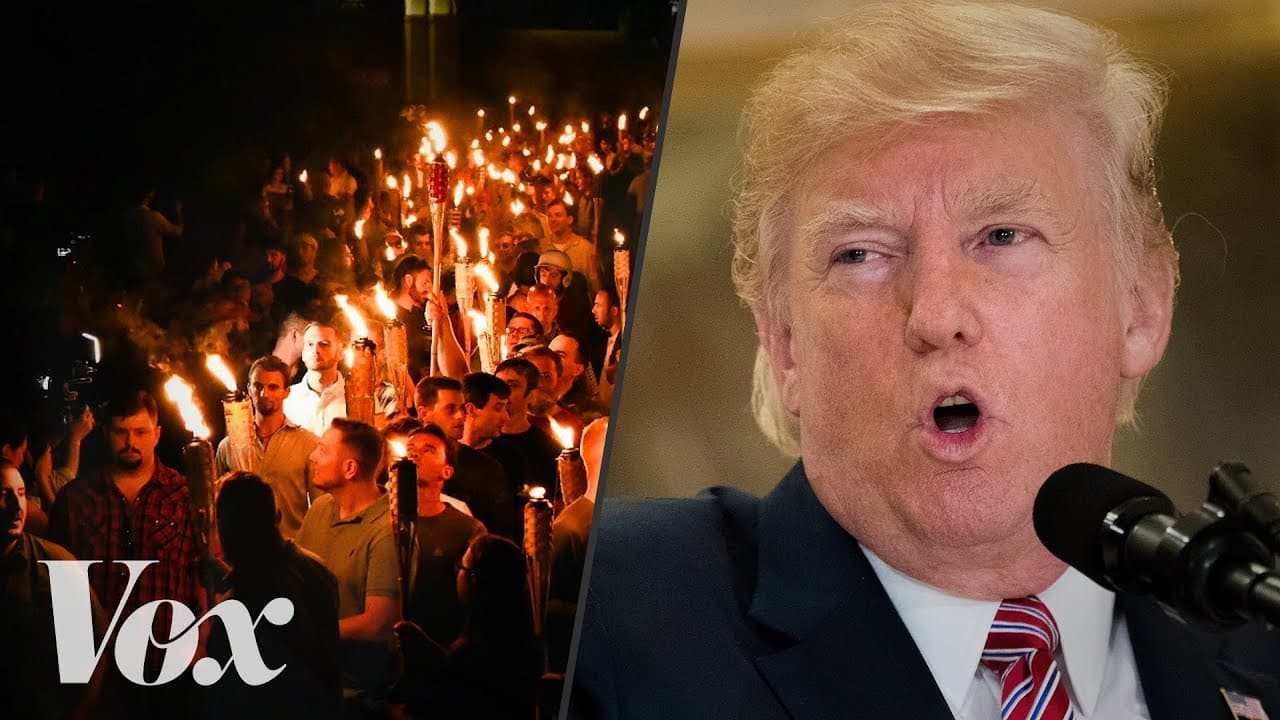
We begin with deadly chaos on the streets of Charlottesville, Virginia. Brutal eruption of violence sparked by white nationalists. You had many people in that group other than neo-Nazis and white nationalists. And the press has treated them absolutely unfairly. You had a lot of people in that group that were there to innocently protest. Protesting ... Read More
Key Insights
- The Charlottesville incident highlighted the violent actions of white nationalists and the controversial response from President Trump, who suggested moral equivalence between neo-Nazis and counter-protesters.
- Trump's comments have led to significant criticism from both the media and political figures, questioning his moral authority as president and his defense of a hateful ideology.
- The media's reaction to Trump's statements was notably different, with many journalists expressing shock and questioning the president's moral compass.
- The incident has sparked a broader debate on how journalists should cover a president whose actions and words challenge fundamental moral values.
- The media is faced with the dilemma of maintaining neutrality while also addressing the moral implications of Trump's statements and actions.
- There is concern that normalizing Trump's behavior could alter public perception of acceptable conduct from a sitting president.
- The coverage of Trump's presidency post-Charlottesville will reflect the media's stance on moral issues and influence the national narrative on right and wrong.
- The media's role in shaping public understanding of events and values is underscored by the need to critically assess Trump's rhetoric and its impact on society.
Install to Summarize YouTube Videos and Get Transcripts
Explore YouTube Video Summarizer or Get YouTube Transcript Extractor
Questions & Answers
Q: What sparked the violent events in Charlottesville?
The violence in Charlottesville was sparked by a rally organized by white nationalists, which led to brutal clashes between them and counter-protesters. The incident was further exacerbated by the actions of a driver who plowed into a crowd of counter-demonstrators, resulting in fatalities and injuries.
Q: How did President Trump respond to the Charlottesville incident?
President Trump's response to the Charlottesville incident was controversial, as he suggested that there was blame on both sides and referred to some attendees of the white supremacist rally as 'very fine people.' His comments were widely criticized for equating neo-Nazis with those protesting against racism.
Q: What was the media's reaction to Trump's comments on Charlottesville?
The media's reaction to Trump's comments on Charlottesville was notably intense, with many journalists expressing shock and questioning the president's moral compass. This reaction was different from the usual coverage, as it highlighted the challenge of maintaining neutrality in the face of morally questionable statements from the president.
Q: What dilemma do journalists face in covering Trump's presidency?
Journalists face the dilemma of how to cover a president whose actions and words challenge fundamental moral values. They must balance maintaining journalistic neutrality with the responsibility to address the moral implications of Trump's rhetoric, particularly when it involves defending or normalizing hateful ideologies.
Q: How might normalizing Trump's behavior affect public perception?
Normalizing Trump's behavior could alter public perception of what is considered acceptable conduct from a sitting president. It risks changing societal norms about what is tolerable in political discourse, particularly when it involves defending or downplaying white supremacy and other extremist ideologies.
Q: What is the significance of the media's role in shaping public understanding?
The media plays a crucial role in shaping public understanding of events and values by telling stories about what happens, who we are, and what we stand for. The way the media covers Trump's presidency, especially in light of incidents like Charlottesville, will influence the national narrative on right and wrong.
Q: Why is Trump's response to Charlottesville considered a loss of moral authority?
Trump's response to Charlottesville is considered a loss of moral authority because he failed to unequivocally condemn white supremacy and instead suggested moral equivalence between neo-Nazis and those protesting against racism. This response undermines the moral leadership expected from a president.
Q: What questions does the media face in the Trump era?
In the Trump era, the media faces questions about how to treat a president who is perceived as profoundly immoral. This includes whether to maintain traditional journalistic neutrality or to take a more critical stance in light of actions and statements that challenge fundamental notions of right and wrong.
Summary & Key Takeaways
-
The violent events in Charlottesville and Trump's response have sparked widespread criticism and raised questions about his moral authority. Journalists are grappling with how to cover a president whose actions challenge fundamental values, as normalizing his behavior could alter public perceptions of acceptable conduct.
-
Trump's comments equating neo-Nazis with counter-protesters have led to significant backlash, highlighting the media's role in shaping the national narrative. The incident underscores the challenge journalists face in maintaining neutrality while addressing the moral implications of Trump's rhetoric.
-
The media's reaction to Trump's statements was unprecedented, with many journalists expressing shock and questioning his moral compass. This has sparked a broader debate on how to cover a president whose actions and words challenge basic notions of right and wrong.
Read in Other Languages (beta)
Share This Summary 📚
Summarize YouTube Videos and Get Video Transcripts with 1-Click
Try YouTube Summary with ChatGPT & Claude or YouTube Transcript Generator
Explore More Summaries from Vox 📚

Summarize YouTube Videos and Get Video Transcripts with 1-Click
Try YouTube Summary with ChatGPT & Claude or YouTube Transcript Generator