Classification of Instruments
TL;DR
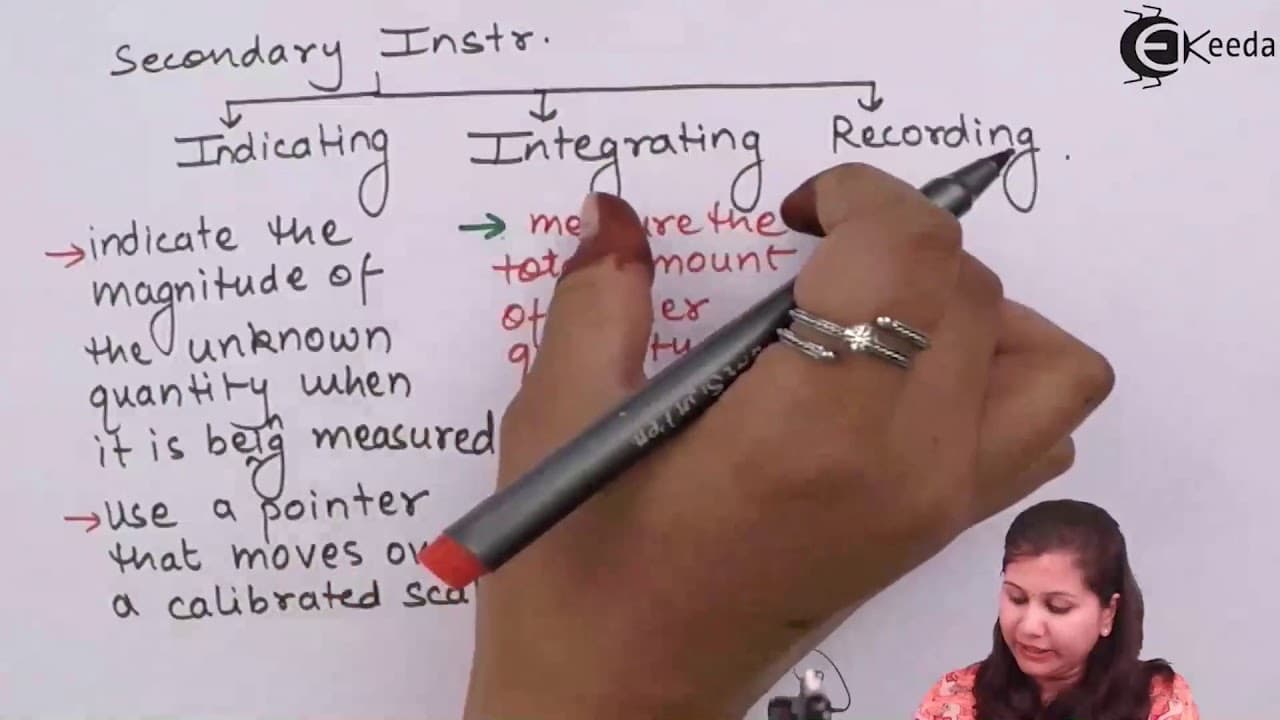
This video provides an overview of the classification of measuring instruments, including absolute and secondary instruments, analog and digital instruments, and mechanical, electrical, and electronic instruments.
Transcript
hello friends in this video we will study the classification of measuring instruments so let us start with our topic the measuring instruments they are defined as the instruments or the device which is used for the measurement for example the rulers the rulers are used for measuring the length so ruler is a type of measuring instrument another exam... Read More
Key Insights
- ⚡ Measuring instruments are used to measure unknown quantities like temperature, voltage, and current.
- 🅰️ Instruments can be classified into categories based on various criteria like method of measurement, power used, operation type, and output type.
- 🍉 Absolute instruments measure unknown quantities in terms of instrument constants, while secondary instruments provide direct readings.
- ❓ Analog instruments provide continuously varying output, while digital instruments provide output in discrete steps.
- 🦾 Instruments can be mechanical, electrical, or electronic, depending on the mechanism involved in pointer deflection.
- 🧑🦽 Manual instruments require an observer, while automatic instruments provide direct readings.
- ✊ Self-operated instruments do not require external power, and power-operated instruments do.
Install to Summarize YouTube Videos and Get Transcripts
Explore YouTube Video Summarizer or Get YouTube Transcript Extractor
Questions & Answers
Q: What are measuring instruments?
Measuring instruments are devices used to measure unknown quantities, such as temperature, voltage, and current.
Q: How are measuring instruments classified?
Measuring instruments can be classified based on various criteria, such as the method of measurement, manual or automatic operation, power used, and type of method used (deflection or null).
Q: What is the difference between absolute and secondary instruments?
Absolute instruments measure unknown quantities in terms of instrument constants, while secondary instruments provide direct readings of the unknown quantity.
Q: What are the differences between analog and digital instruments?
Analog instruments provide output in a continuously varying form, while digital instruments provide output in discrete steps. Analog instruments use a pointer deflection mechanism, while digital instruments use electronic signals.
Q: What are examples of mechanical, electrical, and electronic instruments?
Examples of mechanical instruments include galvanometers, which use coil movement to deflect a pointer. Electrical instruments include ammeters and voltmeters, where the current flow causes pointer deflection. Electronic instruments, like cathode ray oscilloscopes, use electron movement to deflect a pointer.
Q: Which instruments require the presence of an observer?
Manual instruments require the presence of an observer to record readings, while automatic instruments provide direct readings without an operator.
Q: What are self-operated instruments?
Self-operated instruments do not require external power and provide direct measurement readings without the need for an observer.
Q: How do deflection and null output instruments differ?
Deflection instruments use pointer deflection to measure unknown quantities, while null output instruments measure the magnitude of the unknown quantity by nullifying it to zero.
Summary & Key Takeaways
-
Measuring instruments are devices used to measure unknown quantities, such as temperature, voltage, and current.
-
They can be classified into categories based on the method of measurement, manual or automatic operation, power used, and type of method used (deflection or null).
-
Absolute instruments measure unknown quantities in terms of instrument constants, while secondary instruments provide direct readings. Analog instruments provide continuously varying output, while digital instruments provide discrete steps.
Read in Other Languages (beta)
Share This Summary 📚
Summarize YouTube Videos and Get Video Transcripts with 1-Click
Try YouTube Summary with ChatGPT & Claude or YouTube Transcript Generator
Explore More Summaries from Ekeeda 📚






Summarize YouTube Videos and Get Video Transcripts with 1-Click
Try YouTube Summary with ChatGPT & Claude or YouTube Transcript Generator