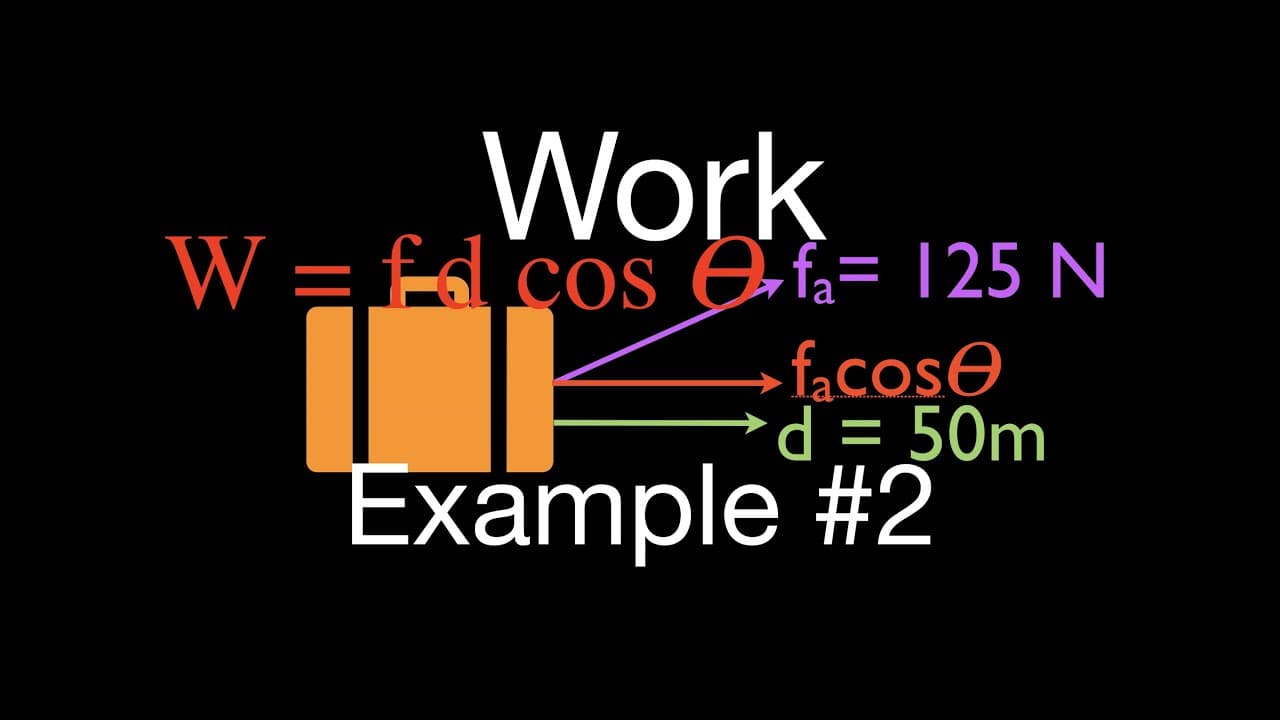
Energy, Work & Power (10 of 31) Calculate the Work Done by a Non-Horizontal Force
TL;DR
Calculate work done by a force at an angle above horizontal, using cosine in trigonometry.
Transcript
okay in today's video we're going to go over a problem concerning the work done by a force when that force is applied above the horizontal or when the work Sooni when the force and the displacement are not parallel to each other now in the previous video we did an example where the force was horizontal and the displacements horizontal but in this c... Read More
Key Insights
- 💦 Work calculation involves multiplying force, distance, and cosine of the angle of force above horizontal.
- 🔺 The angle of force affects the component of force parallel to displacement.
- 💦 Pushing and pulling an object with the same force and angle result in the same amount of work.
- 🆘 The cosine function helps determine the effective force on an object moved at an angle.
- 💦 Trigonometry principles can be applied to solve work problems involving forces at angles.
- 💦 Understanding components of forces using trigonometry aids in work calculations.
- 💦 Work done is independent of the method (pushing or pulling) as long as the force and angle remain constant.
Install to Summarize YouTube Videos and Get Transcripts
Explore YouTube Video Summarizer or Get YouTube Transcript Extractor
Questions & Answers
Q: How is work calculated when a force is applied above the horizontal?
Work is calculated by multiplying the force, distance, and cosine of the angle between force and displacement, giving the component of force parallel to the direction of movement.
Q: Does the angle of the applied force affect the work done?
Yes, the angle affects the amount of work done as the cosine of the angle determines the component of the force affecting the displacement.
Q: What happens to work when pushing instead of pulling an object?
Work remains the same whether pushing or pulling, as long as the force and angle of application are constant due to the cosine function in the work calculation.
Q: Why is the cosine function used in calculating work in this scenario?
The cosine function is used to find the component of force parallel to displacement, ensuring accurate calculation of work done at an angle.
Summary & Key Takeaways
-
Explains calculating work done by a force at an angle above horizontal.
-
Demonstrates using cosine of the angle to find the component of force parallel to displacement.
-
Shows how the same amount of work is done whether pushing or pulling an object with no friction.
Read in Other Languages (beta)
Share This Summary 📚
Summarize YouTube Videos and Get Video Transcripts with 1-Click
Try YouTube Summary with ChatGPT & Claude or YouTube Transcript Generator
Explore More Summaries from Step by Step Science 📚

Summarize YouTube Videos and Get Video Transcripts with 1-Click
Try YouTube Summary with ChatGPT & Claude or YouTube Transcript Generator