Coding Challenge #10.1: Maze Generator with p5.js - Part 1
TL;DR
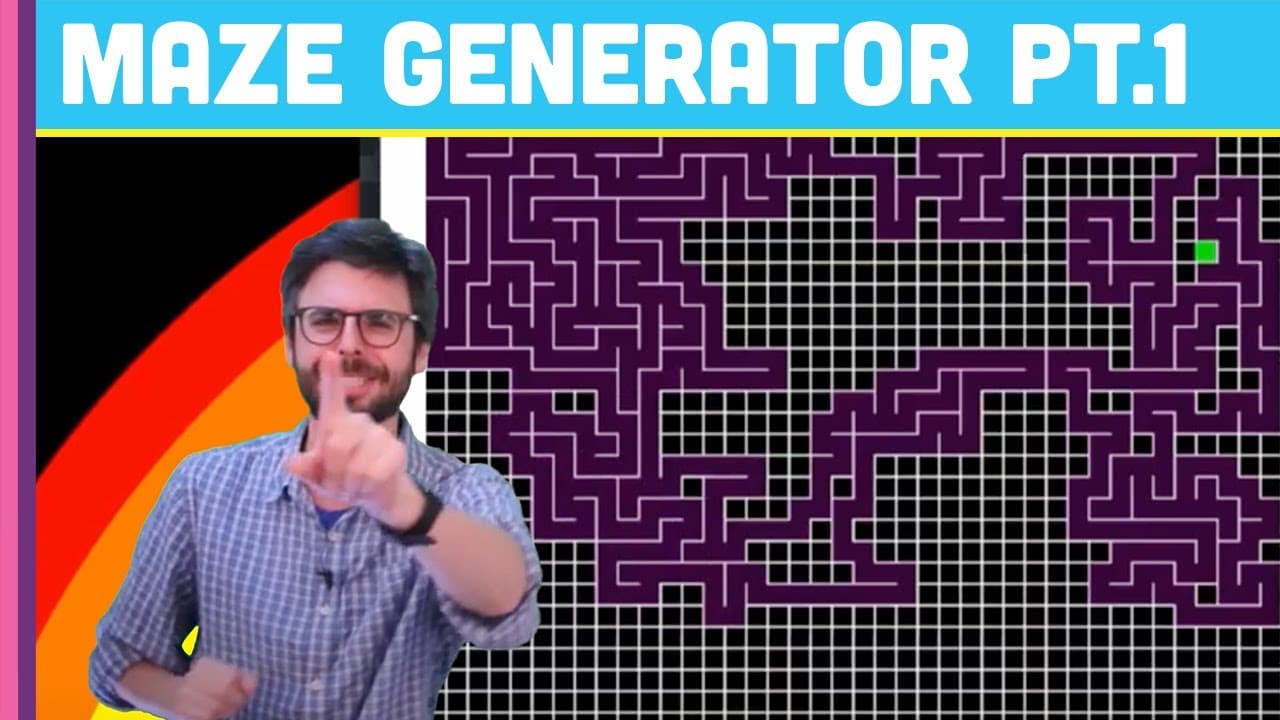
Coding challenge creating a maze generator using depth-first search and recursive backtracker.
Transcript
welcome to a new coding challenge mais generation so I've got a maze generator running behind me it's using something called a depth-first search and a recursive back tracker those are all very fancy sounding names and what I'm going to do in this challenge probably in multiple parts so it'll be two or three videos you can follow along in sequence ... Read More
Key Insights
- 😲 The maze generator utilizes depth-first search and recursive backtracker algorithms for path creation.
- 😲 Object-oriented programming concepts, such as cell objects and properties, play a crucial role in maze construction.
- 😲 Arrays and stacks are utilized to store cell information and track paths during maze generation.
- 😲 The HTML5 canvas and p5.js are employed for visual representation of the maze grid.
- 😲 The process involves setting up a grid, defining cell objects, managing walls, and implementing algorithms for maze generation.
- 😲 Understanding the mechanics of walls, positions, and cell connectivity is essential for creating a challenging maze layout.
- 😲 The challenge integrates programming concepts like loops, conditionals, and functions to handle maze generation logic effectively.
Install to Summarize YouTube Videos and Get Transcripts
Explore YouTube Video Summarizer or Get YouTube Transcript Extractor
Questions & Answers
Q: What is the purpose of the depth-first search algorithm in maze generation?
The depth-first search algorithm systematically explores all paths in the maze to create a continuous labyrinth without revisiting cells, ensuring a single path from start to finish.
Q: How does the recursive backtracker algorithm contribute to maze generation?
The recursive backtracker algorithm eliminates dead ends by backtracking and removing walls, creating a more challenging and intricate maze structure with multiple paths.
Q: Why is object-oriented programming essential in developing a maze generator?
Object-oriented programming allows for the creation of reusable cell objects with properties such as position and walls, enabling efficient maze construction and manipulation through encapsulation and abstraction.
Q: How does the use of arrays and stacks facilitate maze generation?
Arrays store cell objects in a grid, while stacks help maintain the order of visited cells, aiding in tracking paths and backtracking during maze construction.
Summary & Key Takeaways
-
Explains the process of building a maze generator from scratch in a web browser.
-
Utilizes object-oriented programming, arrays, stacks, recursion, and HTML5 canvas.
-
Implements a grid of cell objects with walls to create a maze pattern.
Read in Other Languages (beta)
Share This Summary 📚
Summarize YouTube Videos and Get Video Transcripts with 1-Click
Try YouTube Summary with ChatGPT & Claude or YouTube Transcript Generator
Explore More Summaries from The Coding Train 📚



Summarize YouTube Videos and Get Video Transcripts with 1-Click
Try YouTube Summary with ChatGPT & Claude or YouTube Transcript Generator