Applying Quadratic Functions 2
TL;DR
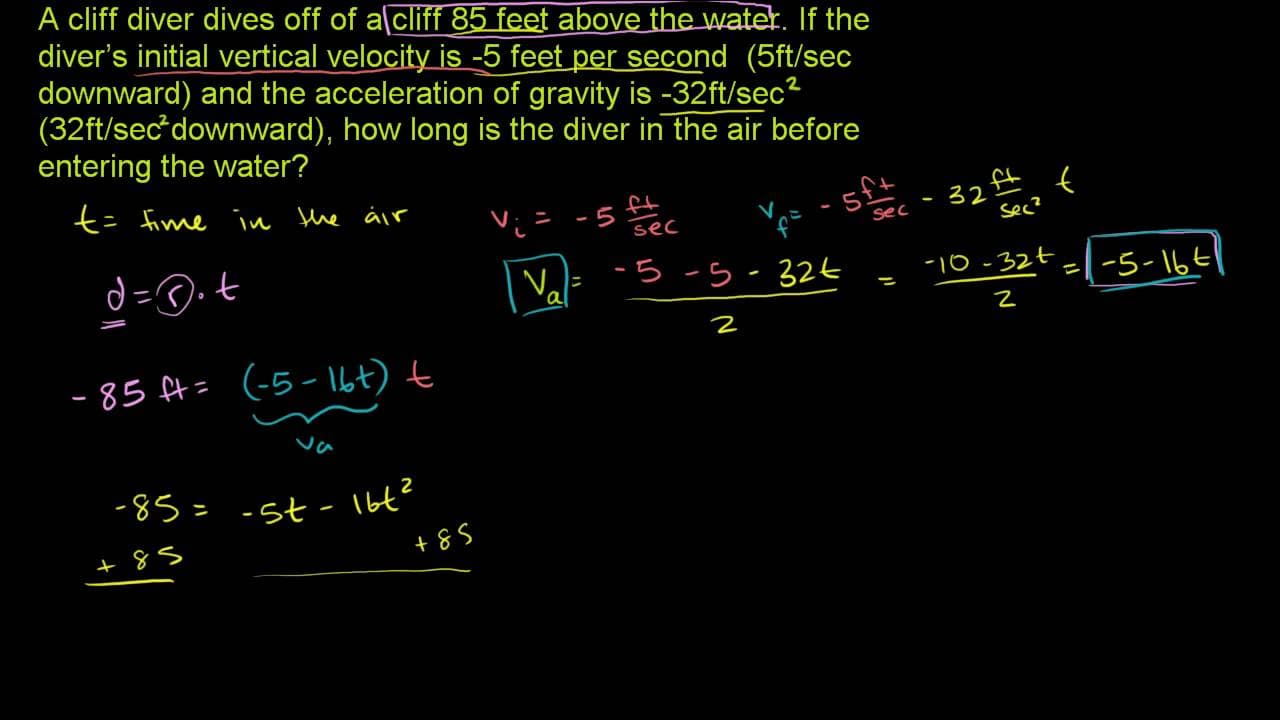
A cliff diver with an initial velocity of -5 ft/s and accelerated by gravity at -32 ft/s^2 spends 2.15 seconds in the air.
Transcript
A cliff diver dives off of a cliff 85 feet above the water. If the diver's initial vertical velocity is negative 5 feet per second-- so he's going downward, so they tell us right here-- 5 feet per second downward, and the acceleration of gravity is negative 32 feet per second squared, or 32 feet per second downward-- so that means after every secon... Read More
Key Insights
- 💝 The initial velocity of the diver is -5 ft/s, indicating a downward direction.
- 💝 The acceleration due to gravity is -32 ft/s^2, causing the diver's velocity to increase by 32 ft/s in the downward direction for every second.
- ❓ The average velocity considers both the initial and final velocities of the diver.
Install to Summarize YouTube Videos and Get Transcripts
Explore YouTube Video Summarizer or Get YouTube Transcript Extractor
Questions & Answers
Q: What are the initial conditions for the cliff diver?
The cliff diver starts 85 feet above water with an initial velocity of -5 ft/s and is accelerated downwards at -32 ft/s^2.
Q: How is the final velocity of the diver determined?
The final velocity is calculated by adding the product of acceleration and time to the initial velocity. It is essentially the initial velocity minus 32t.
Q: What is the formula for average velocity?
The formula for average velocity in this scenario is (-5 - 32t) / 2, where t is the time in seconds.
Q: How is the time in air calculated?
The time in air can be found by setting the average velocity equal to the distance traveled (in this case, -85 ft) and solving the resulting quadratic equation. The time is approximately 2.15 seconds.
Summary & Key Takeaways
-
The diver starts 85 feet above water and has an initial velocity of -5 ft/s and an acceleration of -32 ft/s^2.
-
The final velocity is determined by adding the product of acceleration and time to the initial velocity.
-
The average velocity is calculated as the average of the initial and final velocities, and using the distance formula, the time in air is determined.
Read in Other Languages (beta)
Share This Summary 📚
Summarize YouTube Videos and Get Video Transcripts with 1-Click
Try YouTube Summary with ChatGPT & Claude or YouTube Transcript Generator
Explore More Summaries from Khan Academy 📚



Summarize YouTube Videos and Get Video Transcripts with 1-Click
Try YouTube Summary with ChatGPT & Claude or YouTube Transcript Generator