Peter van Manen: How can Formula 1 racing help ... babies?
TL;DR
This content discusses how the principles of motor racing are being applied to healthcare, using data and technology to detect early warning signs and improve patient outcomes.
Transcript
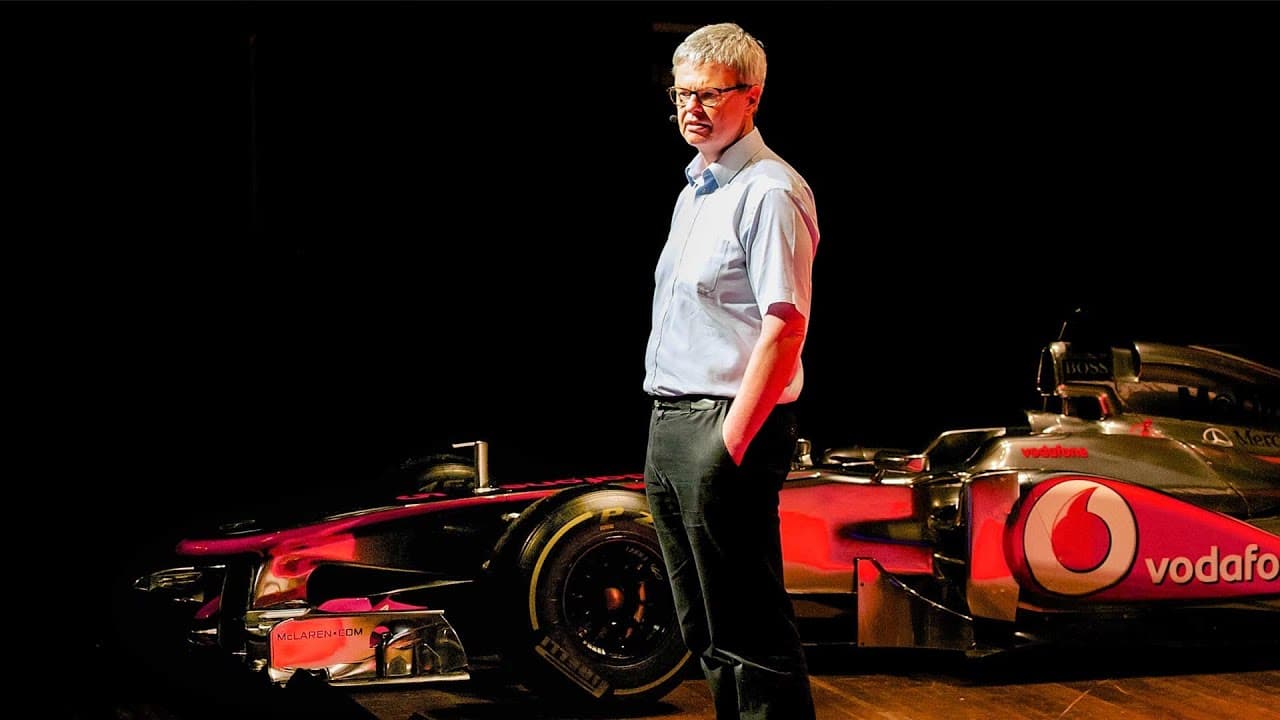
Motor racing is a funny old business. We make a new car every year, and then we spend the rest of the season trying to understand what it is we've built to make it better, to make it faster. And then the next year, we start again. Now, the car you see in front of you is quite complicated. The chassis is made up of about 11,000 components, the engin... Read More
Key Insights
- 🏎️ Motor racing requires attention to detail and constant improvement, with thousands of components that can go wrong. Changes are made frequently, with 5,000 new components added every two weeks.
- 🔬 Data collection and analysis are crucial in Formula 1 racing, with about 120 sensors measuring various aspects of the car during a race. This data is logged, with 500 parameters and events sent back to the garage at a rate of 2-4 megabits per second.
- 💡 The importance of data lies in its transformation into actionable knowledge. Efforts are made to turn the massive amount of data collected into stories and insights, such as understanding engine performance, tire degradation, and fuel consumption.
- 💚 Data analysis can identify patterns and anticipate events that may not be apparent at first glance. By analyzing patterns in real-time data, such as heart rate, in a pediatric intensive care unit, early warning signs of deteriorating health can be detected.
- 👶 Applying data analysis techniques used in Formula 1 to healthcare, specifically in pediatric intensive care, can enhance patient care and early detection of potential issues. By streaming and storing data from bedside instruments, patterns in real-time data can be identified.
- 🏥 It is crucial to detect and respond to changes in a patient's condition quickly, similar to making critical adjustments during a race. By installing a real-time link between ambulances and hospitals, crucial data can be transmitted and analyzed even before arrival at the hospital.
- 📈 Visualization and interpretation of data are important in healthcare, as they can provide important cues to doctors and nurses. By displaying data in new ways, patterns and signals can be amplified to help healthcare professionals identify when something is going wrong.
- 💻 The goal is to expand the use of data-driven healthcare beyond hospital walls. With wireless connectivity, patients, doctors, and nurses can stay connected and make informed decisions, regardless of their physical location.
Install to Summarize YouTube Videos and Get Transcripts
Explore YouTube Video Summarizer or Get YouTube Transcript Extractor
Questions & Answers
Q: What is the purpose of telemetry and data logging in motor racing?
The purpose of telemetry and data logging in motor racing is to monitor and measure various parameters of the car, such as engine performance, tire degradation, and fuel consumption. This data is then analyzed to understand the car's performance and make necessary improvements to make it faster and better.
Q: How many components are there in a Formula 1 car?
A Formula 1 car is composed of approximately 11,000 components in the chassis, 6,000 components in the engine, and 8,500 components in the electronics. In total, there are about 25,000 components in a Formula 1 car that can potentially go wrong.
Q: How often are new components made for a Formula 1 car?
New components are made for a Formula 1 car every two weeks of the racing season. During this time, approximately 5,000 new components are produced and fitted to the car. This means that around 5-10% of the race car is different every two weeks of the year, as constant changes are made to make the car faster.
Q: How much data is generated and transmitted by a Formula 1 car during a two-hour race?
During a two-hour race, a Formula 1 car generates and transmits a massive amount of data. Each car sends 750 million numbers, equivalent to twice as many numbers as words spoken by an individual in their lifetime. This data, which includes various parameters and events, is sent back to the garage using telemetry at a rate of two to four megabits per second.
Summary & Key Takeaways
-
Motor racing involves continuously building and improving cars, with each car having thousands of components that can go wrong.
-
In Formula 1, the cars are constantly changing and about 5,000 new components are made every two weeks.
-
Data from sensors on the cars is collected and analyzed to understand the state of the car and make improvements, similar to how data is used in healthcare to detect changes and improve patient care.
Read in Other Languages (beta)
Share This Summary 📚
Summarize YouTube Videos and Get Video Transcripts with 1-Click
Try YouTube Summary with ChatGPT & Claude or YouTube Transcript Generator
Explore More Summaries from TED 📚




Summarize YouTube Videos and Get Video Transcripts with 1-Click
Try YouTube Summary with ChatGPT & Claude or YouTube Transcript Generator