What Are the Different Perspectives on Defining Language?
TL;DR
Language can be defined from multiple perspectives, including anthropological, social science, and cognitive science. Key definitions describe it as a method of communication, a system of arbitrary vocal symbols, and an evolutionary adaptation of humans. Understanding language involves recognizing its complexity, particularly through the concept of mental grammar, which allows us to produce and comprehend sentences without formal training.
Transcript
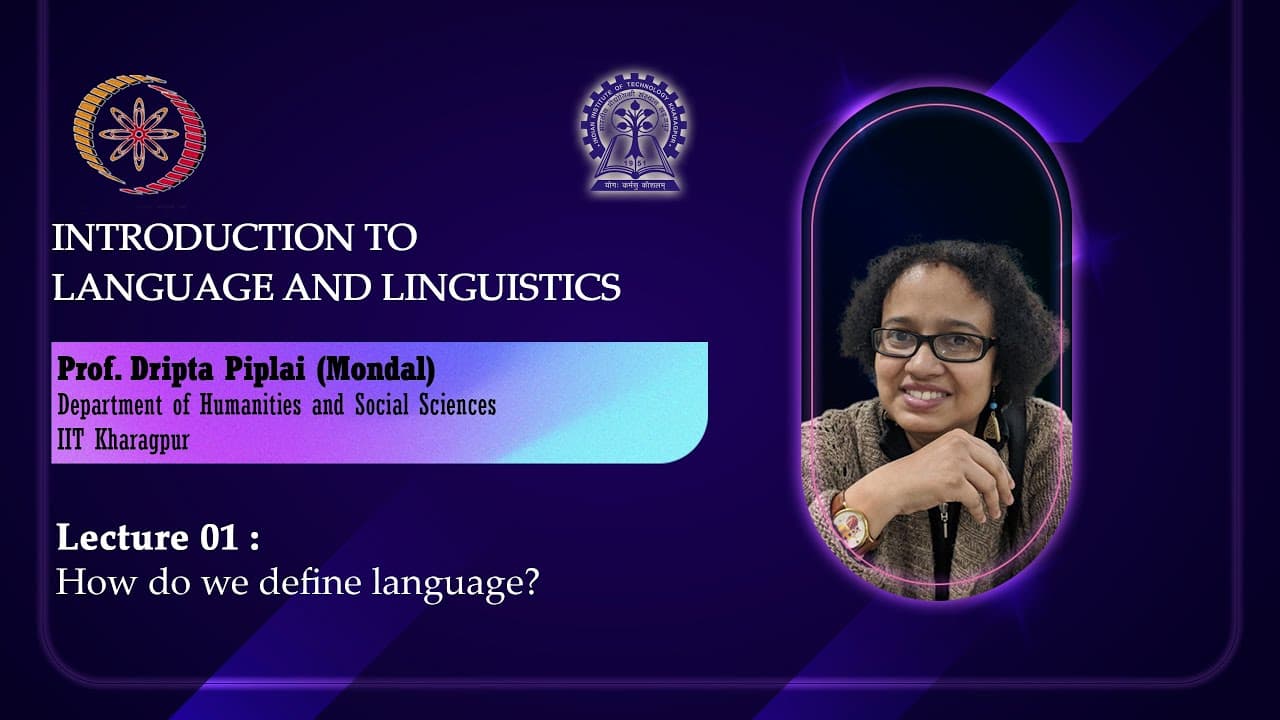
thank you hello welcome to the nptel course introduction to language and linguistics and this is the first lecture for the course so the name of the first lecture is how do we Define language so we will be talking about the idea of language from different perspectives we will talk about new definitions of language and also ask this basic question w... Read More
Key Insights
- 🧠 Linguistics: Different perspectives on language have been discussed, including AI, philosophy/psychology, and social science. The discipline of linguistics focuses on the general description and analysis of spoken language, rather than traditional grammar or written language. Linguistics aims to understand the existing knowledge of language, rather than dictating what should be known.
- 🌍 Motivation: When considering the motivation for joining a linguistics course, individuals may be interested in the origin or evolution of language, the development of language in children, the similarities and differences between languages, the relationship between language and computers, or the use of sign language by chimps. These motivations come from various backgrounds and perspectives.
- 📚 Definitions: Language has been defined by different scholars. Sapir described it as a purely human, non-instinctive method of communicating ideas, emotions, and desires using symbols. Bloch and Trager defined language as a system of arbitrary vocal symbols used by a social group. Stephen Pinker viewed language as an evolutionary adaptation, a psychological faculty, a mental organ, and a natural system of computational module.
- 🐦 Language vs. Animal Communication: Human language is distinct from animal communication, and language can be examined from the perspective of one's local and national identity. Panini, an ancient grammarian from India, discussed the construction of words, while the Greeks and Romans also explored language and grammar from their respective perspectives.
- 🧩 Chomsky's View: Noam Chomsky presented a new perspective on language in 1957. He viewed language as a set of sentences constructed from a finite set of elements. Chomsky emphasized language's structural properties, abstraction, purposefulness, and acquisition by children. He challenged the behaviorist stimulus-response model, suggesting that language learning is not based on imitation but rather a mental grammar program.
- 🔍 Plato's Problem and Poverty of Stimulus: Plato's problem questions how humans acquire language and why they possess extensive knowledge. The poverty of stimulus refers to how children are exposed to limited language data but can still produce and understand complex sentences. Chomsky proposed that the brain has a program or mental grammar that enables this linguistic ability.
- 🧠 Complexity of Language: The ability to speak and understand language is complex, with individuals producing and comprehending combinations of words they have never encountered before. Children develop complex grammars automatically without formal training. The concept of mental grammar plays a crucial role in understanding language acquisition and production.
- 💡 Key Takeaways: Different perspectives, such as AI, philosophy/psychology, and social science, shape our understanding of language. Definitions of language vary, but Chomsky's perspective and the concept of mental grammar carry great importance. Language acquisition, the complexity of linguistic ability, and the mysteries of Plato's problem and the poverty of stimulus are central to the study of language and linguistics.
Install to Summarize YouTube Videos and Get Transcripts
Explore YouTube Video Summarizer or Get YouTube Transcript Extractor
Questions & Answers
Q: How does linguistics differ from traditional grammar?
Linguistics goes beyond traditional grammar by focusing on the general description and analysis of language, rather than prescriptive rules. It also primarily focuses on spoken language rather than written language, and it aims to understand the knowledge of language that already exists within us.
Q: What is the significance of investigating the cognitive structure of language?
Investigating the cognitive structure of language allows us to bridge the gap between biological and cognitive sciences. By studying language as a cognitive structure, similar to studying a complex bodily organ, we can gain a deeper understanding of its complexity and how it is acquired.
Q: How does Chomsky's view of language challenge the behaviorist idea of language learning?
Chomsky's view opposes the behaviorist idea that language learning is solely based on stimulus-response models. He argues that language learning cannot be explained through imitation, as individuals can produce and understand combinations of words that they have never heard before. This suggests that our ability to create complex sentences is guided by a mental grammar program in the brain.
Q: How do children acquire language without formal training?
Children develop complex grammars automatically, without the need for formal training. They have an innate ability to acquire language, as they can produce and understand sentences that they have never heard before. This suggests that there is a mental grammar program in the brain that guides language acquisition.
Summary & Key Takeaways
-
The lecture discusses the different perspectives from which language can be defined, including anthropological, social science, and cognitive science.
-
It introduces three definitions of language: language as a method of communication using voluntary symbols, language as a system of arbitrary vocal symbols used by social groups, and language as an evolutionary adaptation of humans.
-
The lecture highlights the complexity of language acquisition and the concept of mental grammar, which allows us to produce and understand complex sentences.
Read in Other Languages (beta)
Share This Summary 📚
Summarize YouTube Videos and Get Video Transcripts with 1-Click
Try YouTube Summary with ChatGPT & Claude or YouTube Transcript Generator
Explore More Summaries from IIT Kharagpur July 2018 📚




Summarize YouTube Videos and Get Video Transcripts with 1-Click
Try YouTube Summary with ChatGPT & Claude or YouTube Transcript Generator