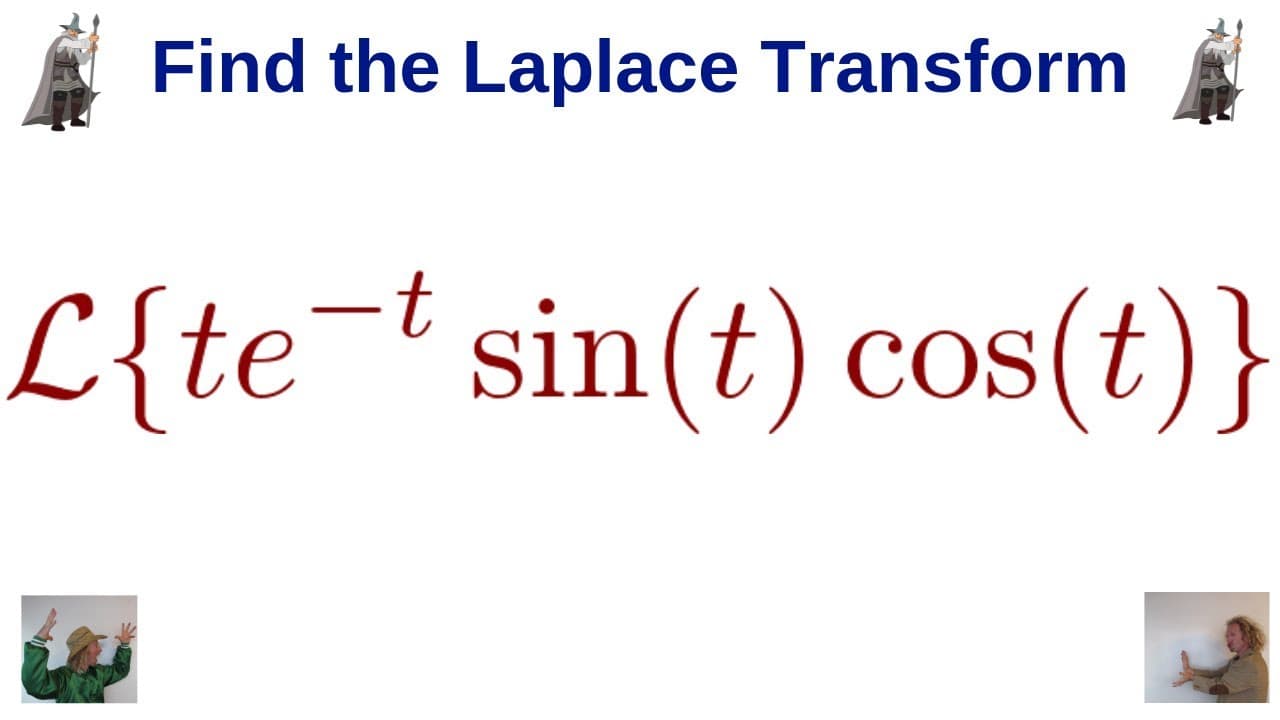
Laplace Transform of t*e^(-t)*sin(t)*cos(t)
TL;DR
Learn how to compute Laplace transforms involving trig functions using differentiation and shifting theorems.
Transcript
hey what's up YouTube and this problem we're gonna compute the Laplace transform of T times e to the negative T times sine T times cosine T solution so whenever you have a problem with the Laplace transform say of T to a power times f of T where you can actually compute the Laplace of little F the following formula is extremely useful it's negative... Read More
Key Insights
- ❓ Utilize differentiation and shifting theorems to simplify Laplace transform computations involving trig functions.
- 🕴️ Remember key trig identities like sine 2t = 2 sin t cos t to simplify trig functions in Laplace transforms.
- 😃 Understand the formula involving negative 1 to the nth derivative of big F in computing Laplace of little F.
- 🆓 Differentiate little F to find the derivative of big F for the Laplace transform calculation.
- ➕ Apply shifting theorems when transforming Laplace of trig functions by changing the variable from s to s plus or minus a.
- 🙆 Memorize Laplace transform formulas for sine and cosine functions involving K over s squared plus K squared for efficient computations.
- 🆓 Break down complex Laplace transform problems step by step, starting with finding big F (Laplace of little F) and differentiating to obtain the final solution.
Install to Summarize YouTube Videos and Get Transcripts
Explore YouTube Video Summarizer or Get YouTube Transcript Extractor
Questions & Answers
Q: What is the key formula used in computing Laplace transforms involving trig functions?
The formula involves negative 1 to the nth derivative of big F with respect to s, where big F is the Laplace transform of little F.
Q: How do shifting theorems play a role in solving Laplace transform problems with trig functions?
Shifting theorems help in transforming Laplace of sine and cosine functions by changing the variable such as shifting from s to s minus a or s to s plus a.
Q: Why is differentiation important when computing Laplace transforms of functions involving trig identities?
Differentiation helps in finding the derivative of big F, which is the Laplace of little F, and is crucial in applying the formula involving the nth derivative of big F.
Q: How can trig identities like sine 2t = 2 sin t cos t be helpful in simplifying Laplace transform computations?
Trig identities allow rewriting complex trig functions like sine t cosine t as simpler forms such as 1/2 sin 2t, making Laplace transform computations more manageable.
Summary & Key Takeaways
-
Laplace transform of T times e to the negative T times sine T times cosine T involves using the nth derivative of big F to compute Laplace of little F.
-
Trig identities, Laplace transforms of sine and cosine functions, and shifting theorems are crucial in solving Laplace transform problems with trig functions.
-
Differentiate little F, find big F (Laplace of little F), and apply the formula involving negative 1 to the nth derivative of big F to compute the final Laplace transform.
Read in Other Languages (beta)
Share This Summary 📚
Summarize YouTube Videos and Get Video Transcripts with 1-Click
Try YouTube Summary with ChatGPT & Claude or YouTube Transcript Generator
Explore More Summaries from The Math Sorcerer 📚


Summarize YouTube Videos and Get Video Transcripts with 1-Click
Try YouTube Summary with ChatGPT & Claude or YouTube Transcript Generator