Problem 4 Based on Discrete Time Convolution | Signals and Systems
TL;DR
This video demonstrates how to solve a convolution problem using discrete time signals and provides step-by-step explanations for each calculation.
Transcript
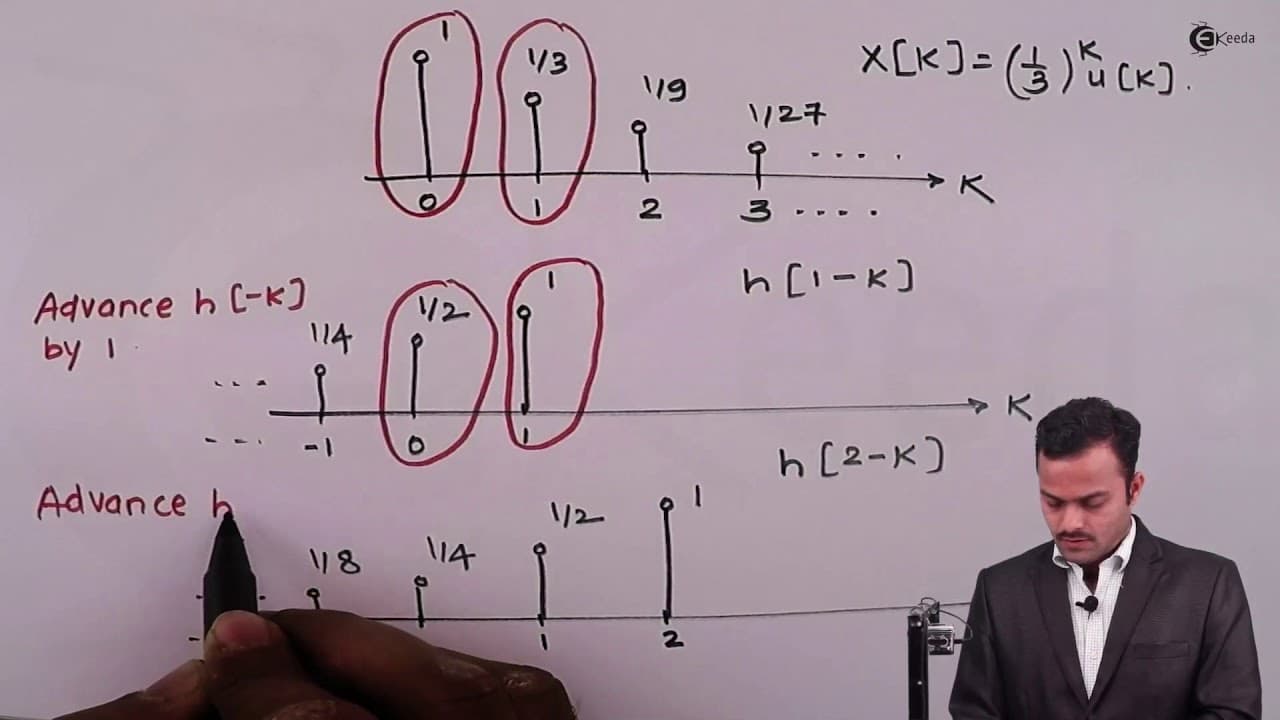
hi friends in this video we are going to solve a problem based on convolution where we are going to take discrete time signals so here is the problem so in this problem we are supposed to convolve two signals x of n which is given as 1 by 3 raised to n u of n which is nothing but the input signal and h of n which is 1 by 2 raised to n u of n which ... Read More
Key Insights
- 📡 Convolution is a mathematical operation used to combine two signals in order to obtain the output signal.
- 📡 Plotting and analyzing the input and impulse response signals is crucial for understanding the convolution problem.
- 😥 Time reversal and shifting operations play a significant role in determining the common sample points for the convolution calculation.
- 👻 The convolution formula allows for the calculation of the output signal, considering all the samples and their respective weights.
Install to Summarize YouTube Videos and Get Transcripts
Explore YouTube Video Summarizer or Get YouTube Transcript Extractor
Questions & Answers
Q: What is the formula for convolution?
The formula for convolution is y(n) = ∑[k = -∞ to ∞] x(k) * h(n - k), where x(n) and h(n) are the input and impulse response signals, respectively.
Q: How do you calculate the output for n = 0 in this problem?
For n = 0, the only common sample between x(k) and h(n - k) is k = 0. Therefore, the output y(0) is equal to x(0) * h(0) = 1 * 1 = 1.
Q: How does shifting and time reversal affect the convolution calculation?
Shifting a signal by a certain amount involves delaying or advancing the signal. Time reversal, on the other hand, changes the order of the samples in the signal. These operations affect the common sample points between the signals, which are crucial for the convolution calculation.
Q: Can you explain the formula used to calculate y(n)?
The formula used to calculate y(n) is y(n) = ∑[k = 0 to n] (1/2)^n * (3)^(-k). This formula represents the general expression for the convolution of x(n) and h(n) in this problem.
Summary & Key Takeaways
-
The video begins by explaining the problem, which involves convolving two signals: x(n) and h(n).
-
The signals are plotted and analyzed separately to understand their characteristics.
-
The video then demonstrates how to apply the convolution formula and solve for the output signal, y(n).
Read in Other Languages (beta)
Share This Summary 📚
Summarize YouTube Videos and Get Video Transcripts with 1-Click
Try YouTube Summary with ChatGPT & Claude or YouTube Transcript Generator
Explore More Summaries from Ekeeda 📚


Summarize YouTube Videos and Get Video Transcripts with 1-Click
Try YouTube Summary with ChatGPT & Claude or YouTube Transcript Generator