Parts of a cell
TL;DR
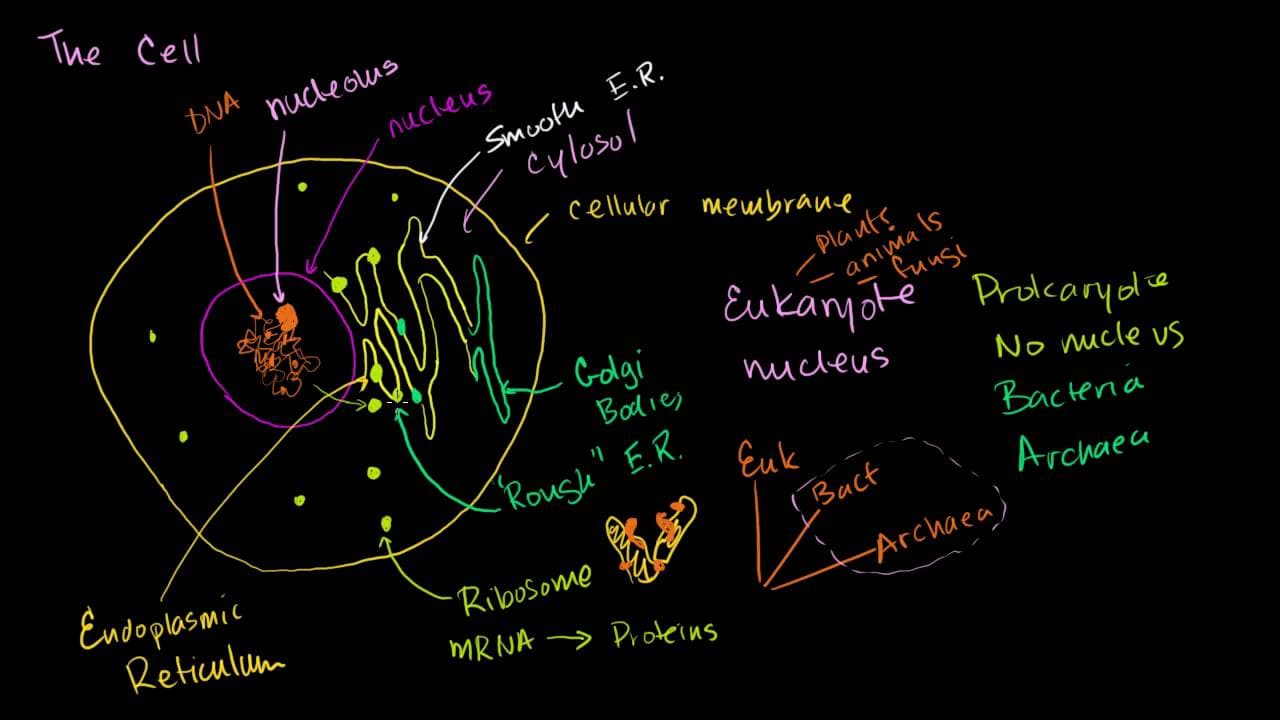
This video provides a comprehensive overview of the structure of a cell, covering topics such as the cellular membrane, DNA, eukaryotes and prokaryotes, ribosomes, endoplasmic reticulum, Golgi bodies, lysosomes, mitochondria, chloroplasts, cell walls, microfilaments, and centrioles.
Transcript
Let's talk a little bit about the structure of the cell. I've done a lot of videos where we deal with things that go on inside of them, but I haven't done one where we just talk about the entire structure of them. So a good place to start is-- let me just draw the membrane. And the cellular membrane is a good place to start because this is what sep... Read More
Key Insights
- ♻️ The cellular membrane separates the cell from the external environment and defines its boundaries.
- ❓ Eukaryotes have a nucleus, while prokaryotes do not.
- ❓ Ribosomes are responsible for protein synthesis, translating mRNA into proteins.
- ❓ The endoplasmic reticulum and Golgi bodies are involved in protein processing and transport within the cell.
- 🗑️ Lysosomes and lytic vacuoles are involved in the breakdown and digestion of cellular waste.
- ❓ Mitochondria are responsible for cellular respiration, converting sugars into ATP.
- ❓ Chloroplasts are involved in photosynthesis, capturing energy from sunlight to produce carbohydrates.
- 🇼🇫 Cell walls provide rigidity and support to the cell.
Install to Summarize YouTube Videos and Get Transcripts
Explore YouTube Video Summarizer or Get YouTube Transcript Extractor
Questions & Answers
Q: What is the purpose of the cellular membrane?
The cellular membrane separates the cell from the external environment and defines its boundaries. It controls the movement of substances in and out of the cell, allowing for proper function and a stable internal environment.
Q: What is the difference between eukaryotes and prokaryotes?
Eukaryotes have a nucleus, which contains their DNA, while prokaryotes do not have a nucleus. Eukaryotes, such as animals and plants, tend to be larger and more complex than prokaryotes, such as bacteria and Archaea.
Q: What is the role of ribosomes in protein synthesis?
Ribosomes are responsible for translating mRNA into proteins. They can be attached to the endoplasmic reticulum or free-floating in the cytosol. Ribosomes are made up of proteins and ribosomal RNA, which forms the structure and enables protein synthesis.
Q: What is the function of the Golgi bodies?
Golgi bodies are involved in processing, modifying, and packaging proteins for transport within the cell or secretion outside of the cell. Proteins from the endoplasmic reticulum enter the Golgi bodies and undergo further processing before being transported to their destination.
Summary & Key Takeaways
-
The cellular membrane separates the cell from the outside world and defines its compartment.
-
All cells have DNA, which defines what a living organism is.
-
Eukaryotes have a nucleus, while prokaryotes do not.
Read in Other Languages (beta)
Share This Summary 📚
Summarize YouTube Videos and Get Video Transcripts with 1-Click
Try YouTube Summary with ChatGPT & Claude or YouTube Transcript Generator
Explore More Summaries from Khan Academy 📚



Summarize YouTube Videos and Get Video Transcripts with 1-Click
Try YouTube Summary with ChatGPT & Claude or YouTube Transcript Generator