Action and reaction forces | Movement and forces | Middle school physics | Khan Academy
TL;DR
Newton's third law states that for every force, there is an equal and opposite reaction force.
Transcript
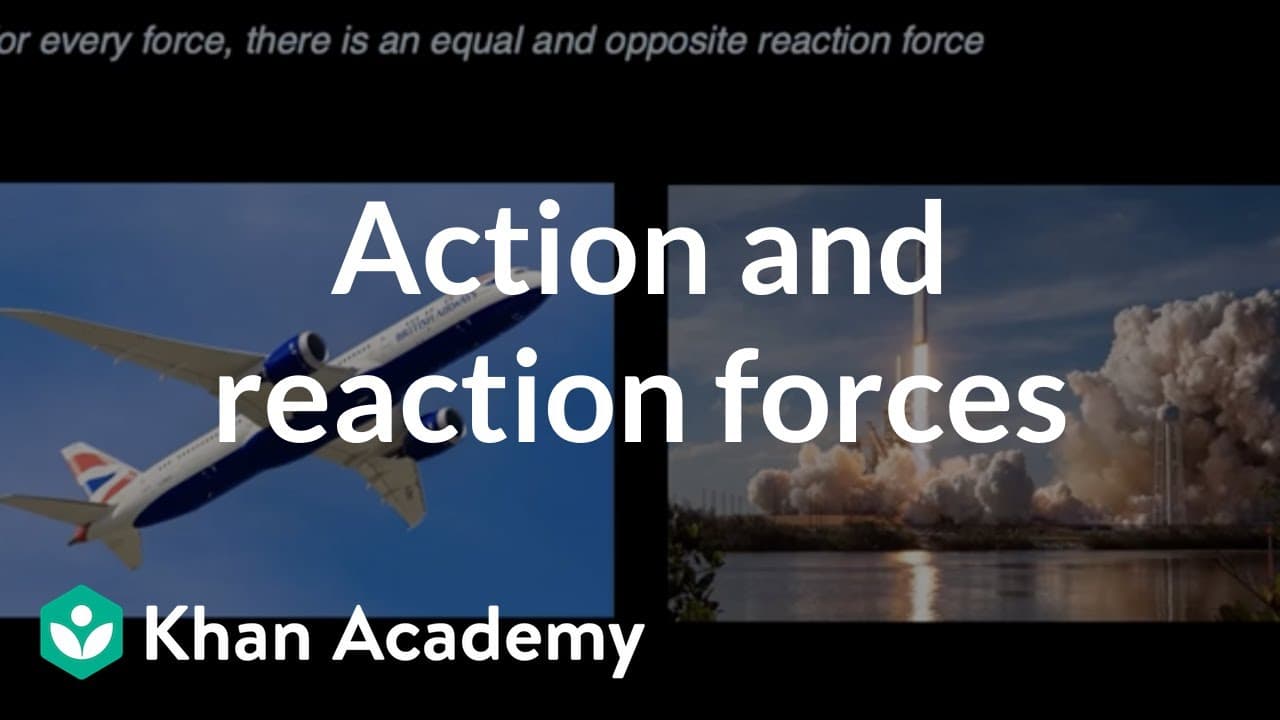
- [Lecturer] You've probably heard the phrase that for every force, there's an equal and opposite reaction force. And this is also known as Newton's third law of motion, but it's also one of the most misunderstood laws of physics. So that's why we're going to dig into it a little bit in this video. So I have two examples here where Newton's third l... Read More
Key Insights
- 👮 Newton's third law of motion states that for every force, there is an equal and opposite reaction force.
- ❓ The reaction force is exerted on a different object and occurs simultaneously with the original force.
- ✈️ Examples of Newton's third law include a plane moving forward by pushing air particles and a rocket exploding.
- 👮 The law can be observed in celestial bodies, such as the Moon and Earth's gravitational interaction.
Install to Summarize YouTube Videos and Get Transcripts
Explore YouTube Video Summarizer or Get YouTube Transcript Extractor
Questions & Answers
Q: What is Newton's third law of motion?
Newton's third law states that for every force, there is an equal and opposite reaction force. When an object exerts a force on another object, the second object exerts an equal and opposite force on the first.
Q: How does a plane move forward using Newton's third law?
A plane moves forward by pushing air particles through its jet engines at high velocities. The force exerted by the plane on the air particles creates an equal and opposite reaction force, causing the plane to accelerate forward.
Q: How does the rocket's explosion demonstrate Newton's third law?
When a rocket explodes, the force exerted on the molecule fragments is in one direction. In response, the fragments exert an equal and opposite force on the rocket, propelling it in the opposite direction.
Q: Can Newton's third law be applied to everyday situations?
Yes, Newton's third law applies to various scenarios. For example, pushing down on a table creates a force on the table, and the table exerts an equal and opposite force on the finger. Similarly, our weight due to gravity results in an equal and opposite force between us and the Earth.
Summary & Key Takeaways
-
Newton's third law of motion states that for every force exerted on an object, there is an equal and opposite reaction force exerted by the object.
-
Examples include a plane pushing air particles through jet engines and a rocket exploding.
-
The reaction force is exerted on a different object and does not cancel out the original force.
Read in Other Languages (beta)
Share This Summary 📚
Summarize YouTube Videos and Get Video Transcripts with 1-Click
Try YouTube Summary with ChatGPT & Claude or YouTube Transcript Generator
Explore More Summaries from Khan Academy 📚



Summarize YouTube Videos and Get Video Transcripts with 1-Click
Try YouTube Summary with ChatGPT & Claude or YouTube Transcript Generator