What Is Kinetic Molecular Theory of Gases?
TL;DR
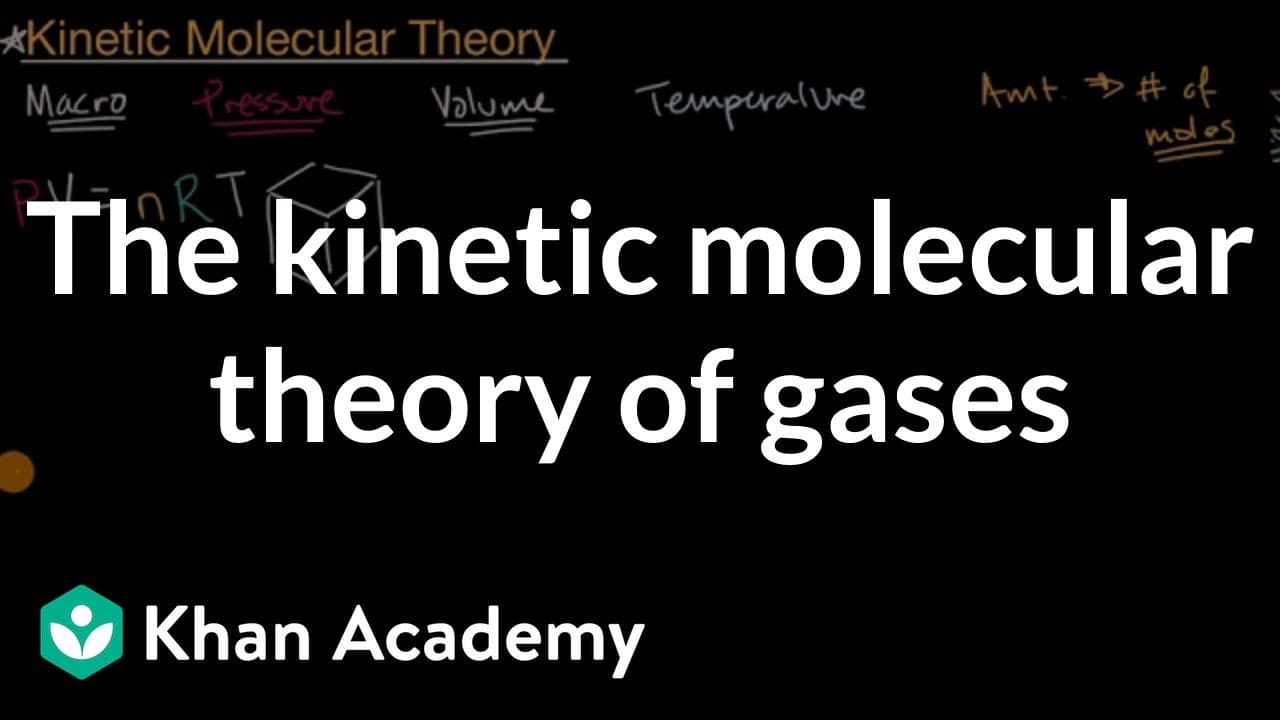
Kinetic molecular theory describes gases as collections of small particles in constant random motion, where pressure results from elastic collisions with container walls. It assumes gas particles have negligible volume compared to the container and do not exert forces on each other. Temperature is proportional to the average kinetic energy of these particles, linking macro measurements to molecular behavior.
Transcript
- [Instructor] In this video, we're gonna talk about something called kinetic molecular theory, which sounds very fancy. But as we'll see in the next few seconds, or the next few minutes, it actually helps build our intuition for what is actually going on with the gas or at least an approximation of what's going on with the gas. So first, let's thi... Read More
Key Insights
- 🎚️ Kinetic molecular theory provides a framework for understanding the behavior of gases at a molecular level, connecting macro-level measurements.
- 🫢 Gases are considered to be made up of small particles in constant random motion, with pressure caused by elastic collisions with the container walls.
- 🔇 The theory assumes that gas particles do not exert attractive or repulsive forces on each other, and their combined volume is negligible compared to the container's volume.
Install to Summarize YouTube Videos and Get Transcripts
Explore YouTube Video Summarizer or Get YouTube Transcript Extractor
Questions & Answers
Q: How does kinetic molecular theory explain gas pressure?
According to kinetic molecular theory, gas pressure is caused by the particles of the gas colliding with the walls of the container. These collisions, assumed to be elastic, result in a force per unit area, which we measure as pressure.
Q: What does kinetic molecular theory assume about the volume of gas particles?
Kinetic molecular theory assumes that the combined volume of gas particles is negligible compared to the total volume in which the gas is contained. This means that most of the volume within a container is empty space between particles.
Q: How does kinetic molecular theory relate to temperature?
The theory states that temperature is related to the average kinetic energy of gas particles. The higher the temperature, the higher the average kinetic energy. This is because temperature measures the amount of thermal energy associated with particle motion.
Q: What makes the collisions between gas particles elastic?
According to kinetic molecular theory, elastic collisions between gas particles means that kinetic energy is preserved during collisions. This means that the mass and velocity of particles remain unchanged before and after collisions.
Summary & Key Takeaways
-
Kinetic molecular theory helps us understand the behavior of gases at a molecular level, connecting macro-level measurements such as pressure, volume, temperature, and number of moles.
-
It assumes that gases are made up of small particles in constant random motion, with their collective volume being negligible compared to the container's volume.
-
The theory states that particles do not exert attractive or repulsive forces on each other, and their collisions are completely elastic. Temperature is related to the average kinetic energy of the particles.
Read in Other Languages (beta)
Share This Summary 📚
Summarize YouTube Videos and Get Video Transcripts with 1-Click
Try YouTube Summary with ChatGPT & Claude or YouTube Transcript Generator
Explore More Summaries from Khan Academy 📚



Summarize YouTube Videos and Get Video Transcripts with 1-Click
Try YouTube Summary with ChatGPT & Claude or YouTube Transcript Generator