Worked example of a profit maximization problem | Microeconomics | Khan Academy
TL;DR
This video explains how a corn market functions in a perfectly competitive market and how a representative corn farmer maximizes their profit.
Transcript
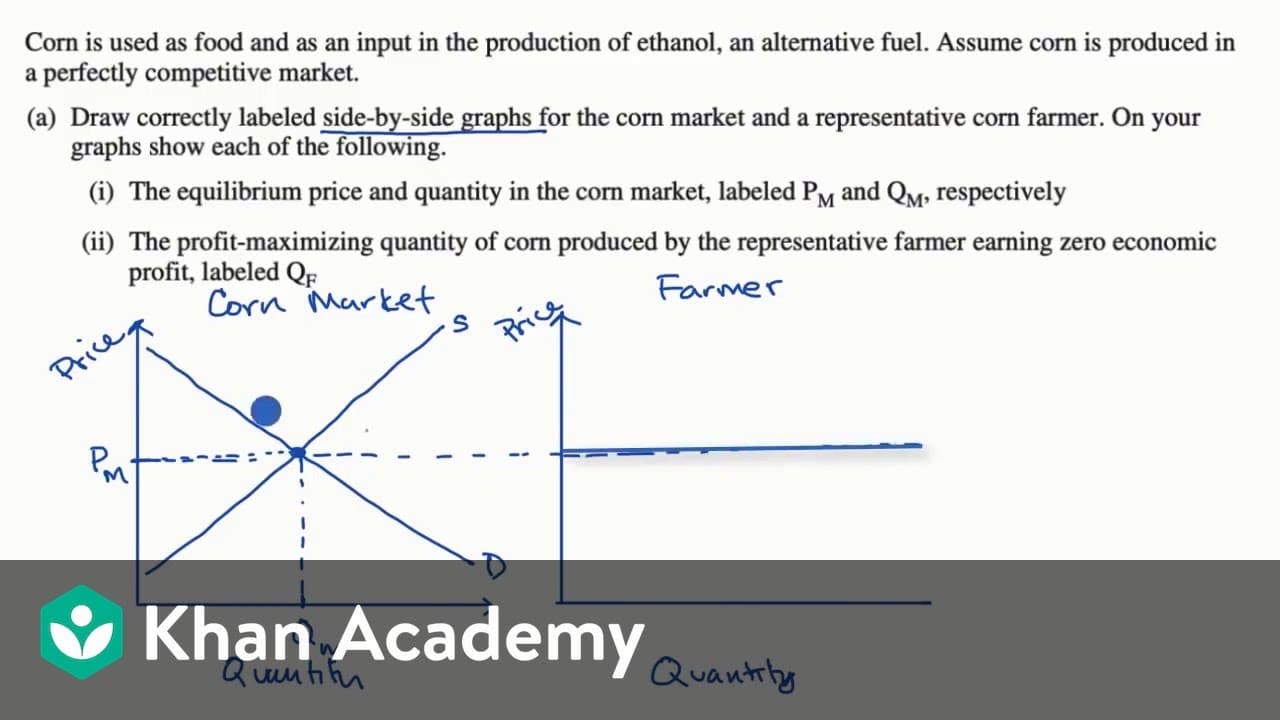
- [Instructor] We're told corn is used as food and as an input in the production of ethanol, an alternative fuel. Assume corn is produced in a perfectly competitive market. Draw correctly labeled side-by-side graphs for the corn market and a representative corn farmer. On your graphs, show each of the following: the equilibrium price and quantity i... Read More
Key Insights
- 🦄 Corn markets operate in a perfectly competitive market structure, where price is determined by the intersection of demand and supply curves.
- 🧑🌾 The equilibrium price and quantity in the corn market affect the profit-maximizing decisions of individual farmers.
- 🧑🌾 The profit-maximizing quantity for farmers occurs where marginal cost intersects with marginal revenue, which is the market price.
- 🧑🌾 Beyond the profit-maximizing quantity, farmers would incur losses as it would require more resources to produce corn than what they can sell it for.
- 🟰 Zero economic profit is obtained when the price is equal to average total cost.
- 🇨🇷 The concept of marginal cost, marginal revenue, and average total cost is essential in understanding profit maximization in a competitive market.
- 🧑🌾 Farmers in a competitive market have no control over market prices and must accept them as their own marginal revenue.
Install to Summarize YouTube Videos and Get Transcripts
Explore YouTube Video Summarizer or Get YouTube Transcript Extractor
Questions & Answers
Q: What is a perfectly competitive market?
A perfectly competitive market is a market structure where there are many buyers and sellers, homogeneous products, no barriers to entry or exit, perfect information, and no market power.
Q: How is the equilibrium price and quantity determined in a corn market?
The equilibrium price and quantity in a corn market are determined by the intersection of the demand and supply curves. It is the point where quantity demanded equals quantity supplied.
Q: Why is the farmer considered a price taker?
The farmer is considered a price taker because they have no control over the market price. They must accept the equilibrium price set by the market as their own marginal revenue.
Q: How does a farmer maximize profit while earning zero economic profit?
A farmer maximizes profit by producing the quantity of corn where marginal cost equals marginal revenue, which in this case is the market price. Zero economic profit is achieved when the price is equal to the average total cost.
Summary & Key Takeaways
-
The video discusses the concept of a perfectly competitive corn market where the equilibrium price and quantity are determined by the intersection of the demand and supply curves.
-
A representative corn farmer, being a price taker, has to accept the equilibrium price set by the market.
-
The profit-maximizing quantity of corn produced by the farmer is determined by the intersection of the marginal cost and marginal revenue, ensuring zero economic profit.
Read in Other Languages (beta)
Share This Summary 📚
Summarize YouTube Videos and Get Video Transcripts with 1-Click
Try YouTube Summary with ChatGPT & Claude or YouTube Transcript Generator
Explore More Summaries from Khan Academy 📚



Summarize YouTube Videos and Get Video Transcripts with 1-Click
Try YouTube Summary with ChatGPT & Claude or YouTube Transcript Generator