Class Takeaways—Data Science and AI Strategy
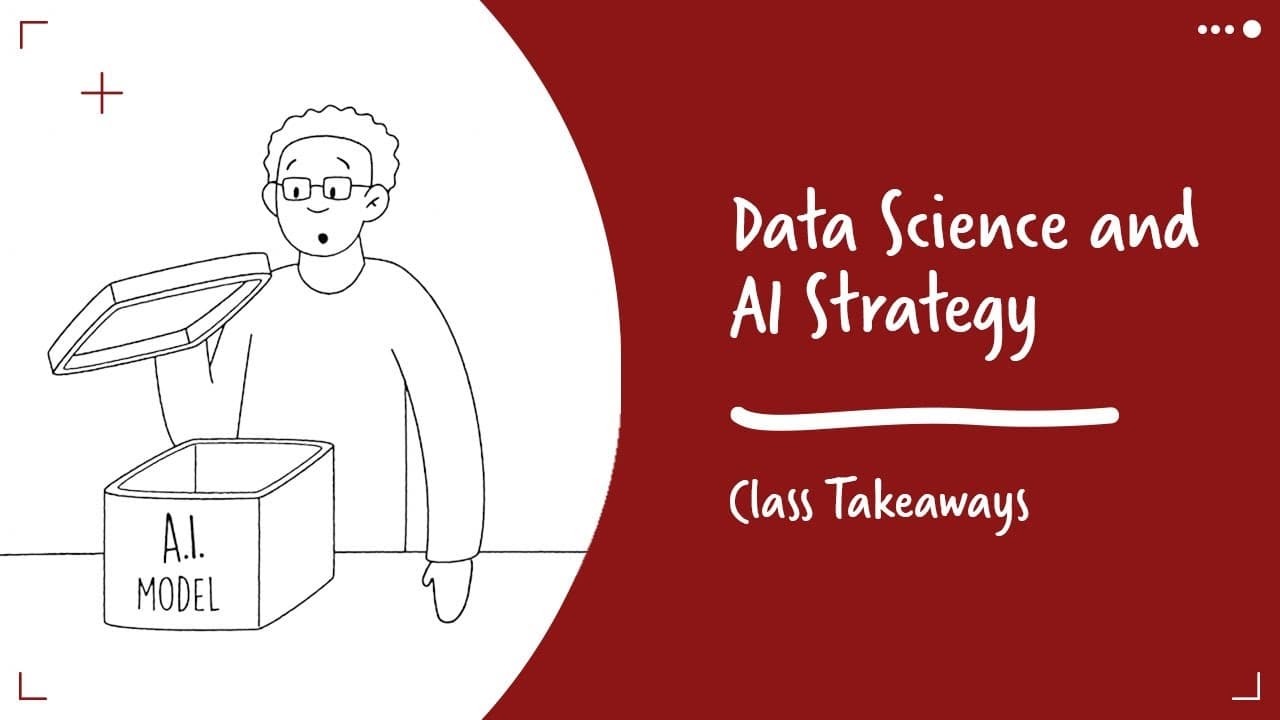
TL;DR
Data science and AI have two pillars - analytics and reporting, and AI-driven decision-making. Technical risks in AI development can be mitigated by defining incremental milestones. Data alone is not a competitive advantage, but should be combined with product and service design. Prioritize your business needs before considering AI capabilities. Validation procedures are crucial in capturing important insights from data science and AI research.
Transcript
[MUSIC] Hello, my name is Kuang Xu I'm a professor of operations research at the Stanford GSB. I work on applying AI and data science to solving business problems. Today I'm here to tell you about a class I teach, called a data science and AI strategy and here are five key takeaways. [MUSIC] Data science and AI is not a monolith. And we learn in th... Read More
Key Insights
- 💄 Data science and AI have two pillars: analytics and reporting, and AI-driven decision-making products.
- 🔬 Technical risks in AI and data science development can be mitigated with incremental milestones.
- 🐕🦺 Data alone is not a competitive advantage; it should be combined with product and service design.
- 👨💼 Prioritize business needs before considering AI capabilities to avoid unnecessary investment.
- 🔬 Insights from AI and data science may seem obvious but should be properly validated for their impact.
- 🎨 Communication skills are vital for analytics and reporting, while engineering and product design are crucial for AI-driven decision-making.
- 🔬 AI and data science solutions require significant upfront investment in data collection and model training.
Install to Summarize YouTube Videos and Get Transcripts
Explore YouTube Video Summarizer or Get YouTube Transcript Extractor
Questions & Answers
Q: What are the two pillars of data science and AI mentioned in the class?
The two pillars are analytics and reporting for strategic decision-making, and AI-driven decision-making products. Analytics focuses on using data science, machine learning, and statistics to derive insights for internal stakeholders, while AI-driven decision-making involves automated tools for generating recommendations and products.
Q: How can the technical risks in AI development be mitigated?
One way to mitigate technical risks is to define incremental milestones throughout the development process. By breaking down the project into smaller milestones, progress can be measured more effectively and adjustments can be made along the way to ensure constant progress.
Q: Why is data alone not a competitive advantage?
Initially, collecting more data can provide valuable insights and impact the business significantly. However, as the data collection moves into niche areas, obtaining data becomes more difficult and the consumer base shrinks. To have a competitive advantage, it is important to combine data with product and service design.
Q: What should businesses consider before implementing AI?
Businesses should first prioritize their actual needs before considering AI capabilities. Instead of getting caught up in the potential of the technology, focus on what is necessary for the company's growth. Only then, explore the available AI advancements to build the capabilities that align with the identified needs.
Summary & Key Takeaways
-
Data science and AI can be categorized into analytics and reporting for strategic decision-making, and AI-driven decision-making products.
-
Developing AI and data science solutions involve technical risks, and it is important to de-risk the process with incremental milestones.
-
Collecting more data initially has low cost and high value, but venturing into niche areas can become costly with low consumer value.
-
Before implementing AI, prioritize building what is truly needed for the company's growth, rather than getting caught up in the capabilities of the technology.
-
Insights from AI and data science may seem obvious but can have significant impact on product and company direction. Establish proper validation procedures to uncover these insights.
Read in Other Languages (beta)
Share This Summary 📚
Summarize YouTube Videos and Get Video Transcripts with 1-Click
Try YouTube Summary with ChatGPT & Claude or YouTube Transcript Generator
Explore More Summaries from Stanford Graduate School of Business 📚


Summarize YouTube Videos and Get Video Transcripts with 1-Click
Try YouTube Summary with ChatGPT & Claude or YouTube Transcript Generator