2003 AIME II problem 10 | AIME | Math for fun and glory | Khan Academy
TL;DR
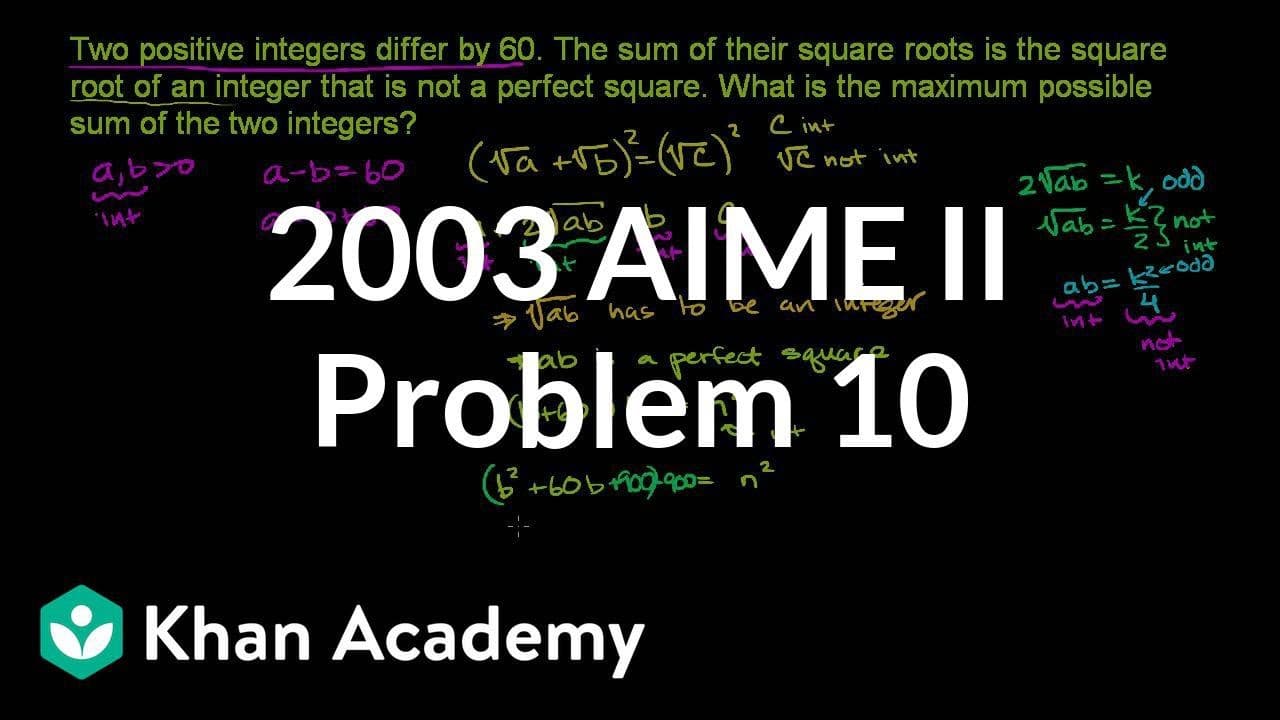
Find the maximum sum of two positive integers that differ by 60, where the sum of their square roots is the square root of an integer that is not a perfect square.
Transcript
Two positive integers differ by 60. The sum of their square roots is the square root of an integer that is not a perfect square. What is the maximum possible sum of the two integers? So the second sentence is a little confusing, but let's take a step-by-step. So two positive integers differ by 60. So let's say they're a and b. So we have a and b. T... Read More
Key Insights
- 😃 The positive integers a and b differ by 60.
- ❎ The sum of the square roots of a and b equals the square root of an integer that is not a perfect square.
- ❎ The square root of the product of a and b must be an integer.
- ❎ The product of a and b must be a perfect square.
- #️⃣ Both a and b must be even numbers.
- 🧑🏭 The sum of two even factors of a product is also even.
Install to Summarize YouTube Videos and Get Transcripts
Explore YouTube Video Summarizer or Get YouTube Transcript Extractor
Questions & Answers
Q: What are the given constraints for finding the maximum sum of two integers?
The positive integers a and b must differ by 60, and the sum of their square roots must equal the square root of an integer that is not a perfect square.
Q: Why does the square root of the product of a and b have to be an integer?
The square root of the product of a and b must be an integer because a, b, and c (the integer that is not a perfect square) are all integers. If integers plus an integer equal another integer, the sum of the integers in the middle must be an integer.
Q: How does the square root of ab being an integer contradict the given constraints?
If the square root of ab is an integer, then ab would be a perfect square, which is not allowed according to the given constraints. The square root of ab must not simplify any further.
Q: How can we find the maximum possible sum of a and b?
To find the maximum sum, we need to maximize b. By trying different factors of 900 that meet the constraints, we can gradually increase b and find the corresponding a value that maximizes the sum.
Summary & Key Takeaways
-
Two positive integers, a and b, differ by 60.
-
The sum of the square roots of a and b is the square root of an integer that is not a perfect square.
-
To maximize the sum of a and b, we need to maximize b and find an a that meets the given constraints.
Read in Other Languages (beta)
Share This Summary 📚
Summarize YouTube Videos and Get Video Transcripts with 1-Click
Try YouTube Summary with ChatGPT & Claude or YouTube Transcript Generator
Explore More Summaries from Khan Academy 📚



Summarize YouTube Videos and Get Video Transcripts with 1-Click
Try YouTube Summary with ChatGPT & Claude or YouTube Transcript Generator