Deriving formula for centripetal acceleration from angular velocity | AP Physics 1 | Khan Academy
TL;DR
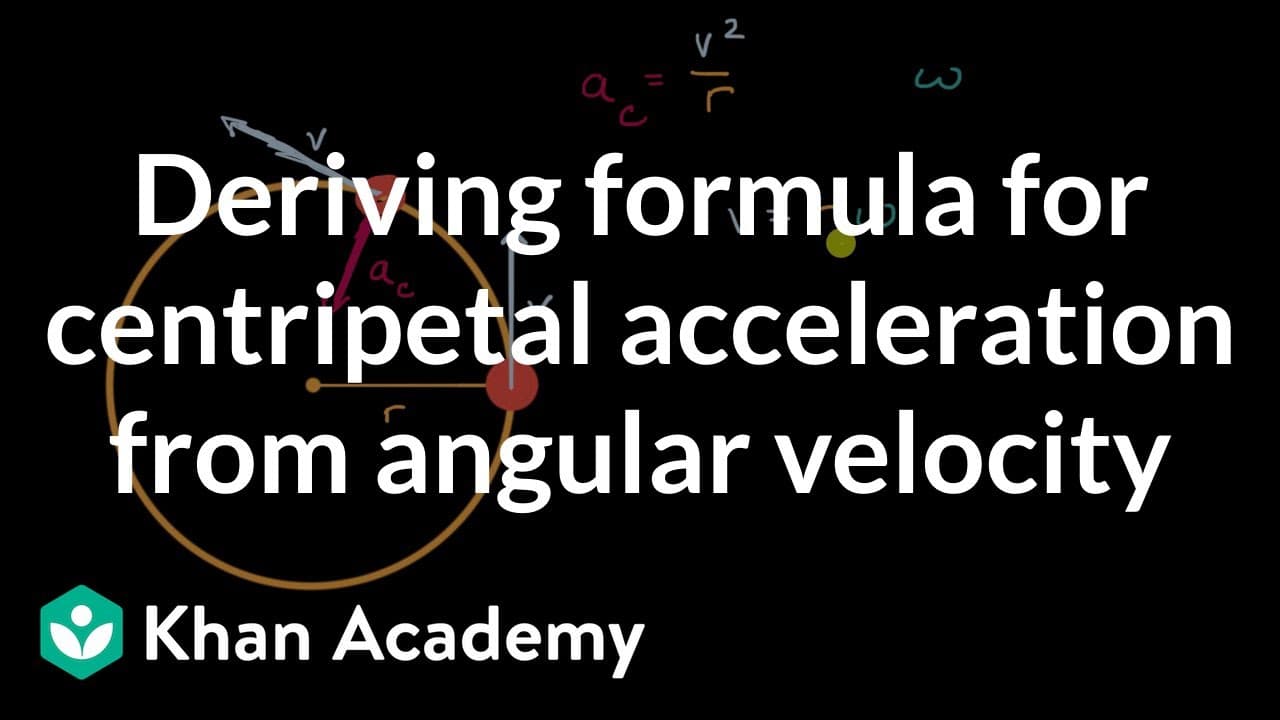
When an object moves in a circular motion at a fixed speed, its velocity constantly changes because velocity is a vector with both magnitude and direction. This change in direction implies acceleration, known as centripetal acceleration, which can be connected to angular velocity through a formula.
Transcript
- [Instructor] In multiple videos we have already talked about if something is moving in a circular motion at a fixed speed, its velocity is constantly changing. Why is that? Because velocity is a vector and a vector has not just a magnitude which would be its speed but also its direction, so even if I have the same speed at this point as I have at... Read More
Key Insights
- 💱 Velocity changes in circular motion due to the change in direction, requiring acceleration.
- 🥋 Centripetal acceleration is responsible for maintaining the curved path in uniform circular motion.
- 📐 The magnitude of centripetal acceleration can be calculated using the formula: Centripetal acceleration = Radius multiplied by the magnitude of angular velocity squared.
- 🐎 Linear speed in circular motion is connected to the radius and magnitude of the angular velocity.
Install to Summarize YouTube Videos and Get Transcripts
Explore YouTube Video Summarizer or Get YouTube Transcript Extractor
Questions & Answers
Q: Why does an object's velocity constantly change when it moves in a circular motion at a fixed speed?
An object's velocity changes because velocity is a vector with both magnitude and direction. Even if the object has the same speed, the change in direction implies a change in velocity, which requires acceleration.
Q: What is centripetal acceleration?
Centripetal acceleration is the inward acceleration experienced by an object moving in uniform circular motion. It is responsible for maintaining the object's curved path and constantly changing velocity.
Q: How can the magnitude of centripetal acceleration be calculated?
The magnitude of centripetal acceleration can be calculated using the formula: Centripetal acceleration = Radius multiplied by the magnitude of angular velocity squared.
Q: How does angular velocity relate to linear speed in circular motion?
The linear speed is equal to the radius of the motion multiplied by the magnitude of the angular velocity. Angular velocity represents the rate at which an object covers a certain angle in radians per second.
Summary & Key Takeaways
-
When an object moves in a circular motion at a fixed speed, its velocity constantly changes due to the change in direction.
-
The change in velocity implies acceleration, known as centripetal acceleration.
-
The formula for the magnitude of centripetal acceleration is equal to the radius multiplied by the magnitude of angular velocity squared.
Read in Other Languages (beta)
Share This Summary 📚
Summarize YouTube Videos and Get Video Transcripts with 1-Click
Try YouTube Summary with ChatGPT & Claude or YouTube Transcript Generator
Explore More Summaries from Khan Academy 📚



Summarize YouTube Videos and Get Video Transcripts with 1-Click
Try YouTube Summary with ChatGPT & Claude or YouTube Transcript Generator