Types of mixtures | Intermolecular forces and properties | AP Chemistry | Khan Academy
TL;DR
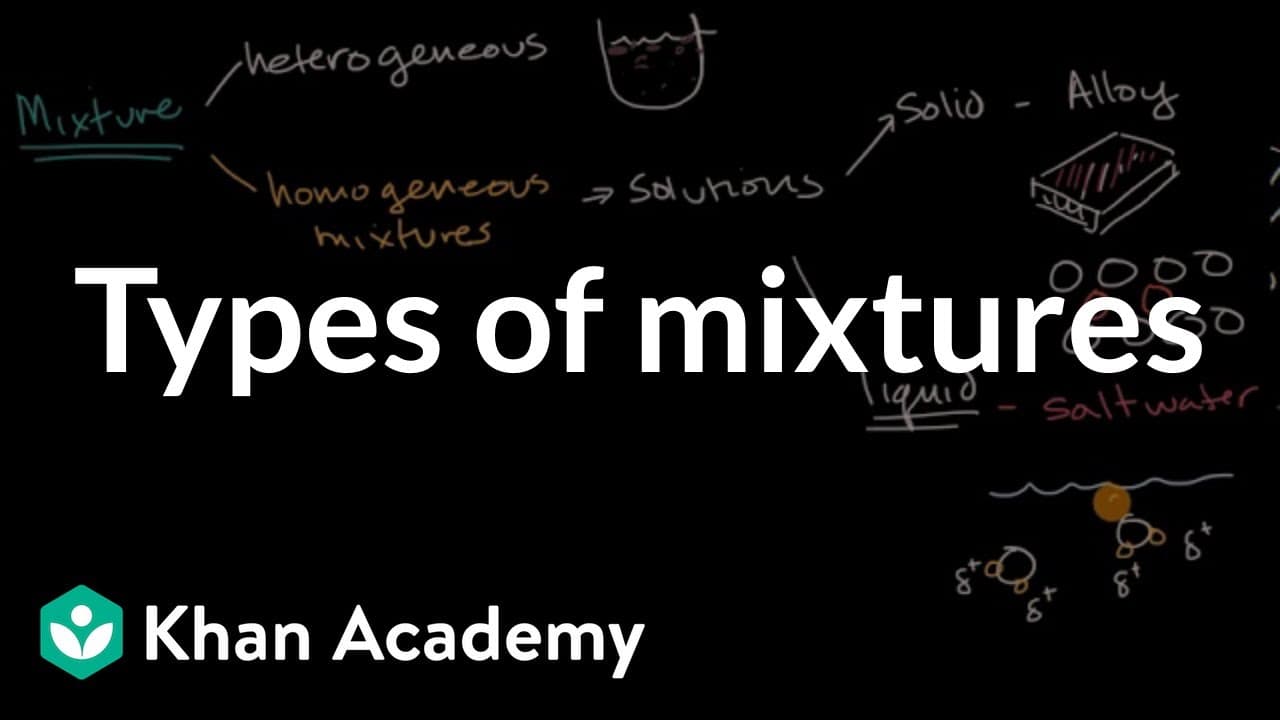
Mixtures can be heterogeneous or homogeneous, with the latter referred to as solutions. They can exist in solid, liquid, or gas form.
Transcript
- [Instructor] I suspect that you might already be familiar with the term mixture. It really does mean what you think it means. If you take two or more substances and you were to mix them together, you are dealing with a mixture. And it could be a solid, a liquid or a gas. Now there's fundamentally two different types of mixtures. There's heterogen... Read More
Key Insights
- 💁 A mixture is formed when two or more substances are combined, and it can exist in solid, liquid, or gas form.
- 🥳 There are two types of mixtures: heterogeneous and homogeneous. Heterogeneous mixtures have visibly different parts, while homogeneous mixtures have consistent concentrations throughout.
- 🫢 Homogeneous mixtures are also called solutions, and they can be solid, liquid, or gas solutions.
- 🤘 Solid solutions, such as metal alloys, appear the same throughout but are composed of different metals at a microscopic level.
- 💦 Liquid solutions, like salt water, appear uniform and can be referred to as aqueous solutions when the solvent is water.
Install to Summarize YouTube Videos and Get Transcripts
Explore YouTube Video Summarizer or Get YouTube Transcript Extractor
Questions & Answers
Q: What is the difference between a heterogeneous mixture and a homogeneous mixture?
A heterogeneous mixture has visibly different parts with inconsistent concentrations, while a homogeneous mixture, or solution, has consistent concentrations throughout.
Q: Can mixtures exist in solid, liquid, and gas forms?
Yes, mixtures can exist in any of these forms. Examples include metal alloys as solid solutions, salt water as a liquid solution, and air as a gas solution.
Q: What are examples of, or are there, different types of liquid solutions?
Yes, there are various types of liquid solutions. One common example is aqueous solutions, where a solute is dissolved in water.
Q: What is a gas solution?
A gas solution is a mixture of gases, with the air around us being an example. It appears uniform at a macroscopic level, but is composed of different gases at a microscopic level.
Summary & Key Takeaways
-
Mixtures can be heterogeneous, with visibly different parts and inconsistent concentrations, or homogeneous, with consistent concentrations throughout.
-
Homogeneous mixtures are also known as solutions and can exist in solid, liquid, or gas form.
-
Examples of solid solutions include metal alloys like bronze, while salt water is an example of a liquid solution.
Read in Other Languages (beta)
Share This Summary 📚
Summarize YouTube Videos and Get Video Transcripts with 1-Click
Try YouTube Summary with ChatGPT & Claude or YouTube Transcript Generator
Explore More Summaries from Khan Academy 📚



Summarize YouTube Videos and Get Video Transcripts with 1-Click
Try YouTube Summary with ChatGPT & Claude or YouTube Transcript Generator