Problem 4 on Pumping Lemma
TL;DR
This video discusses the pumping lemma and how it can be used to prove that certain languages are not context-free.
Transcript
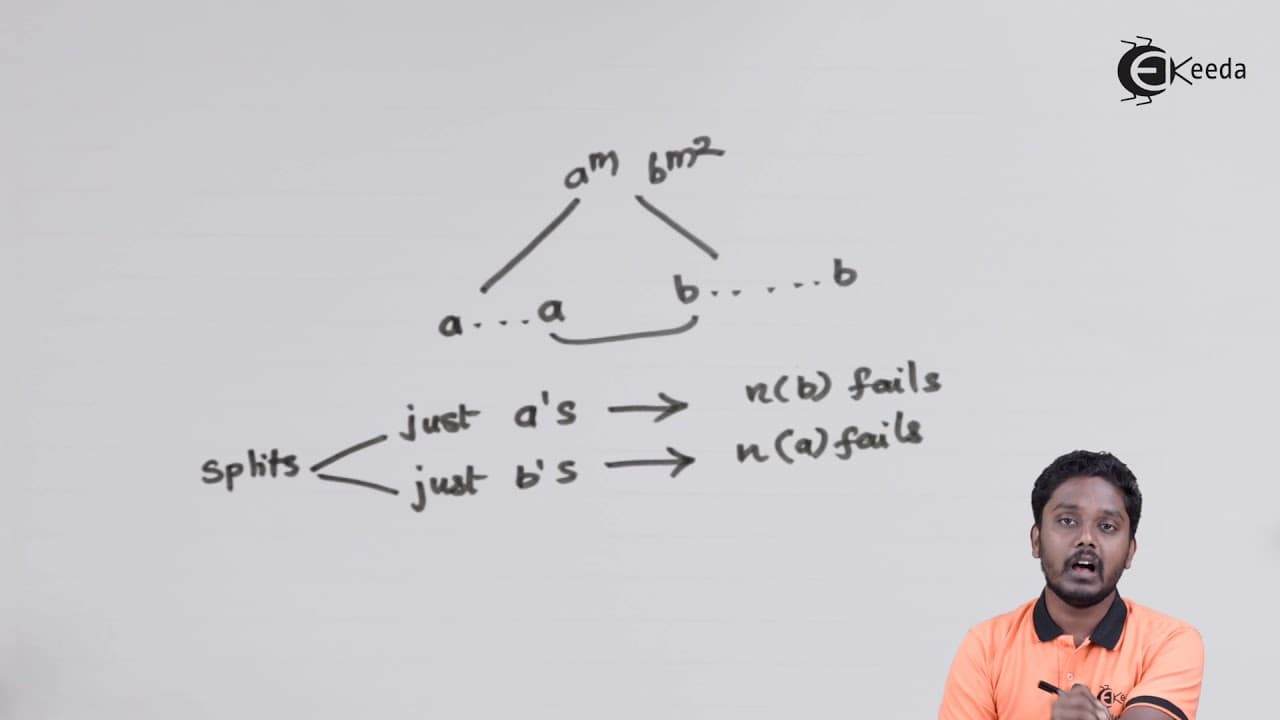
click the bell icon to get latest videos from akira hello friends let's solve the last question on proving that certain languages not context-free using pumping lemma over here we have taken up a language such that a number of A's are followed by number of Me's their number of visas exactly the square of number of is again we start with the same pr... Read More
Key Insights
- 🥶 The video discusses the pumping lemma and its application in determining if a language is context-free.
- ❓ It demonstrates how to select a specific string and split it to analyze the behavior of the language under pumping.
- 🥶 The example used shows how the pumping lemma can be used to prove that a language is not context-free.
- 🎮 The video mentions the pumping lemma for linear languages and suggests that it will be covered in a future video.
- ⛽ The importance of the pumping lemma in language theory is highlighted.
- 🥶 Understanding the pumping lemma can help in identifying the limitations of context-free grammars.
- 🥶 The video emphasizes the need to prove that a language is context-free using the pumping lemma before assuming it to be one.
Install to Summarize YouTube Videos and Get Transcripts
Explore YouTube Video Summarizer or Get YouTube Transcript Extractor
Questions & Answers
Q: What is the pumping lemma?
The pumping lemma is a tool used in language theory to determine if a language is context-free. It helps identify languages that cannot be described by a context-free grammar.
Q: How is the pumping lemma applied to prove that a language is not context-free?
By selecting a specific string in the language and splitting it into parts, we can analyze how the language behaves when certain parts are pumped (repeated multiple times). If pumping breaks the properties of the language, it is not context-free.
Q: Can you explain the example used in the video to prove a language is not context-free?
The example language has a specific pattern of A's followed by B's, where the number of B's is the square of the number of A's. By selecting a particular string and splitting it, we can show that pumping either the A's or the B's leads to a violation of the pattern and, therefore, the language is not context-free.
Q: What other types of languages can be analyzed using the pumping lemma?
In addition to context-free languages, the pumping lemma can also be applied to linear languages. Linear languages have certain properties that the pumping lemma can help identify.
Summary & Key Takeaways
-
The video introduces the pumping lemma and its purpose in determining whether a language is context-free or not.
-
It explains the process of selecting a language and a string for testing using the pumping lemma.
-
The video demonstrates how to split the selected string into different parts and analyze the results to determine if the language is context-free.
Read in Other Languages (beta)
Share This Summary 📚
Summarize YouTube Videos and Get Video Transcripts with 1-Click
Try YouTube Summary with ChatGPT & Claude or YouTube Transcript Generator
Explore More Summaries from Ekeeda 📚






Summarize YouTube Videos and Get Video Transcripts with 1-Click
Try YouTube Summary with ChatGPT & Claude or YouTube Transcript Generator