What Is the Circular Flow of Income and Expenditures?
TL;DR
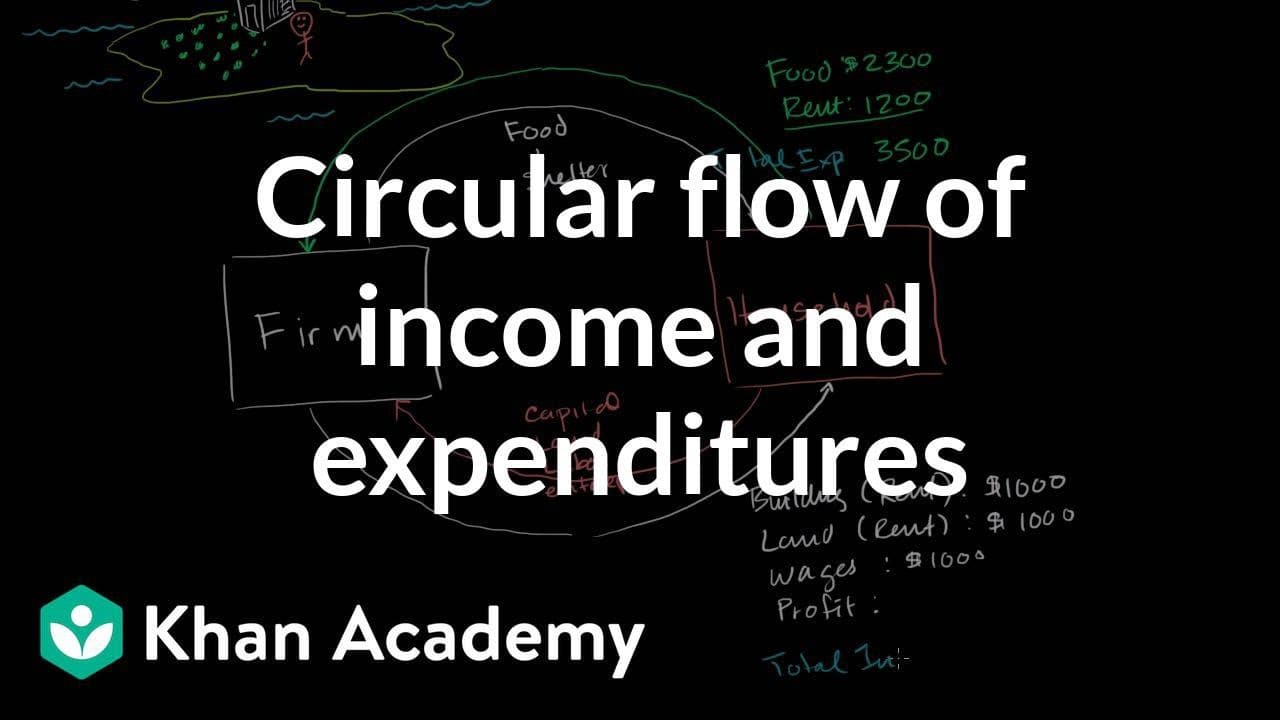
The circular flow of income and expenditures represents the continuous movement of money, resources, and goods between households and firms. In this simplified economy, a single individual owns a firm, providing labor and resources while receiving rent, wages, and profit, which in turn allows the firm to produce goods and services. This model exemplifies the foundational economic concept of interdependency in markets.
Transcript
Let's say, that there's a country that's made up only of this island that that's sitting in the middle of the lake and on that island there is only one dude here. He has one house and he has some land on which crops can be grown. But he wants to think a little bit more formally about his economy and he starts setting up some institutions that start... Read More
Key Insights
- 👋 The circular flow of goods and services involves households providing resources to firms, and firms providing goods, services, and income to households.
- ❓ In a simplified economy, the measurement of Gross Domestic Product (GDP) can be done by considering total expenditures, total income, or total revenue, although they would yield the same result.
- 💐 This example illustrates a basic model of a circular flow, but real-world economies are more complex with multiple households and firms.
- 🟰 The individual's income must be equal to or greater than their expenditures to maintain a sustainable economy.
- 🧑🏭 The concept of entrepreneurship is included as one of the factors of production, which is compensated through profit.
- 👋 The firm's revenue is derived from the sale of goods and services to the household, and the household's revenue comes from renting out resources to the firm.
- 💐 The circular flow demonstrates the interdependency and exchange of resources between households and firms.
Install to Summarize YouTube Videos and Get Transcripts
Explore YouTube Video Summarizer or Get YouTube Transcript Extractor
Questions & Answers
Q: What factors of production does the individual provide to the firm?
The individual provides capital (building), land, and labor to the firm.
Q: What does the firm pay the individual for the resources?
The firm pays $1,000 per year for building rent, $1,000 for land rent, and $1,000 for wages.
Q: How does the individual pay for goods and services from the firm?
The individual pays $2,300 per year for food and $1,200 per year for building rent.
Q: How is the profit distributed in this simplified economy?
The profit of $500 goes to the individual who owns the firm, in addition to the rents and wages he receives.
Summary & Key Takeaways
-
On a fictional island, a single individual sets up a firm with his own resources, including capital, land, and labor.
-
The firm produces goods and services, including food and property rental, which the individual consumes.
-
In exchange for his resources, the individual receives rent, wages, and profit from the firm.
Read in Other Languages (beta)
Share This Summary 📚
Summarize YouTube Videos and Get Video Transcripts with 1-Click
Try YouTube Summary with ChatGPT & Claude or YouTube Transcript Generator
Explore More Summaries from Khan Academy 📚



Summarize YouTube Videos and Get Video Transcripts with 1-Click
Try YouTube Summary with ChatGPT & Claude or YouTube Transcript Generator