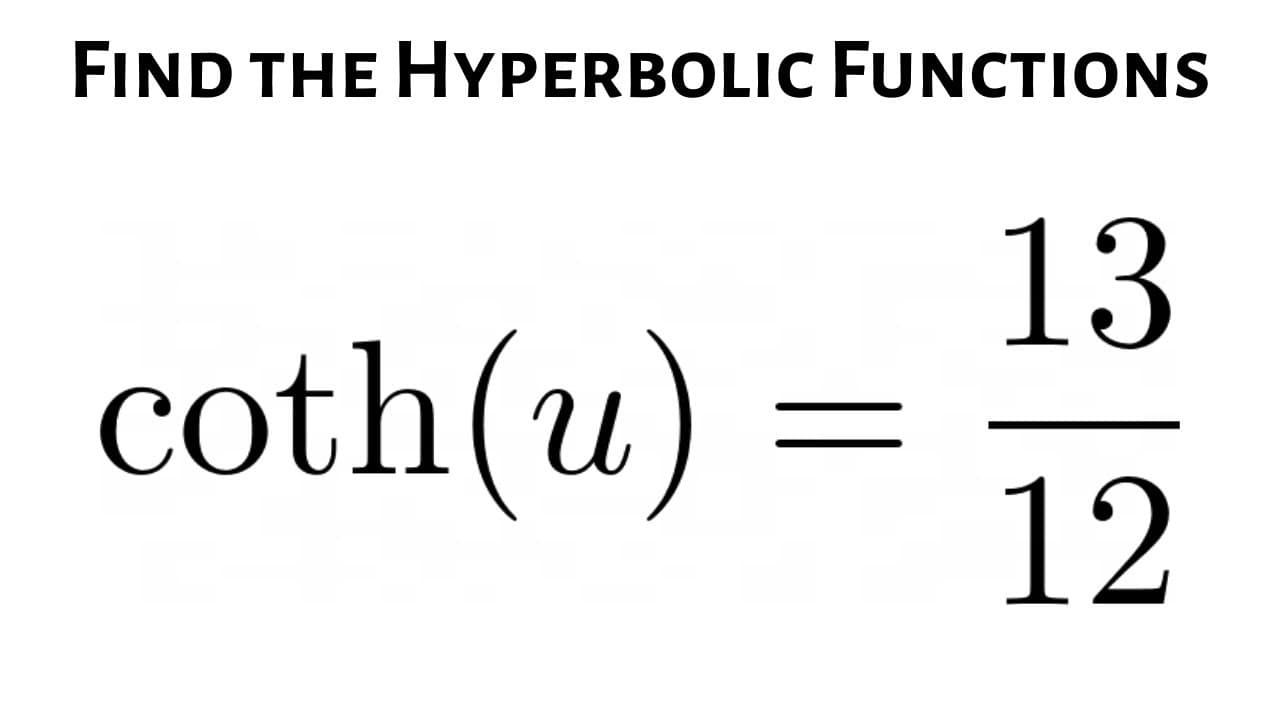
How to Find the Hyperbolic Functions when you are Given the Hyperbolic Cotangent
TL;DR
Finding six hyperbolic trig functions given cotangent value.
Transcript
hi everyone in this problem we're told that the hyperbolic cotangent of u is equal to 13 over 12 and we're being asked to find the other five uh hyperbolic functions so let's do this problem using like a minimal amount of information so i'll assume that we know this identity here so cosine squared of u minus cinch squared of u is equal to one now t... Read More
Key Insights
- ❓ Leveraging known trig identities simplifies the process of deriving hyperbolic trig functions.
- 🦻 Understanding reciprocal relationships between hyperbolic functions aids in finding missing trig functions efficiently.
- 🤘 Positivity of certain hyperbolic functions can guide the determination of sign for related functions.
- 🆘 Memorizing essential trig identities can significantly help in solving complex trigonometric problems.
- 🥺 Utilizing known values in trigonometry can lead to deriving multiple trig functions efficiently.
Install to Summarize YouTube Videos and Get Transcripts
Explore YouTube Video Summarizer or Get YouTube Transcript Extractor
Questions & Answers
Q: How do you derive hyperbolic trig functions given a specific value?
By utilizing known trig identities and relationships between hyperbolic functions, one can derive hyperbolic sine, cosine, tangent, cosecant, and secant from a given value like cotangent.
Q: Why is it important to start with a known trig identity in solving these types of problems?
Starting with a known trig identity ensures a structured approach to deriving other hyperbolic trig functions, simplifying the problem-solving process and reducing errors.
Q: How does the positivity of the cotangent value help determine the sign of other hyperbolic functions?
The positivity of cotangent implies positivity of cosine, sine, and cosecant, guiding towards the correct sign for hyperbolic functions like cosecant and secant.
Q: Why is it crucial to use reciprocal relationships between hyperbolic functions in finding the remaining trig functions?
Reciprocal relationships simplify the process of finding hyperbolic functions by leveraging known values and providing direct links between different trig functions.
Summary & Key Takeaways
-
Given cotangent value, derive hyperbolic sine, cosine, tangent, cosecant, and secant using trig identities.
-
Start with known trig identity to find hyperbolic cosecant and work from there to find other functions.
-
Use relationships between hyperbolic trig functions and known values to determine remaining functions.
Read in Other Languages (beta)
Share This Summary 📚
Summarize YouTube Videos and Get Video Transcripts with 1-Click
Try YouTube Summary with ChatGPT & Claude or YouTube Transcript Generator
Explore More Summaries from The Math Sorcerer 📚



Summarize YouTube Videos and Get Video Transcripts with 1-Click
Try YouTube Summary with ChatGPT & Claude or YouTube Transcript Generator