Demand-pull inflation under Johnson | Macroeconomics | Khan Academy
TL;DR
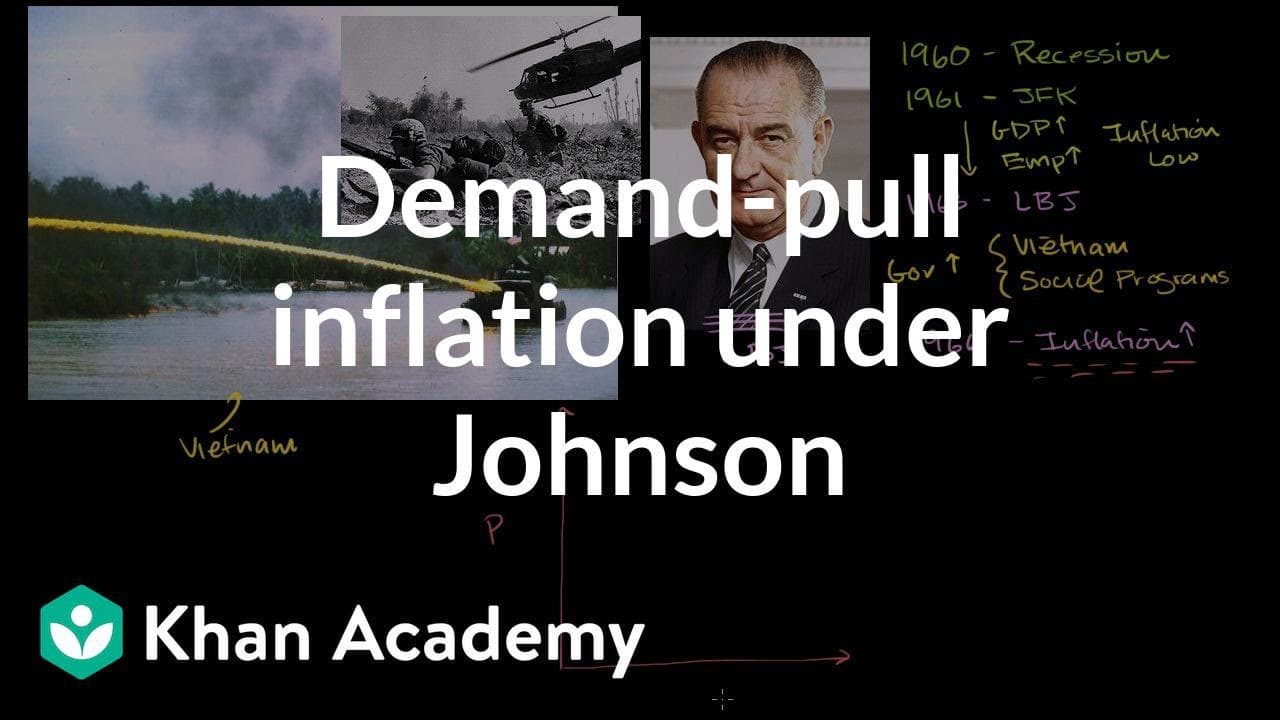
The video analyzes the state of the U.S. economy in the 1960s and examines if the Aggregate Demand-Aggregate Supply model accurately describes what happened.
Transcript
Male voice: What I want to do in this video is a little bit of 1960's U.S. economic history and then just see if our Aggregate Demand Aggregate Supply model fits the description of what actually happened. One could argue you don't need the ADAS model to describe what happened, but we should at least make sure that it does describe what happened. If... Read More
Key Insights
- 🥳 Weak economies tend to go against the party in power during elections.
- ❓ Keynesian policies, focused on increasing government spending to stimulate demand, were used during John F. Kennedy's presidency.
- 😘 Kennedy's policies resulted in positive economic outcomes, such as increased GDP, employment, and low inflation.
- 🥺 Lyndon B. Johnson's presidency saw continued government spending, causing the economy to overheat, leading to high inflation.
- 🤑 Increased government spending can inject more money into the economy but may lead to inflation.
- ❓ The ADAS model accurately describes and predicts the inflationary impact of increased government spending beyond an economy's potential.
- 🥺 Operating above an economy's potential can lead to unsustainability and the eventual settling of prices and output.
Install to Summarize YouTube Videos and Get Transcripts
Explore YouTube Video Summarizer or Get YouTube Transcript Extractor
Questions & Answers
Q: How did the weak economy in 1960 affect the presidential election?
The weak economy in 1960 played a significant role in the election, as it typically goes against the party in power. The recession likely contributed to the Democratic candidate, John F. Kennedy, winning the election.
Q: What were the main goals of John F. Kennedy's economic policies?
Kennedy aimed to turn around the economy by implementing Keynesian policies, which focused on increasing government spending, providing money to the poor, and offering tax cuts to stimulate demand and put more money into people's pockets.
Q: How did Lyndon B. Johnson's presidency impact the economy?
Johnson inherited a strong economy from Kennedy but continued with increased government spending, especially due to the Vietnam War and social programs aimed at reducing inequality. This caused the economy to overheat, resulting in high inflation.
Q: What impact did the increased government spending have on the economy in the 1960s?
The increased government spending injected more money into the economy, leading to inflation. Despite the economy already operating close to its capacity, the government continued to spend, causing the economy to overheat and inflation to grow dramatically.
Summary & Key Takeaways
-
In 1960, the weak economy led to the election of Democratic candidate John F. Kennedy, who implemented Keynesian policies to stimulate demand and improve the economy.
-
Kennedy's policies led to an increase in GDP, employment, and low inflation.
-
After Kennedy's assassination, Lyndon B. Johnson continued with increased government spending, causing the economy to overheat and inflation to rise.
Read in Other Languages (beta)
Share This Summary 📚
Summarize YouTube Videos and Get Video Transcripts with 1-Click
Try YouTube Summary with ChatGPT & Claude or YouTube Transcript Generator
Explore More Summaries from Khan Academy 📚



Summarize YouTube Videos and Get Video Transcripts with 1-Click
Try YouTube Summary with ChatGPT & Claude or YouTube Transcript Generator