How to Balance Chemical Equations Effectively
TL;DR
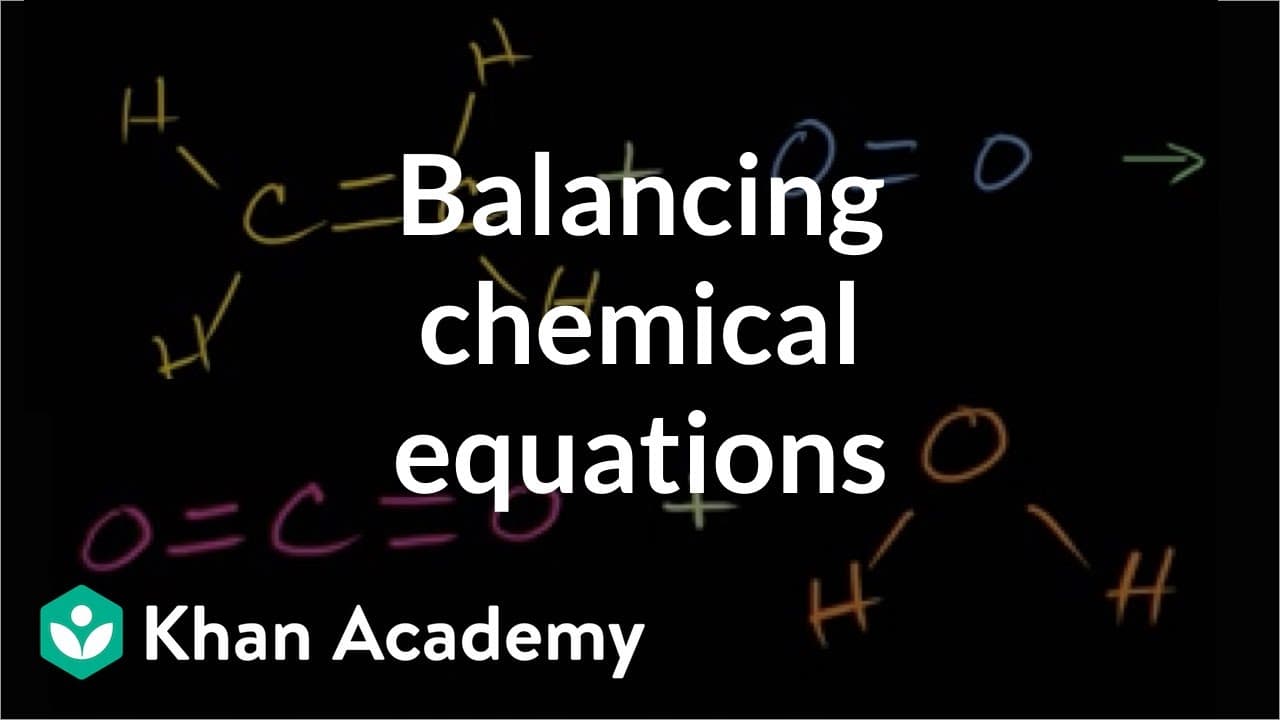
To balance chemical equations, adjust the coefficients of the molecules to ensure the same number of atoms on both sides, while never changing the subscripts, as that modifies the molecular structure. Maintaining the integrity of each substance is crucial for accurately representing chemical reactions and adhering to the law of conservation of mass.
Transcript
- [Voiceover] We've now seen a couple of examples of balancing chemical equations. And we've seen that, okay, if let's say, we're trying to balance this equation right over here and we started with the carbons. I have two carbons on the reactant side. They're both sitting in this ethylene molecule. And so I would want two carbons on the product sid... Read More
Key Insights
- 🙃 Balancing chemical equations involves adjusting coefficients to maintain the same number of atoms on both sides.
- 🎁 Changing subscripts creates different substances, while balancing equations ensures the same substances are present.
- #️⃣ The number of molecules can be modified, but the constituents within each molecule should remain the same.
- 🥳 Coefficients represent the quantity of molecules involved, while subscripts denote the ratio of atoms within a molecule.
- 👮 Balancing equations is crucial for accurately representing chemical reactions and conforming to the law of conservation of mass.
- 💳 Adjusting subscripts changes the entire identity of a molecule, while coefficients only modify the quantity.
- 🙃 Balancing equations requires equalizing the number of atoms for each element on both sides.
Install to Summarize YouTube Videos and Get Transcripts
Explore YouTube Video Summarizer or Get YouTube Transcript Extractor
Questions & Answers
Q: Why do we adjust coefficients and not subscripts when balancing chemical equations?
Adjusting subscripts changes the structure of molecules and creates new substances, whereas balancing equations requires maintaining the same constituents within each molecule. Coefficients represent the number of molecules involved and can be adjusted to achieve balance.
Q: What happens when we change the subscripts of molecules in a chemical equation?
Changing subscripts alters the structure of molecules, resulting in different substances. Balancing equations aims to maintain the same substances on both sides, and thus, only coefficients can be modified.
Q: How do we ensure the correct number of atoms on both sides of a chemical equation?
To balance the equation, adjust coefficients to equalize the number of atoms for each element on both sides. This ensures that the equation obeys the law of conservation of mass.
Q: Why is it important to maintain the integrity of molecules when balancing chemical equations?
Maintaining the integrity of molecules ensures that the equation accurately represents the chemical reaction. Changing the structure of molecules by altering subscripts would describe a different reaction altogether.
Summary & Key Takeaways
-
Balancing chemical equations involves adjusting the coefficients of molecules to ensure the same number of atoms on both sides of the equation.
-
Changing the subscripts within a molecule alters its structure and creates a different substance.
-
It is important to maintain the correct number of molecules while balancing equations, without changing the constituents within each molecule.
Read in Other Languages (beta)
Share This Summary 📚
Summarize YouTube Videos and Get Video Transcripts with 1-Click
Try YouTube Summary with ChatGPT & Claude or YouTube Transcript Generator
Explore More Summaries from Khan Academy 📚



Summarize YouTube Videos and Get Video Transcripts with 1-Click
Try YouTube Summary with ChatGPT & Claude or YouTube Transcript Generator