Snell's law example 1 | Geometric optics | Physics | Khan Academy
TL;DR
This video provides simple examples of Snell's Law, explaining how to calculate angles of refraction using the refraction indices of different media.
Transcript
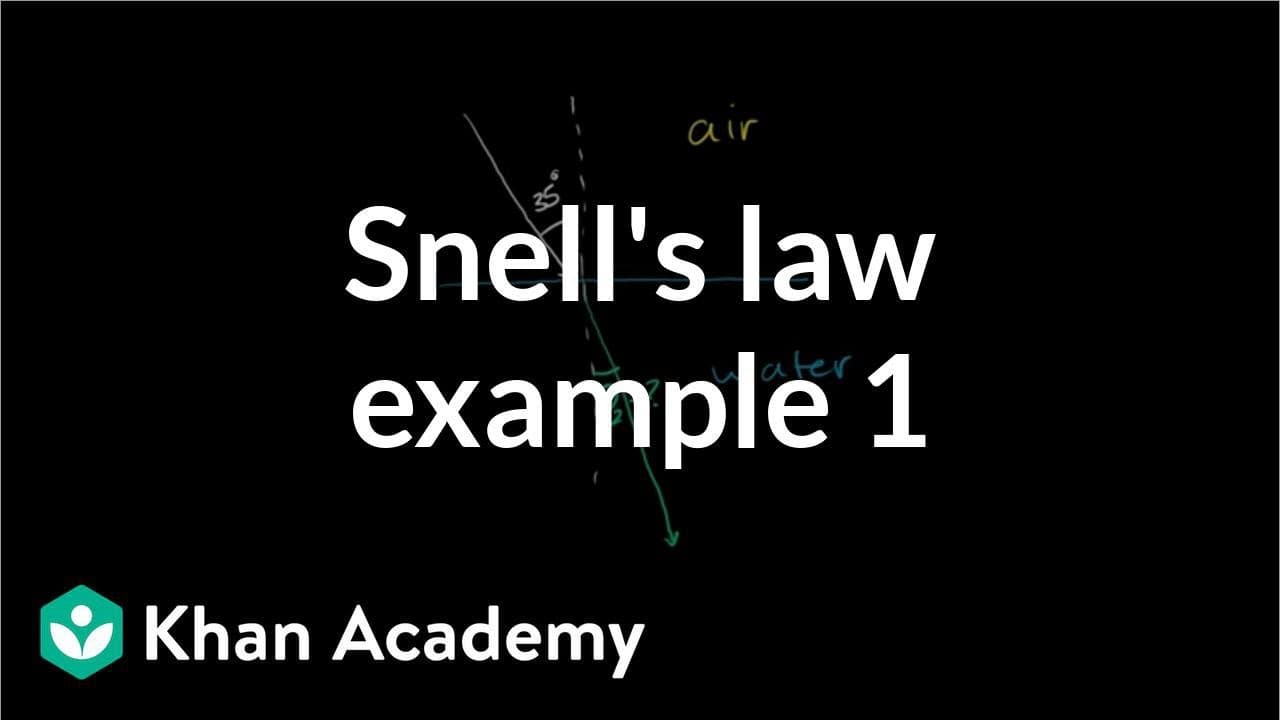
As promised, let's do a couple of simple Snell's law examples. So let's say, that I have two media-- I guess the plural of mediums. So let's say I have air right here. And then right here is the surface. Let me do that in a more appropriate color. That is the surface of the water. And I know that I have a light ray, coming in with an incident angle... Read More
Key Insights
- 🙂 Snell's Law relates to the bending of light as it passes from one medium to another with a different refractive index.
- 🔺 The incident angle and refraction angle can be used to calculate the refraction index of a material.
- 🙂 The refraction index can be used to calculate the speed of light in a material.
Install to Summarize YouTube Videos and Get Transcripts
Explore YouTube Video Summarizer or Get YouTube Transcript Extractor
Questions & Answers
Q: How can Snell's Law be used to determine the angle of refraction?
Snell's Law states that the ratio of the refraction indices of two media is equal to the ratio of the sines of the incident and refracted angles. By rearranging the equation, the angle of refraction can be calculated.
Q: Can Snell's Law be used to determine the refraction index of an unknown material?
Yes, if the incident angle and angle of refraction are known, the refraction index of the unknown material can be calculated by dividing the sine of the incident angle by the sine of the refracted angle.
Q: How can the speed of light in a material be determined using Snell's Law?
The refraction index of a material is equal to the speed of light in a vacuum divided by the speed of light in that material. By rearranging the equation, the speed of light in the material can be calculated.
Q: What are the practical applications of Snell's Law?
Snell's Law is used in various fields, including optics, ophthalmology, and engineering. It helps in understanding the behavior of light when it enters a different medium, and is crucial in designing lenses, eyeglasses, and other optical devices.
Summary & Key Takeaways
-
The video demonstrates how to calculate the angle of refraction when light passes from air to water using Snell's Law and the refraction indices of air and water.
-
Another example is given where the incident angle and angle of refraction are known, and the video shows how to calculate the refraction index and the speed of light in an unknown material.
Read in Other Languages (beta)
Share This Summary 📚
Summarize YouTube Videos and Get Video Transcripts with 1-Click
Try YouTube Summary with ChatGPT & Claude or YouTube Transcript Generator
Explore More Summaries from Khan Academy 📚



Summarize YouTube Videos and Get Video Transcripts with 1-Click
Try YouTube Summary with ChatGPT & Claude or YouTube Transcript Generator