What Are Robotaxis and How Will They Change Transportation?
TL;DR
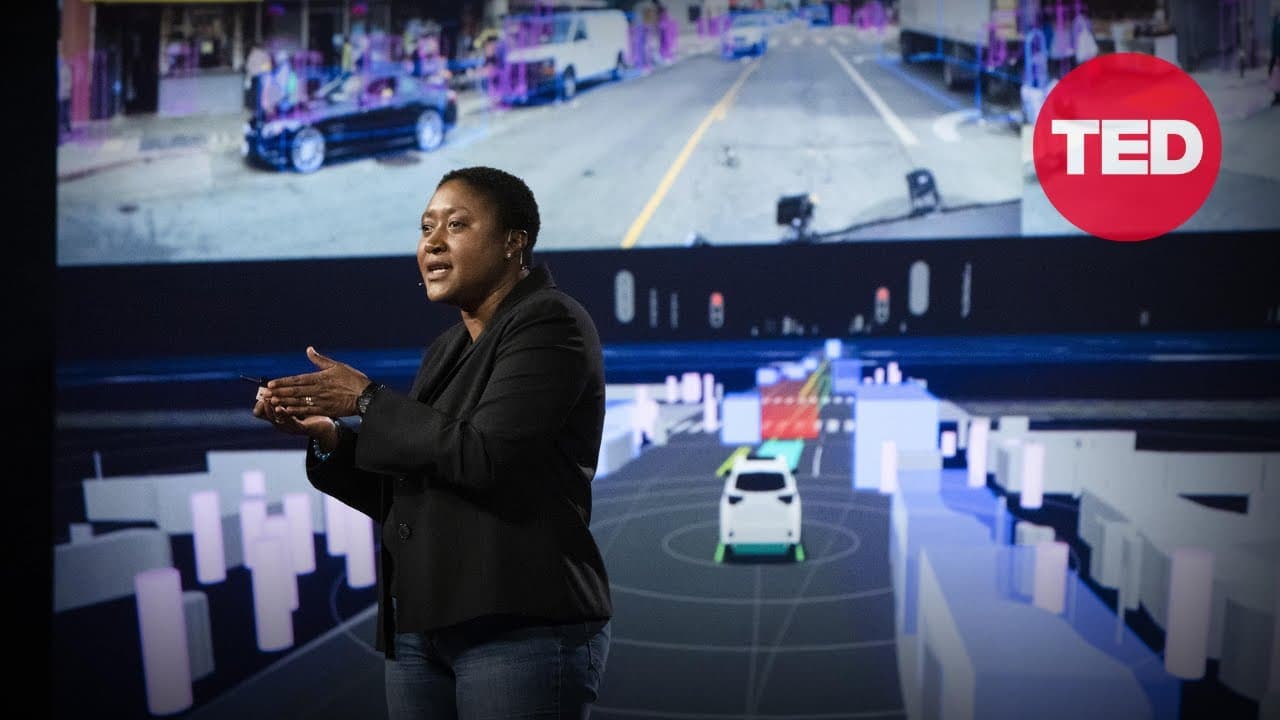
Robotaxis promise to revolutionize urban transportation by providing efficient, on-demand rides directly from point A to point B, minimizing individual car ownership which contributes to pollution and traffic. Advanced computer vision technology, including camera systems, radar, and lidar, enhances their operational safety and efficiency, yet challenges remain in replicating human-like perception.
Transcript
I’m Aicha Evans, I am from Senegal, West Africa, and I fell in love with technology, science and engineering at a very young age. Three things happened. I was studying in Paris, and starting at seven years old, flying back and forth between Dakar, Senegal and Paris as an unaccompanied minor. So it wasn't just about the travel. It was really about a... Read More
Key Insights
- 💡 Technology is a powerful tool that shapes experiences and understanding of the world, connecting people across different environments and cultures.
Install to Summarize YouTube Videos and Get Transcripts
Explore YouTube Video Summarizer or Get YouTube Transcript Extractor
Questions & Answers
Q: What initially sparked Aicha's interest in technology, science, and engineering?
Aicha's interest in technology, science, and engineering was sparked at a young age when she was studying in Paris and frequently traveling between Dakar, Senegal and Paris as an unaccompanied minor. She saw this travel as an opportunity to gain knowledge, experience different environments, and adapt to new situations.
Q: How did Aicha's desire to communicate with friends in Paris lead to her interest in technology?
When Aicha was at home in Senegal, she wanted to talk to her friends in Paris. However, the long-distance phone bills became a burden for her father, so he put a lock on the phone. Undeterred, Aicha hacked the phone and continued talking, causing her father to receive the bills. This experience ignited her interest in technology and its ability to connect people.
Q: What is the main focus of the transportation and technology industry that Aicha is a part of?
Aicha mentions that the industry she is part of is working on combining transportation and technology. It is not solely about personal, self-driving cars but rather changing the way we move people, goods, and services. The transformation revolves around the concept of robotaxis, which can transport individuals specifically from point A to point B.
Q: How does Aicha highlight the importance of computer vision in self-driving technology?
Aicha emphasizes that computer vision plays a crucial role in self-driving technology. It provides a real-time digital representation of the world and its interactions, allowing the vehicle to see and interpret its surroundings. Camera systems, radar, Lidar, and long-wave infrared are used together to create a comprehensive 360-degree field of vision for the vehicle, ensuring continuous coverage and accurate perception of the environment.
Q: How does Aicha address concerns about real-world testing of self-driving vehicles?
Aicha acknowledges that there will always be edge scenarios or dangerous situations that cannot be tested on real streets. To address this, simulation is used to construct millions of scenarios in a fabricated environment, allowing the software to be tested and optimized. Additionally, there is a human-in-the-loop system where teleguidance operators remotely provide guidance and assistance to the vehicle when it encounters challenging or unfamiliar situations.
Q: How does Aicha view the potential impact of computer vision on various industries?
Aicha believes that computer vision has the potential to transform various industries. She cites examples such as medicine, farming, and astrophysics, where vision systems (like microscopes and telescopes) have revolutionized problem-solving and understanding. With computer vision applied broadly, Aicha expects all industries to be transformed, and the world to be experienced in a different way, ultimately benefiting future generations.
Q: What does Aicha believe is possible with computer vision technology?
Aicha believes that with computer vision technology, we have the opportunity to shift from problem-solving to problem-preventing. By surpassing human capabilities in terms of perception and understanding, computer vision can help create safer, more reliable autonomous vehicles, potentially preventing a significant portion of crashes caused by human error. Aicha sees computer vision as a gift to be embraced and shared with the next generation, as it has the potential to solve a multitude of problems in various fields.
Summary & Key Takeaways
-
Aicha Evans fell in love with technology and engineering at a young age, which was shaped by her experiences of traveling between Senegal and Paris and her fascination with the emerging internet.
-
She believes that individually owned cars are wasteful and contribute to pollution and traffic, and sees the potential of robotaxis to transform transportation by taking people specifically from point A to point B and being utilized by others when not in use.
-
Evans discusses the importance of computer vision in self-driving technology, highlighting the power of camera systems, radar, lidar, and long-wave infrared in providing a comprehensive understanding of the environment, although there are still limitations compared to human perception. She also emphasizes the use of simulation and human guidance in testing and optimizing self-driving systems.
Read in Other Languages (beta)
Share This Summary 📚
Summarize YouTube Videos and Get Video Transcripts with 1-Click
Try YouTube Summary with ChatGPT & Claude or YouTube Transcript Generator
Explore More Summaries from TED 📚





Summarize YouTube Videos and Get Video Transcripts with 1-Click
Try YouTube Summary with ChatGPT & Claude or YouTube Transcript Generator