Understanding Conversion Factors
TL;DR
This video discusses how to understand conversion factors and the underlying math in unit conversions.
Transcript
Sometimes I just hate conversion factors so much I can hardly even describe it. Sure I think they're easy, I think they're convenient. If you have a problem and you're able to cancel out the right units you know you set it up correctly. But at the same time, I hate conversion factors and I hate them because for me, I'm all about learning and I’m al... Read More
Key Insights
- 🥺 Conversion factors can lead to correct answers without understanding the underlying math or problem-solving process.
- 👻 Understanding the underlying math in unit conversions allows for better comprehension and the ability to determine if the obtained answer is logical.
- 🇦🇪 Converting from larger units to smaller units typically involves multiplication, while converting from smaller units to larger units often requires division.
- 🆘 Comparing the initial and final units can help determine if the obtained answer is reasonable.
- 🍳 Complex conversion problems can be tackled by breaking them down into smaller, more comprehendible sections.
- 🤔 Thinking through the math involved and questioning whether the answer makes sense is crucial in unit conversions.
- 🧑🏭 Conversion problems involving multiple conversion factors can be approached step-by-step, ensuring understanding at each stage.
Install to Summarize YouTube Videos and Get Transcripts
Explore YouTube Video Summarizer or Get YouTube Transcript Extractor
Questions & Answers
Q: Why does the speaker express frustration with conversion factors?
The speaker dislikes conversion factors because they can lead to correct answers without understanding the underlying math or problem-solving process.
Q: How does the speaker suggest understanding conversion factors?
To understand conversion factors, one should think about the underlying math being performed (i.e., multiplication or division) and consider if the answer obtained makes sense in relation to the initial and final units.
Q: What mathematical operation is involved when converting feet to inches?
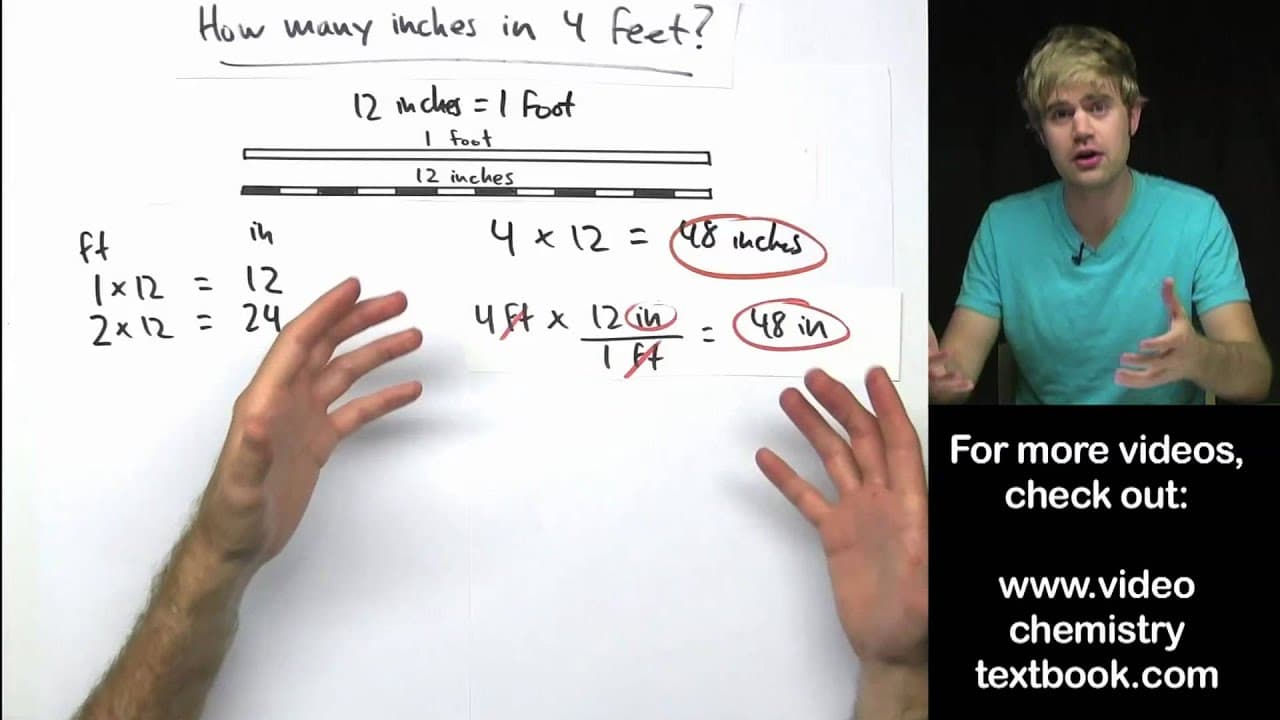
When converting feet to inches, one performs multiplication. For example, multiplying the number of feet by 12 will yield the equivalent number of inches.
Q: How can one ensure that their answer makes sense in a unit conversion problem?
By examining the initial and final units and their sizes, one can determine if the obtained answer is reasonable. For example, converting from feet to inches should generally result in a larger number of inches.
Q: What is the key insight in converting pounds to kilograms?
The key insight is that converting pounds to kilograms involves division. By dividing the number of pounds by 2.2, one can obtain the corresponding weight in kilograms.
Q: How can one approach complex conversion problems effectively?
Breaking down complex conversion problems into smaller, manageable sections allows for a better understanding of each step. By understanding each individual conversion, one can ensure the overall process is accurate.
Summary & Key Takeaways
-
The speaker expresses frustration with conversion factors, as they can lead to correct answers without understanding the underlying math.
-
The speaker explains the thought process behind unit conversions and demonstrates with examples of converting feet to inches and inches to feet.
-
The video emphasizes that understanding the math and thought process allows one to determine if the answer makes sense.
-
The speaker provides examples of converting miles to kilometers and pounds to kilograms, highlighting the importance of division in these conversions.
-
The video concludes with advice to break down complex conversion problems into smaller sections to ensure understanding at each step.
Read in Other Languages (beta)
Share This Summary 📚
Summarize YouTube Videos and Get Video Transcripts with 1-Click
Try YouTube Summary with ChatGPT & Claude or YouTube Transcript Generator
Explore More Summaries from Tyler DeWitt 📚


Summarize YouTube Videos and Get Video Transcripts with 1-Click
Try YouTube Summary with ChatGPT & Claude or YouTube Transcript Generator