Definite Integration Based on Property No 4 Problem No 6
TL;DR
Analyzing a definite integral problem based on property number 4, determining if the given function is even or odd.
Transcript
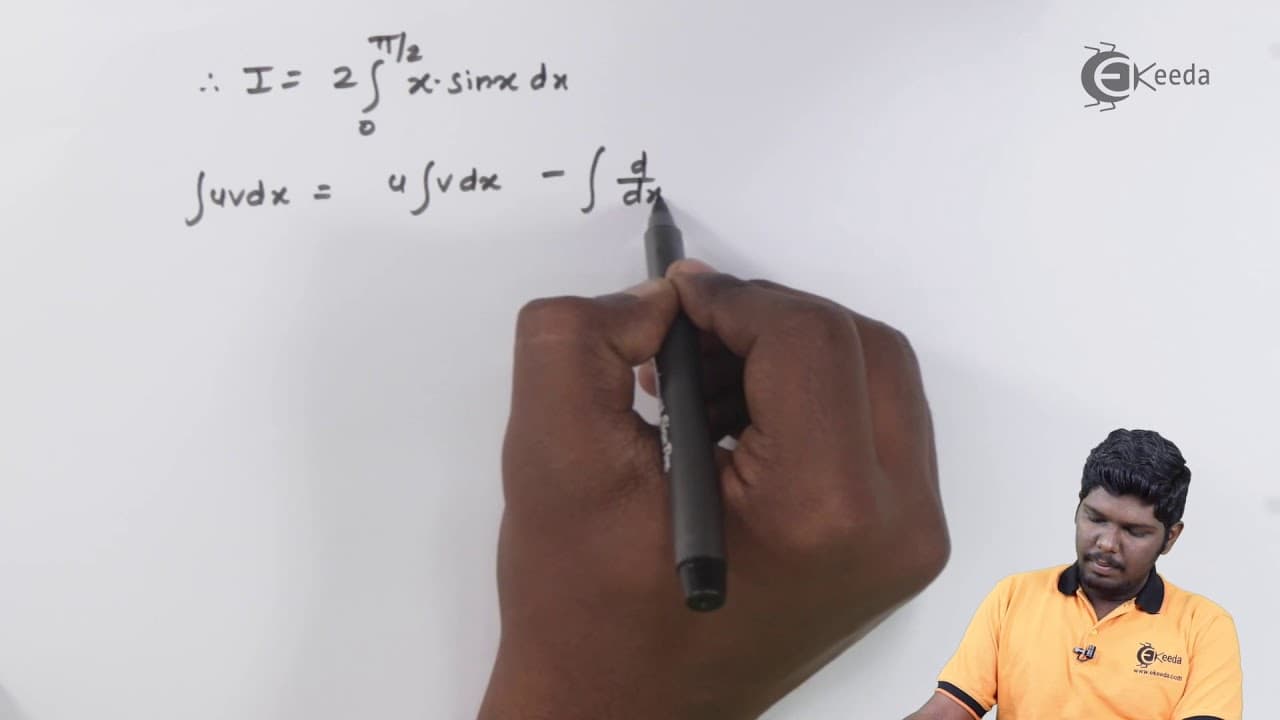
click the Bell icon to get latest videos from equator hello friends in this video we are going to see last problem which is based on property number 4 of definite integral let us start with problem number 6 integral minus PI by 2 to plus PI by 2 X sine X DX first since the limits are present in the form of minus a to a we will check whether the giv... Read More
Key Insights
- 👍 The given function, f(x) = x*sin(x), is proven to be an even function by evaluating f(-x).
- ❓ By recognizing the function's evenness, the integral calculation is simplified.
- 🥳 The UV rule, or integration by parts, is employed to solve the integral step by step.
- ❓ The calculation results in a final answer of 2 for the given integral problem.
- 🖐️ Symmetry properties of functions play a crucial role in definite integral calculations.
- 🪈 Understanding the order of functions in a product is important in applying the UV rule effectively.
- 🧡 Limits in the integral represent the range over which the integral is to be computed.
Install to Summarize YouTube Videos and Get Transcripts
Explore YouTube Video Summarizer or Get YouTube Transcript Extractor
Questions & Answers
Q: What is the purpose of checking whether the given function is even or odd?
Checking the function's evenness or oddness helps determine if it satisfies the symmetry property, making the integral calculation simpler. In this case, since the function f(x) = x*sin(x) is even, the integral is reduced to a more manageable form.
Q: What is the significance of using the UV rule in this problem?
The UV rule, also known as integration by parts, helps simplify the integral of a product of two functions. By selecting the correct order (U part and V part), derivatives and integrals are applied to each part, aiding in the overall integration process.
Q: How are the limits determined for the integral calculation?
The limits are given as -π/2 to π/2, which represent the starting and ending points of the integration. These limits define the range over which the integral is evaluated, and they are substituted into the final expression to obtain the specific values.
Q: Why does the term involving the integral of cos(x) vanish in the final answer?
The integral of cos(x) from 0 to π/2 results in 0 because the cosine function evaluates to 0 at π/2 and subtracting the value at 0 (also 0) does not change the result. Thus, the term containing the integral of cos(x) disappears, leaving only the term with the integral of sin(x).
Summary & Key Takeaways
-
The video discusses a specific integral problem involving the function f(x) = x*sin(x) with limits from -π/2 to π/2.
-
It is demonstrated that the given function is an even function, allowing for a simplified integral calculation.
-
Applying the UV rule, the integral is solved step by step, resulting in a final answer of 2.
Read in Other Languages (beta)
Share This Summary 📚
Summarize YouTube Videos and Get Video Transcripts with 1-Click
Try YouTube Summary with ChatGPT & Claude or YouTube Transcript Generator
Explore More Summaries from Ekeeda 📚



Summarize YouTube Videos and Get Video Transcripts with 1-Click
Try YouTube Summary with ChatGPT & Claude or YouTube Transcript Generator