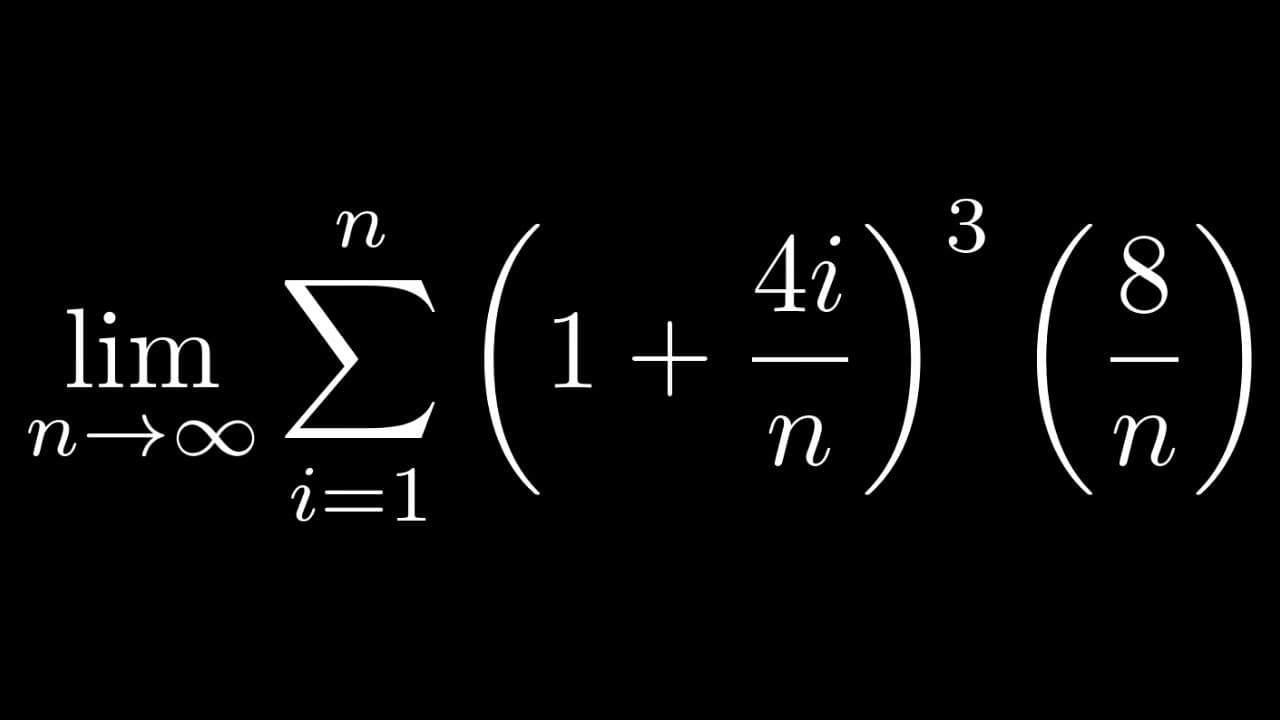
Limit of sum( (1 + 4i/n)^3(8/n), i = 1,...,n ) as n approaches infinity
TL;DR
Computing the limit of a finite sum using Pascal's triangle and coefficient manipulation.
Transcript
in this video we're being asked to compute a limit of a finite sum let's just go ahead and do it all at once so solution so we have the limit as n approaches infinity of the finite sum as n runs from 1 to N and now what we're going to do is we're going to break this up so to do that we're going to use Pascal's triangle so recall Pascal's triangle y... Read More
Key Insights
- 🦻 Pascal's triangle aids in determining coefficients for breaking down a finite sum.
- 🍹 Coefficient manipulation simplifies the calculation of the limit for a finite sum.
- 😑 Understanding the powers of N in the expression is crucial for computing the limit accurately.
- 🙅 The rate at which terms converge or diverge as N approaches infinity is indicated by the powers of N in the final expression.
- 🥳 Coefficients play a significant role in breaking down a finite sum into manageable parts for calculation.
- ⛔ Utilizing Pascal's triangle and coefficient manipulation can streamline the process of computing limits.
- 😑 Coefficient manipulation helps in organizing terms and simplifying the expression for calculating the limit efficiently.
Install to Summarize YouTube Videos and Get Transcripts
Explore YouTube Video Summarizer or Get YouTube Transcript Extractor
Questions & Answers
Q: How is Pascal's triangle used to simplify the calculation of the limit of a finite sum?
Pascal's triangle is used to determine the coefficients for breaking down the finite sum, simplifying the calculation and making it more manageable. Each row of Pascal's triangle corresponds to the coefficients of the expression.
Q: What role do coefficients play in computing the limit of a finite sum?
Coefficients are used to break down the finite sum into manageable parts, allowing for easier calculation of the limit as the sum approaches infinity. The coefficients determine the powers of the variables in each term.
Q: What is the significance of the powers of N in the final expression when computing the limit?
The powers of N in the final expression indicate the rate at which the terms converge or diverge as N approaches infinity. Understanding the powers of N is crucial in determining the behavior of the limit of the finite sum.
Q: How does coefficient manipulation aid in the computation of the limit of a finite sum?
Coefficient manipulation simplifies the expression by breaking it down into terms with specific coefficients and powers. This manipulation technique helps in organizing the terms and calculating the limit efficiently.
Summary & Key Takeaways
-
Computing the limit of a finite sum using Pascal's triangle and coefficient manipulation.
-
Breaking down the finite sum using Pascal's triangle to simplify the calculation.
-
Utilizing coefficient manipulation to compute the limit of the given finite sum.
Read in Other Languages (beta)
Share This Summary 📚
Summarize YouTube Videos and Get Video Transcripts with 1-Click
Try YouTube Summary with ChatGPT & Claude or YouTube Transcript Generator
Explore More Summaries from The Math Sorcerer 📚


Summarize YouTube Videos and Get Video Transcripts with 1-Click
Try YouTube Summary with ChatGPT & Claude or YouTube Transcript Generator