How Do Loops and Recursion Differ in Programming?
TL;DR
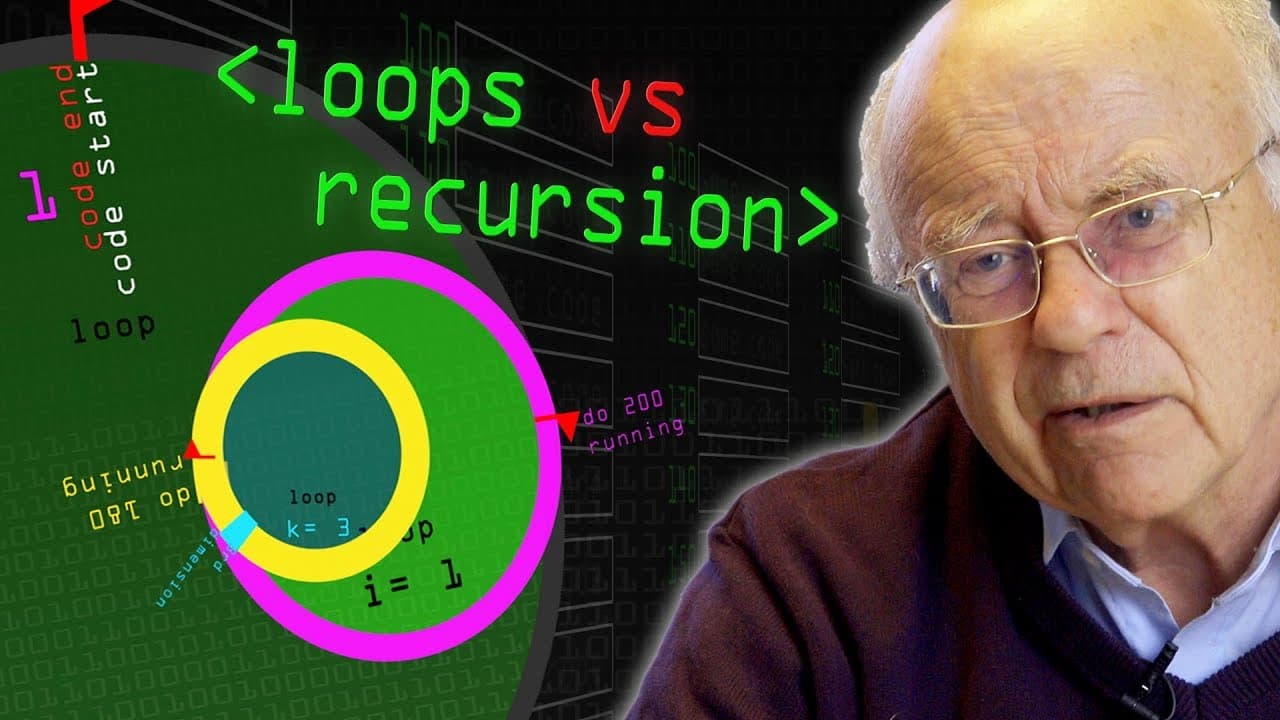
Loops in programming, starting with FORTRAN's DO loops, allow for repeating sequences of instructions until a condition is met. However, for more complex problems, recursion becomes necessary as it can handle scenarios that nested loops cannot, marking a significant evolution in programming techniques.
Transcript
[There's] a lot of interesting stuff both from the point of view of the content but also the historical context between, y' know "When were `for' loops invented?". Well that's what Algol called them but prior to that FORTRAN called them DO loops. And prior to that they existed in assembler. So, first of all, what's the history and what does it get ... Read More
Key Insights
- ✋ The history of loops in computer programming dates back to assembler and then the introduction of high-level languages like FORTRAN.
- 🪹 Nested loops were useful for handling multi-dimensional problems in scientific and engineering calculations.
- 🧑🔬 Some theoretical computer scientists realized the need for recursion to solve complex problems that fell outside the capabilities of nested loops.
- 👤 FORTRAN initially did not support user-level recursion, but it was later implemented within the language.
Install to Summarize YouTube Videos and Get Transcripts
Explore YouTube Video Summarizer or Get YouTube Transcript Extractor
Questions & Answers
Q: What was the first high-level language to introduce loops?
FORTRAN was one of the first high-level languages to introduce loops, known as DO loops, in the 1950s. It allowed for the repetition of instructions until a specified condition was met.
Q: How did loops become more powerful in programming?
Loops became more powerful by allowing nested loops, where a loop exists within another loop. This was possible even in assembler and FORTRAN and was useful for handling multi-dimensional problems.
Q: What are the limitations of nested loops?
The depth of nested loops is limited by the compiler. Early FORTRAN compilers allowed for about 10 levels of nesting, while some modern programming languages like C++ allow for up to 256 levels of nesting.
Q: Why is recursion important in computer programming?
Recursion is important for handling complex problems that cannot be easily solved using nested loops. It allows for a function or routine to call itself, creating a recursive chain of operations.
Summary & Key Takeaways
-
Loops in computer programming have evolved over time, starting with assembler and then moving to high-level languages like FORTRAN.
-
FORTRAN introduced loops called DO loops, which allowed for the repetition of a sequence of instructions until a specified condition was met.
-
Nested loops, where a loop exists within another loop, became possible and were useful for handling multi-dimensional problems in scientific and engineering calculations.
Read in Other Languages (beta)
Share This Summary 📚
Summarize YouTube Videos and Get Video Transcripts with 1-Click
Try YouTube Summary with ChatGPT & Claude or YouTube Transcript Generator
Explore More Summaries from Computerphile 📚




Summarize YouTube Videos and Get Video Transcripts with 1-Click
Try YouTube Summary with ChatGPT & Claude or YouTube Transcript Generator