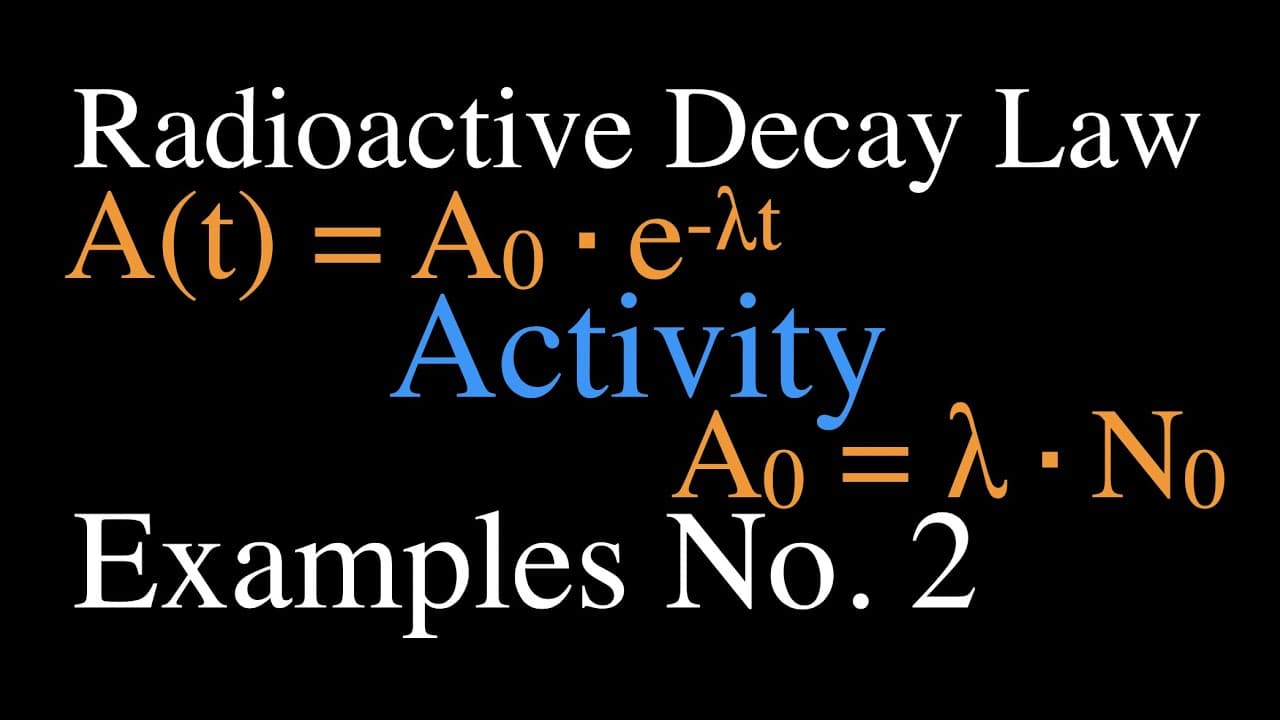
Radioactivity (10 of 16) Decay Activity, Example Problems
TL;DR
Learn how to calculate activity related to different radioactive decay examples.
Transcript
okay in today's video I am going to go over I believe it's four different examples for calculating activity related to radioactive decay now before we do that please don't forget in the bottom right hand corner of this video there is a subscribe button please click on that button subscribe to my channel oh man excellent physics chemistry and math v... Read More
Key Insights
- ☢️ Activity in radioactive decay is determined by the decay constant and the number of radioactive nuclei.
- 💆 Converting mass to moles is crucial in calculating the number of radioactive nuclei in a sample.
- 🛟 The half-life of a radioactive isotope can be calculated using the decay constant and activity measurements.
- #️⃣ Avogadro's number is used to convert moles to the number of atoms in a sample.
- ❓ Activity is measured in becquerels, representing decays per second.
- 🧑💻 The natural log of 2 is used in calculating the decay constant.
- 🛟 Radioactive decay follows a predictable pattern based on the half-life of the isotope.
Install to Summarize YouTube Videos and Get Transcripts
Explore YouTube Video Summarizer or Get YouTube Transcript Extractor
Questions & Answers
Q: How is activity related to radioactive decay calculated?
Activity in radioactive decay is calculated using the decay constant and the number of radioactive nuclei present at the initial time, as shown in the examples provided in the video.
Q: How is the number of radioactive nuclei determined in a sample?
The number of radioactive nuclei in a sample can be determined by converting the mass of the sample to moles and then using Avogadro's number to calculate the quantity.
Q: Why is the decay constant necessary in calculating activity?
The decay constant is essential in calculating activity as it defines the rate at which radioactive nuclei decay, allowing for the determination of activity at a specific time.
Q: How is the half-life of a radioactive isotope calculated?
The half-life of a radioactive isotope can be calculated by using the decay constant, the number of radioactive nuclei, and the activity at different time intervals, as demonstrated in the video.
Summary & Key Takeaways
-
Explanation of calculating activity related to radioactive decay with four examples provided.
-
Demonstration of converting milligrams to moles for determining the number of radioactive nuclei.
-
Method to calculate activity using the decay constant and number of radioactive nuclei.
Read in Other Languages (beta)
Share This Summary 📚
Summarize YouTube Videos and Get Video Transcripts with 1-Click
Try YouTube Summary with ChatGPT & Claude or YouTube Transcript Generator
Explore More Summaries from Step by Step Science 📚

Summarize YouTube Videos and Get Video Transcripts with 1-Click
Try YouTube Summary with ChatGPT & Claude or YouTube Transcript Generator