Introduction to SynthMaster 3 Modulation Sources
TL;DR
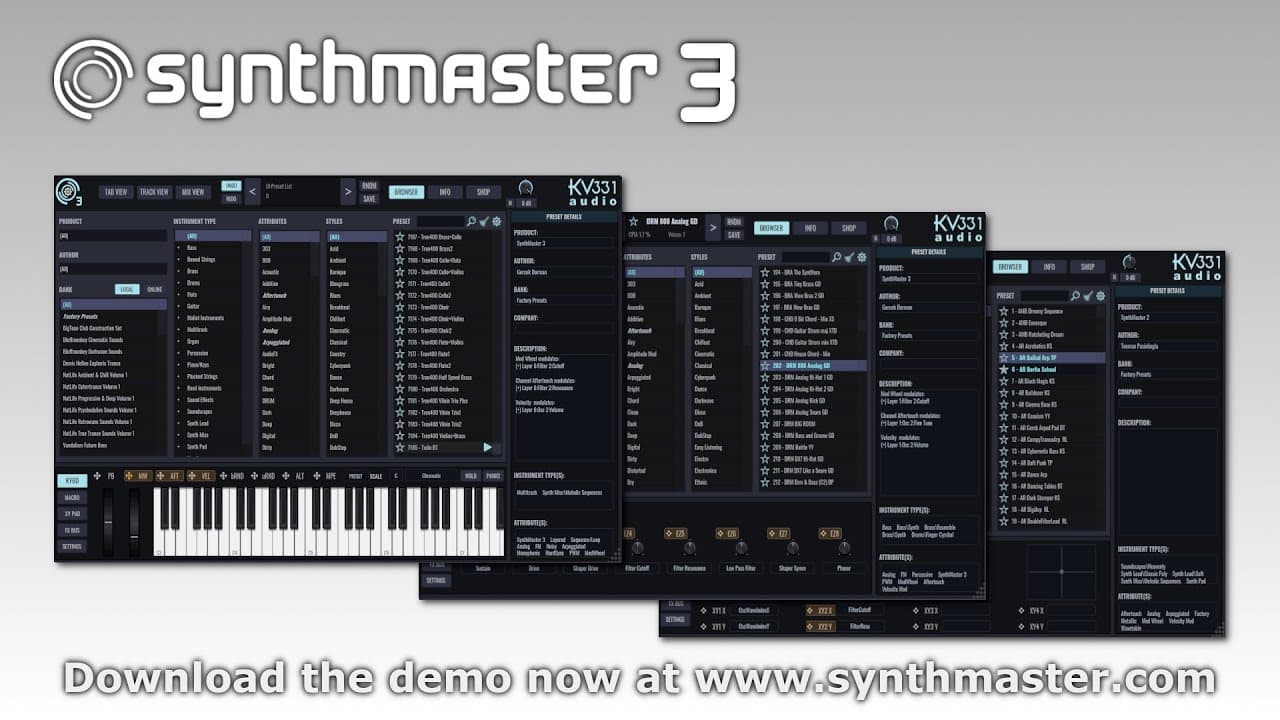
Detailed guide on SynthMaster 3's modulation sources and their functionalities.
Transcript
hi guys in this video I'm going to talk about the modulation sources in synm 3 but before uh going into the modulation sources uh I will explain modulation in general and also the modulation architecture in syn master 3 uh let's start off with the init pre presets which basically consists of a single layer uh with an oscillator basi... Read More
Key Insights
- Modulation in SynthMaster 3 involves altering parameter values over time, crucial for sound design.
- ADSR envelopes in SynthMaster 3 can be digital or analog, each with distinct characteristics affecting sound modulation.
- Multi-segment envelopes allow for complex modulation patterns with customizable segments and looping capabilities.
- Low Frequency Oscillators (LFOs) in SynthMaster 3 can be customized with user-defined waveforms and modulation parameters.
- Noise LFOs generate step noise with adjustable bit depth and attack/release settings, useful for creating varied sound textures.
- Step LFOs function like sequencers, offering rhythmic modulation with customizable step lengths and slopes.
- Scalers in SynthMaster 3 map input values to a user-defined curve, enabling unique modulation effects.
- SynthMaster 3's modulation architecture allows for dynamic and creative sound shaping through a variety of sources.
Install to Summarize YouTube Videos and Get Transcripts
Explore YouTube Video Summarizer or Get YouTube Transcript Extractor
Questions & Answers
Q: What is modulation in SynthMaster 3?
Modulation in SynthMaster 3 refers to the process of changing the value of a parameter over time. It is a fundamental aspect of sound design, allowing users to create dynamic and evolving sounds by altering parameters such as volume, pitch, or filter cutoff.
Q: How do ADSR envelopes function in SynthMaster 3?
ADSR envelopes in SynthMaster 3 control the attack, decay, sustain, and release of a sound. Users can choose between digital and analog types, each offering different characteristics. These envelopes shape the sound's amplitude over time, allowing for precise control over how a sound evolves from start to finish.
Q: What are multi-segment envelopes used for?
Multi-segment envelopes in SynthMaster 3 allow for the creation of complex modulation patterns. They consist of multiple segments that users can customize, including adding, removing, or adjusting points. These envelopes can loop, offering versatile options for sound modulation, and are ideal for creating intricate soundscapes.
Q: How do LFOs differ from regular oscillators?
LFOs, or Low Frequency Oscillators, in SynthMaster 3 are similar to regular oscillators but operate at much lower frequencies. They are used to modulate parameters rather than generate sound directly. LFOs can be customized with different waveforms and modulation settings, making them essential for creating vibrato, tremolo, and other effects.
Q: What are noise LFOs and their purpose?
Noise LFOs in SynthMaster 3 generate step noise that can be modulated with parameters like bit depth, attack, and release. They are used to add randomness and texture to sounds, providing a way to create unique and evolving soundscapes by modulating parameters with noise.
Q: How do step LFOs enhance sound design?
Step LFOs in SynthMaster 3 act like sequencers, allowing users to create rhythmic modulation patterns. Each step can have a different length and slope, providing a way to create complex, timed modulation effects. This is particularly useful for creating rhythmic effects and adding movement to static sounds.
Q: What is the role of scalers in modulation?
Scalers in SynthMaster 3 map input values to a user-defined curve, allowing for unique modulation effects. They can be used to reshape modulation sources like LFOs, providing a way to create complex, non-linear modulation patterns. This feature adds another layer of creativity and control to sound design.
Q: How does SynthMaster 3's modulation architecture benefit users?
SynthMaster 3's modulation architecture offers a variety of sources and parameters for dynamic sound shaping. With options like ADSR envelopes, LFOs, and scalers, users have the tools to create intricate and evolving soundscapes. This flexibility makes it a powerful tool for both beginners and advanced sound designers.
Summary & Key Takeaways
-
SynthMaster 3 offers a comprehensive modulation system essential for sound design, including ADSR envelopes, LFOs, and scalers. Each source provides unique control over sound parameters, enabling intricate sound modulation.
-
ADSR envelopes in SynthMaster 3 can be configured as digital or analog, each offering different modulation characteristics. Multi-segment envelopes allow for complex modulation patterns with looping and point editing capabilities.
-
LFOs in SynthMaster 3 offer customizable waveforms and modulation parameters, including noise LFOs for step noise generation and step LFOs for rhythmic modulation. Scalers allow for unique modulation effects by mapping input values to a curve.
Read in Other Languages (beta)
Share This Summary 📚
Summarize YouTube Videos and Get Video Transcripts with 1-Click
Try YouTube Summary with ChatGPT & Claude or YouTube Transcript Generator
Explore More Summaries from kv331audio 📚
Summarize YouTube Videos and Get Video Transcripts with 1-Click
Try YouTube Summary with ChatGPT & Claude or YouTube Transcript Generator