Gideon v Wainwright
TL;DR
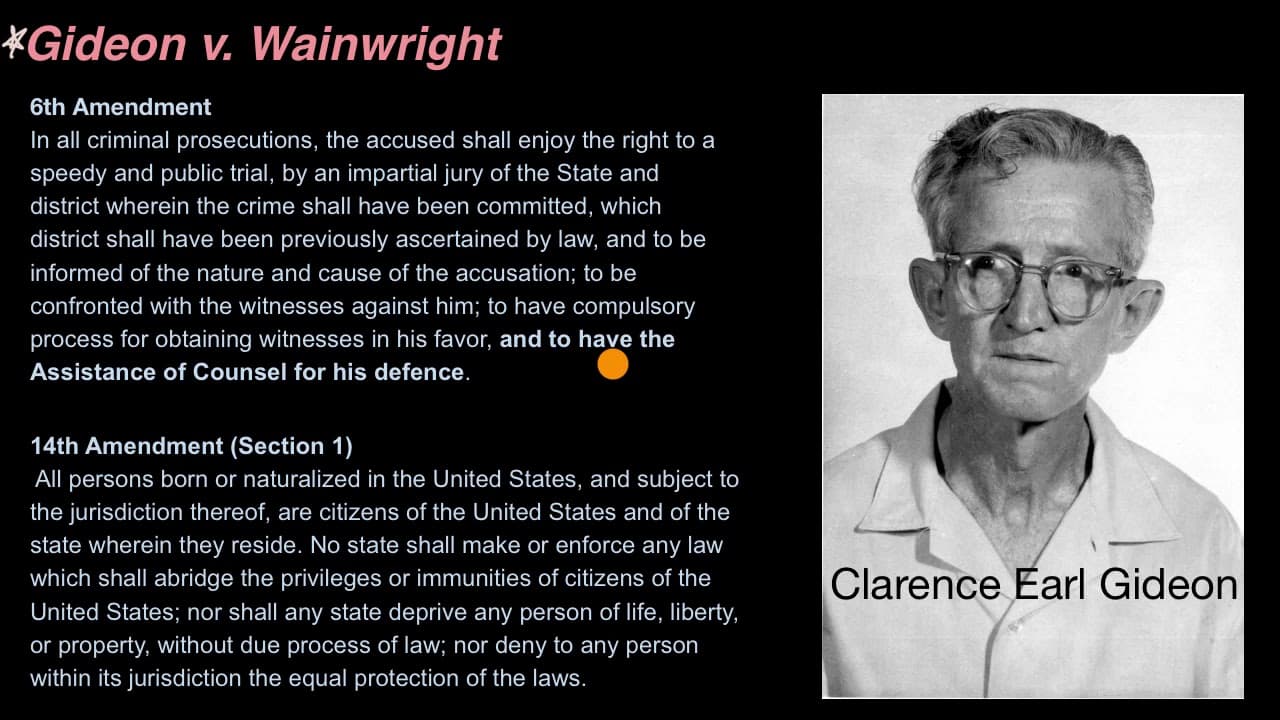
Gideon v. Wainwright is a landmark Supreme Court case that established the right to legal counsel for all accused individuals.
Transcript
- [Instructor] Now we're gonna talk about an important Supreme Court case that reinforced the idea that states have to provide the same rights when people are arrested and accused of a crime, as are guaranteed in the United States Constitution. And that case is Gideon versus Wainwright. So in 1961, you have a gentleman by the name of Clarence Earl ... Read More
Key Insights
- 🇺🇸 Gideon v. Wainwright reinforced the principle that states must provide the same rights in criminal cases as guaranteed by the United States Constitution.
- 🥺 Clarence Gideon's personal determination led to a landmark Supreme Court decision.
- 🗯️ The Sixth Amendment's right to counsel and the 14th Amendment's due process clause played crucial roles in the case.
- 💼 Gideon's case highlighted the importance of equal access to legal representation.
- 🗯️ The Supreme Court's unanimous decision demonstrates the significance placed on safeguarding constitutional rights.
- 🧚 Gideon's retrial showcases the effectiveness of legal counsel in securing a fair trial.
- 👨⚖️ Gideon v. Wainwright impacted criminal justice practice by ensuring legal counsel for all accused individuals.
Install to Summarize YouTube Videos and Get Transcripts
Explore YouTube Video Summarizer or Get YouTube Transcript Extractor
Questions & Answers
Q: What is the significance of Gideon v. Wainwright?
Gideon v. Wainwright established the constitutional right to legal counsel for all individuals accused of a crime, ensuring fair and equal treatment in the criminal justice system.
Q: How did Gideon petition the Supreme Court?
After being rejected by Florida courts, Gideon wrote to the United States Supreme Court, which decided to take his case and provide him with a lawyer.
Q: What was the outcome of Gideon's first trial without a lawyer?
Gideon was found guilty and sentenced to the maximum of five years in prison.
Q: How did the introduction of legal counsel in Gideon's retrial impact the outcome?
Gideon's lawyer thoroughly questioned the witness, creating doubt about his guilt, and the jury ultimately acquitted him after only one hour of deliberation.
Summary & Key Takeaways
-
In 1961, Clarence Gideon was accused of stealing and could not afford a lawyer, but Florida did not provide access to counsel for all cases.
-
Gideon studied the Sixth Amendment and 14th Amendment of the Constitution, arguing that he had a right to legal counsel and due process.
-
Gideon's case went to the Supreme Court, which ruled in his favor, affirming the right to legal counsel for all individuals accused of a crime.
Read in Other Languages (beta)
Share This Summary 📚
Summarize YouTube Videos and Get Video Transcripts with 1-Click
Try YouTube Summary with ChatGPT & Claude or YouTube Transcript Generator
Explore More Summaries from Khan Academy 📚



Summarize YouTube Videos and Get Video Transcripts with 1-Click
Try YouTube Summary with ChatGPT & Claude or YouTube Transcript Generator