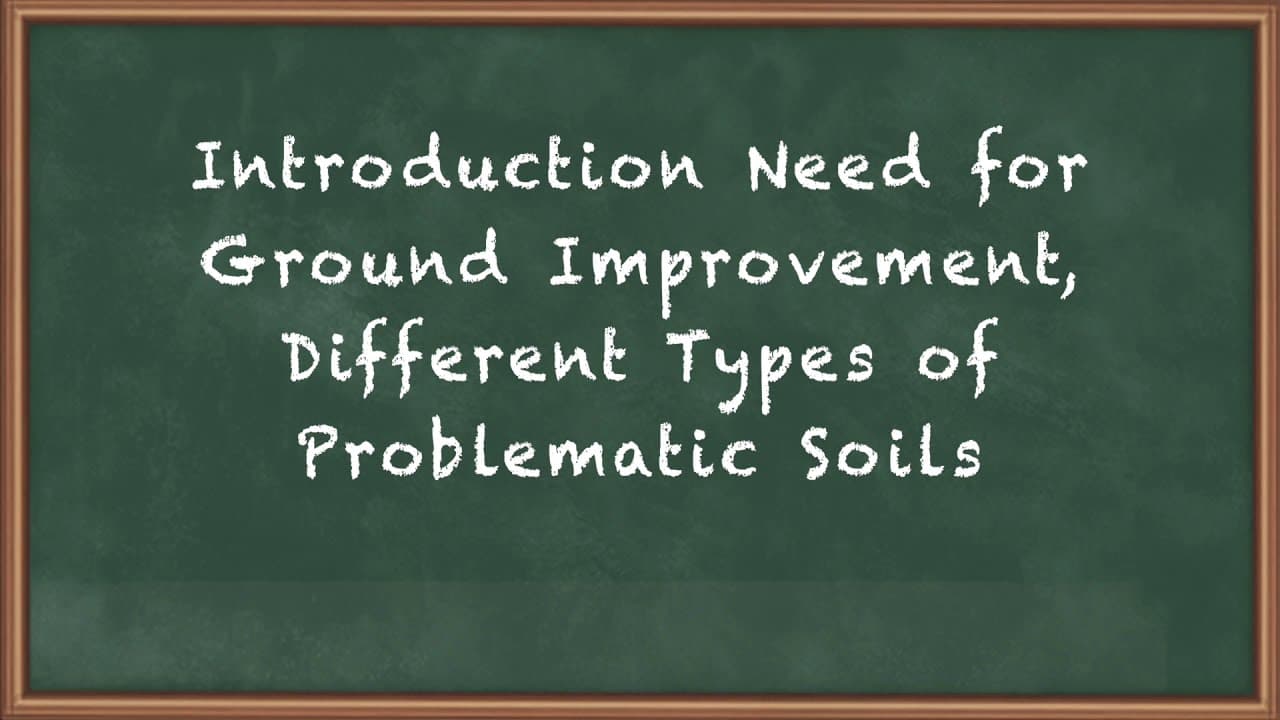
Ground Improvement and Different Types of Problematic Soils - Introduction to Ground Improvement
TL;DR
Ground improvement techniques are used to alter the properties of problematic soil, such as expensive, collapsible, soft, organic, and car deposit soil, in order to improve the soil's bearing capacity, prevent settlement, increase shear strength, density, and permeability, and enable cost-effective foundation design.
Transcript
hello friends so today i'm going to teach you ground improvement technique i'm going to discuss about two topics need for ground improvement and different types of problematic soil so i'm chitra cj taking your ground improvement so let's see the need for ground improvement ground improvement techniques are used when the behavior of the film mass or... Read More
Key Insights
- 🛝 Ground improvement techniques are essential when the behavior of soil does not meet design criteria for supporting structures.
- 😨 Different types of problematic soil, such as expensive, collapsible, soft, organic, and car deposit soil, require specific considerations and techniques for ground improvement.
- 🛝 Ground improvement aims to prevent excessive settlement, improve shear strength, increase soil density, and enhance permeability for better drainage.
- 👷 Designing flexible or rigid structures, removing unstable soil, and modifying existing ground properties are among the alternatives for construction on problematic soil.
Install to Summarize YouTube Videos and Get Transcripts
Explore YouTube Video Summarizer or Get YouTube Transcript Extractor
Questions & Answers
Q: What is the purpose of ground improvement techniques?
Ground improvement techniques are used to alter soil properties, improving bearing capacity, preventing settlement, increasing shear strength, density, and permeability for better drainage.
Q: What are some examples of problematic soil?
Problematic soil types include expensive soil, which expands and shrinks with moisture; collapsible soil, which collapses when saturated; soft soil, which has high water content; organic soil, which has high organic content and low strength; and car deposit soil, formed by soluble rock with low density.
Q: What are the alternatives for constructing on problematic soil?
Alternatives include designing flexible or rigid structures based on the soil type, combining both structures, removing unstable soil and replacing it with stable soil, and modifying the existing ground properties.
Q: How can ground improvement enable cost-effective foundation design?
By modifying soil properties through ground improvement techniques, it becomes possible to design foundations that are more cost-effective without compromising on safety and stability.
Summary & Key Takeaways
-
Ground improvement techniques are necessary when the behavior of the soil does not meet design criteria, requiring alteration of soil properties.
-
The need for ground improvement includes preventing excessive settlement, improving shear strength, increasing soil density, and enhancing soil permeability for better drainage.
-
Different types of problematic soil include expensive soil, collapsible soil, soft soil, organic soil, and car deposit soil, each with unique characteristics and potential damage to structures.
Read in Other Languages (beta)
Share This Summary 📚
Summarize YouTube Videos and Get Video Transcripts with 1-Click
Try YouTube Summary with ChatGPT & Claude or YouTube Transcript Generator
Explore More Summaries from Ekeeda 📚





Summarize YouTube Videos and Get Video Transcripts with 1-Click
Try YouTube Summary with ChatGPT & Claude or YouTube Transcript Generator