Proof of the derivative of sin(x) | Derivatives introduction | AP Calculus AB | Khan Academy
TL;DR
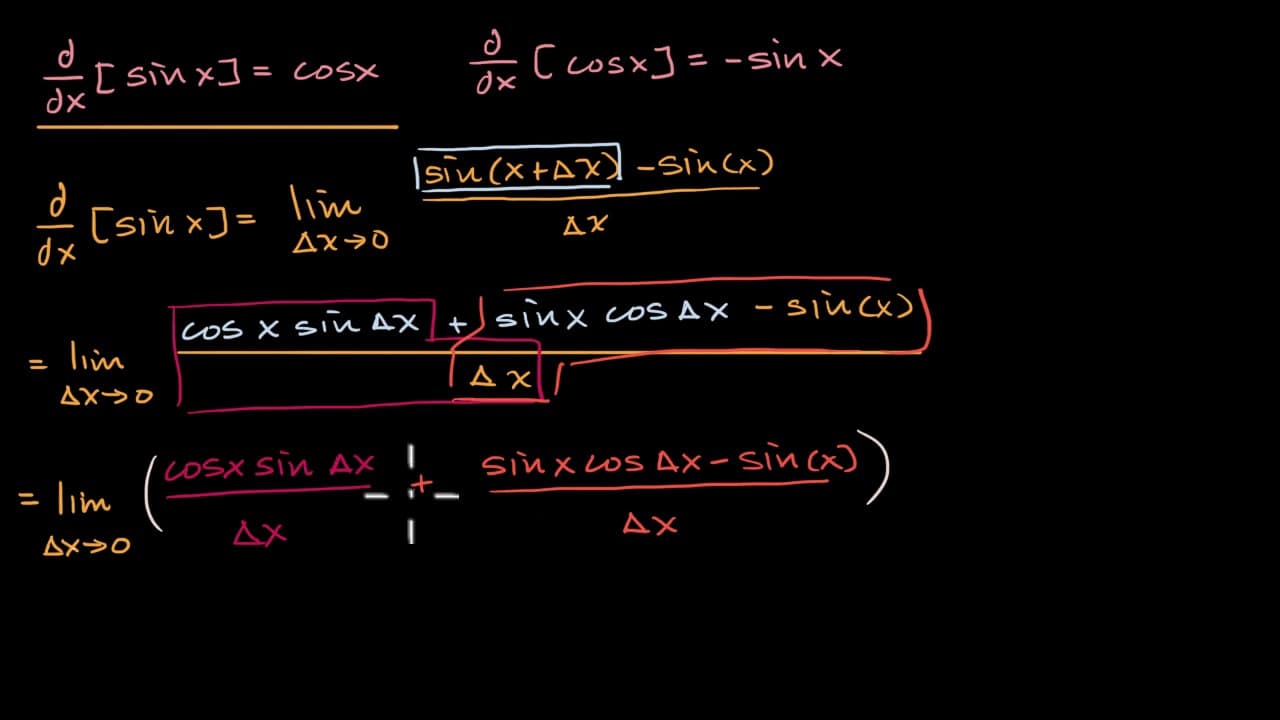
The video explains how to calculate the derivative of a trigonometric function, specifically sine of x, using mathematical rigor.
Transcript
- [Instructor] What we have written here are two of the most useful derivatives to know in calculus. If you know that the derivative of sine of x with respect to x is cosine of x and the derivative of cosine of x with respect to x is negative sine of x, that can empower you to do many more, far more complicated derivatives. But what we're going to ... Read More
Key Insights
- ❓ Understanding the derivation of derivatives enhances the comprehension of calculus concepts.
- 😑 Trigonometric identities, such as the angle addition formulas, play a crucial role in simplifying expressions involving trigonometric functions.
- 💱 The limit as delta x approaches zero is fundamental in determining the rate of change and calculating derivatives.
- ❓ The mathematical proof behind the derivative formulas provides confidence in the accuracy and validity of the equations.
- ☺️ The derivative of sine of x, cosine of x, is a fundamental trigonometric derivative that serves as a building block for more complex derivative calculations.
- 😒 The video mentions the use of other proofs, such as the squeeze theorem or sandwich theorem, to establish the limits involved in the derivative calculation.
- 🎮 The concepts and techniques demonstrated in this video can be applied to other trigonometric functions and their derivatives.
Install to Summarize YouTube Videos and Get Transcripts
Explore YouTube Video Summarizer or Get YouTube Transcript Extractor
Questions & Answers
Q: What is the purpose of proving the derivative of sine of x?
The purpose of proving the derivative of sine of x is to provide a mathematical basis for the formula and ensure that it is not arbitrarily defined. It adds rigor to the concept of derivatives and allows for a better understanding of calculus.
Q: How is the limit used to calculate the derivative?
The limit is used to evaluate the change in the function value (sine of x) divided by the change in the input (delta x). As delta x approaches zero, the slope of the line between two points on the function is determined, which represents the derivative.
Q: How are trigonometric identities applied in the derivation?
Trigonometric identities, specifically the angle addition formulas, are used to rewrite the expression for sine of x plus delta x. By utilizing these identities, the expression can be rearranged to simplify the derivative calculation.
Q: What are the final results of the derivative calculation?
The derivative of sine of x is found to be cosine of x. This result confirms that the rate of change of sine of x is equal to cosine of x.
Summary & Key Takeaways
-
The video discusses the derivation of the first derivative of sine of x using the definition of the derivative and trigonometric identities.
-
The limit as delta x approaches zero is used to evaluate the derivative.
-
By applying the limit and simplifying the expression, the derivative of sine of x is found to be cosine of x.
Read in Other Languages (beta)
Share This Summary 📚
Summarize YouTube Videos and Get Video Transcripts with 1-Click
Try YouTube Summary with ChatGPT & Claude or YouTube Transcript Generator
Explore More Summaries from Khan Academy 📚



Summarize YouTube Videos and Get Video Transcripts with 1-Click
Try YouTube Summary with ChatGPT & Claude or YouTube Transcript Generator