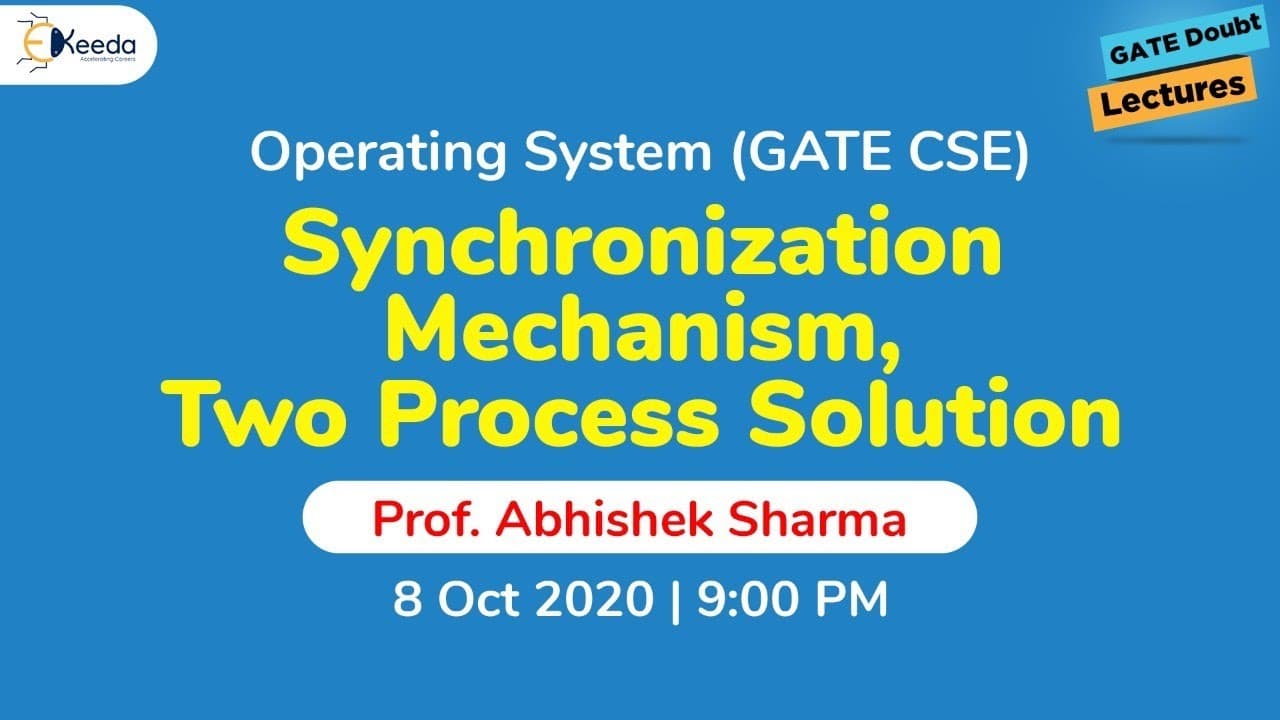
Operating System (GATE CSE) - Synchronization Mechanism, Two Process Solution - 8 Oct, 9 PM
TL;DR
Learn about synchronization problem and Peterson's solution, which involves using shared variables to ensure mutual exclusion between two processes.
Transcript
so so good evening very good evening no no no no no no no issue foreign why not did you send the request on linkedin yeah i did that i did that here can they tell me what you want to move on want me to do what i can help you with tell me well uh am i speaking at all what do you think what i am speaking in well i guess i am speaking in english expla... Read More
Key Insights
- 😒 The first algorithm uses a shared variable to determine which process can execute in its critical section.
- 🎏 The second algorithm addresses the shortcomings of the first by using boolean flags for each process.
- 🥺 Mutual exclusion is achieved in both algorithms, but the second algorithm may lead to a deadlock.
Install to Summarize YouTube Videos and Get Transcripts
Explore YouTube Video Summarizer or Get YouTube Transcript Extractor
Questions & Answers
Q: What is the purpose of the shared variable "turn" in the first algorithm?
The variable "turn" is used to determine which process can enter its critical section. If "turn" is equal to i (the current process), that process is allowed to execute.
Q: How does the second algorithm address the shortcomings of the first algorithm?
The second algorithm uses boolean flags instead of a shared variable. Each process sets its flag to true when it wants to enter the critical section and checks the other process's flag to prevent simultaneous entry.
Q: What happens if both processes set their flags to true simultaneously in the second algorithm?
This can lead to a deadlock situation, where both processes are stuck in a loop waiting for the other's flag to become false. Progress requirement is not met in this case.
Q: How does the second algorithm ensure mutual exclusion between the processes?
Mutual exclusion is achieved by using the while loop to continuously check the other process's flag. If the flag is true, the process waits until the flag becomes false before entering the critical section.
Summary & Key Takeaways
-
The content discusses synchronization problem solutions for two processes named p0 and p1.
-
The first algorithm uses a shared integer variable called "turn" and checks its value to determine which process can execute in its critical section.
-
The second algorithm introduces two boolean flags, one for each process, to indicate if they are ready to enter the critical section.
Read in Other Languages (beta)
Share This Summary 📚
Summarize YouTube Videos and Get Video Transcripts with 1-Click
Try YouTube Summary with ChatGPT & Claude or YouTube Transcript Generator
Explore More Summaries from Ekeeda 📚

Summarize YouTube Videos and Get Video Transcripts with 1-Click
Try YouTube Summary with ChatGPT & Claude or YouTube Transcript Generator