What Is the Law of Conservation of Energy?
TL;DR
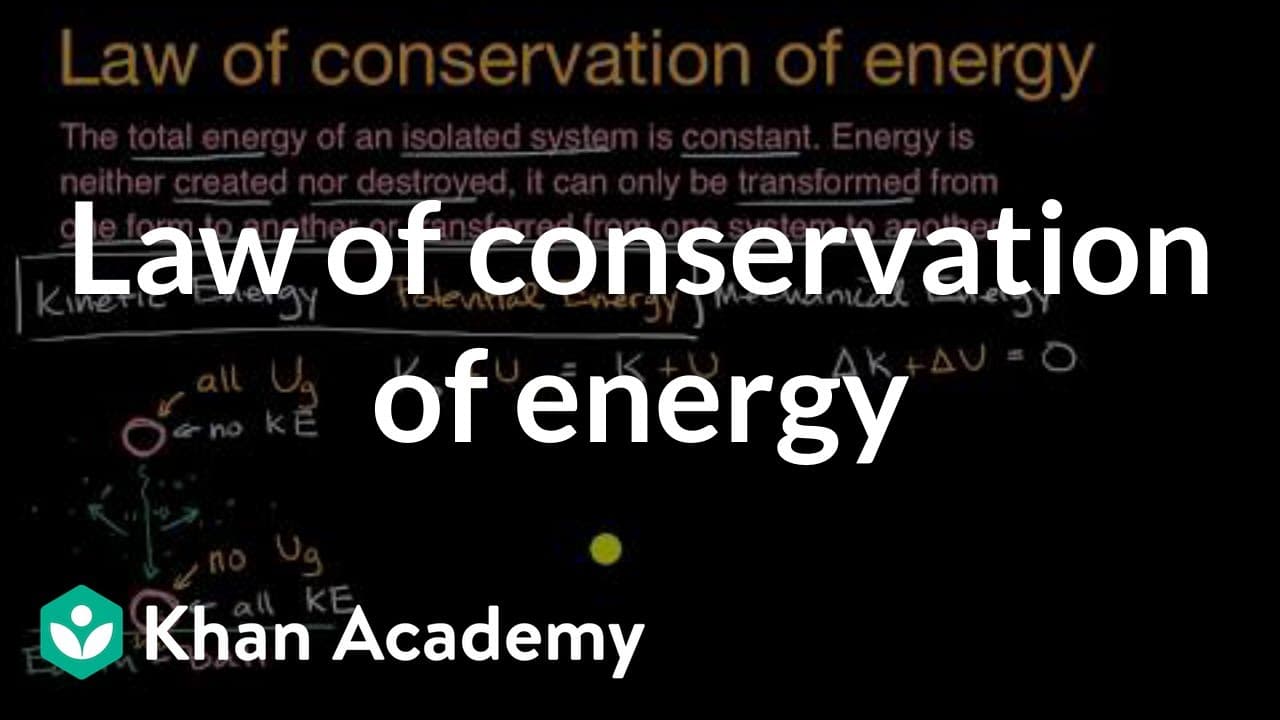
The law of conservation of energy states that energy in an isolated system remains constant and is never created or destroyed, only transformed or transferred. This principle encompasses various energy types, including kinetic, potential, and thermal energy, demonstrating that energy changes forms but the total amount always remains the same.
Transcript
- [Instructor] Get excited because in this video we're going to talk about one of the most important laws in all of science. And that is the law of conservation of energy. You'd be amazed by how much of the universe we can infer based on the law of conservation of energy. And you'll be amazed by how many holes you can poke in science fiction plots ... Read More
Key Insights
- 👮 The law of conservation of energy is one of the most important laws in science and allows us to infer a lot about the universe.
- 💁 Different forms of energy can be transformed or transferred from one to another.
- 👱 Dissipative forces, such as air resistance or friction, result in the conversion of energy into thermal energy.
- 💬 The law of conservation of energy applies to various systems, such as the Earth-ball system and Earth pendulum system.
- 👮 It is essential to specify the system when applying the law of conservation of energy.
- 💦 The equations representing the law of conservation of energy can include non-conservative work done by dissipative forces.
Install to Summarize YouTube Videos and Get Transcripts
Explore YouTube Video Summarizer or Get YouTube Transcript Extractor
Questions & Answers
Q: What is the law of conservation of energy?
The law of conservation of energy states that the total energy of an isolated system remains constant and cannot be created or destroyed but transformed or transferred between different forms.
Q: What are some examples of different forms of energy?
Some examples of different forms of energy include mechanical energy (kinetic and potential energy), thermal energy, nuclear energy, and chemical energy.
Q: How does the law of conservation of energy apply when a ball falls to the ground?
When a ball falls to the ground, its potential energy is converted into kinetic energy. Any dissipation of energy, such as through air resistance or friction, results in the generation of thermal energy.
Q: Can the law of conservation of energy be violated?
No, the law of conservation of energy cannot be violated. Energy can only be transformed or transferred between different forms, but it is never created or destroyed.
Summary & Key Takeaways
-
The law of conservation of energy states that the total energy of an isolated system remains constant and cannot be created or destroyed, only transformed or transferred.
-
Mechanical energy, which includes kinetic and potential energy, is often studied in physics, but there are also other forms of energy such as thermal, nuclear, and chemical energy.
-
When a ball falls to the ground, its potential energy is converted into kinetic energy, and any dissipation of energy, such as through air resistance or friction, results in the generation of thermal energy.
Read in Other Languages (beta)
Share This Summary 📚
Summarize YouTube Videos and Get Video Transcripts with 1-Click
Try YouTube Summary with ChatGPT & Claude or YouTube Transcript Generator
Explore More Summaries from Khan Academy 📚



Summarize YouTube Videos and Get Video Transcripts with 1-Click
Try YouTube Summary with ChatGPT & Claude or YouTube Transcript Generator