Mayans and Teotihuacan | World History | Khan Academy
TL;DR
The Mayan civilization was long-lasting, advanced in areas such as mathematics and writing, had powerful city-states, practiced human sacrifice, and was influenced by Teotihuacan before its decline.
Transcript
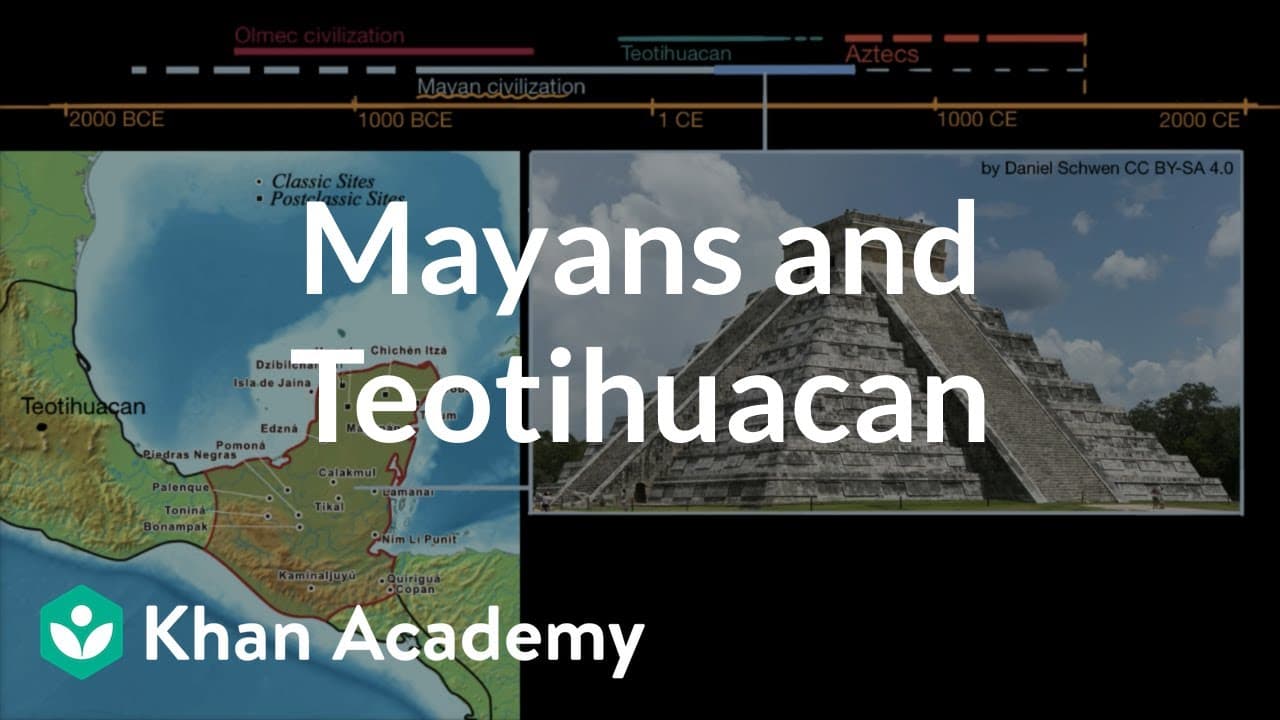
- [Instructor] The Mayan civilization is one of the most long-lasting civilizations, not just in the ancient Americas, but in the world in general. You can see the rough outline here on this map of where the Mayan civilization occurred. You can see it has the Yucatan Peninsula in the north, the Sierra Madre Mountains in the south, and it covers reg... Read More
Key Insights
- 🌍 The Mayan civilization was one of the most long-lasting and advanced civilizations in the world.
- ✍️ Their achievements in mathematics, writing, and calendrics demonstrate their cultural sophistication.
- 🏙️ The Mayan civilization consisted of powerful city-states, with Tikal and Calakmul among the largest and most influential.
- 🏙️ Teotihuacan exerted significant influence over the Mayans, although debates continue regarding the nature of Teotihuacan's relationship with other city-states.
- 🧑🏭 Both Teotihuacan and the Mayan civilization eventually experienced decline, possibly due to internal factors such as drought and famine.
- 🏛️ The Mayan civilization lasted beyond its classical period and had successor states, including the Aztecs.
Install to Summarize YouTube Videos and Get Transcripts
Explore YouTube Video Summarizer or Get YouTube Transcript Extractor
Questions & Answers
Q: What were the main cultural advancements of the Mayan civilization?
The Mayans developed a sophisticated numeral system with place value, a form of writing, and an accurate calendar, which were all significant cultural advancements for their time.
Q: Were the Mayan city-states unified under one empire?
No, the Mayan civilization was more similar to the Greek city-states, with each city-state having its own ruler. Some cities, like Tikal and Calakmul, had more influence over others, but there was no unified empire.
Q: How large were the Mayan cities at their peak?
Cities like Tikal and Calakmul had populations ranging from 50,000 to 100,000 people, making them significant urban centers for their time.
Q: What led to the fall of Teotihuacan and the Mayan civilization?
Teotihuacan likely fell due to internal factors, possibly including drought and famine. The Mayan civilization also experienced similar challenges, leading to uprisings and division.
Summary & Key Takeaways
-
The Mayan civilization existed from around 2000 B.C.E to the 800s and covered modern-day Mexico, Guatemala, Belize, western Honduras, and El Salvador.
-
They developed a sophisticated numeral system with place value, a form of writing, and a highly accurate calendar.
-
The civilization consisted of powerful city-states, with influences from Teotihuacan, and practiced human sacrifice.
Read in Other Languages (beta)
Share This Summary 📚
Summarize YouTube Videos and Get Video Transcripts with 1-Click
Try YouTube Summary with ChatGPT & Claude or YouTube Transcript Generator
Explore More Summaries from Khan Academy 📚



Summarize YouTube Videos and Get Video Transcripts with 1-Click
Try YouTube Summary with ChatGPT & Claude or YouTube Transcript Generator