Why underdogs do better in hockey than basketball
TL;DR
Hockey outcomes are more influenced by luck than basketball.
Transcript
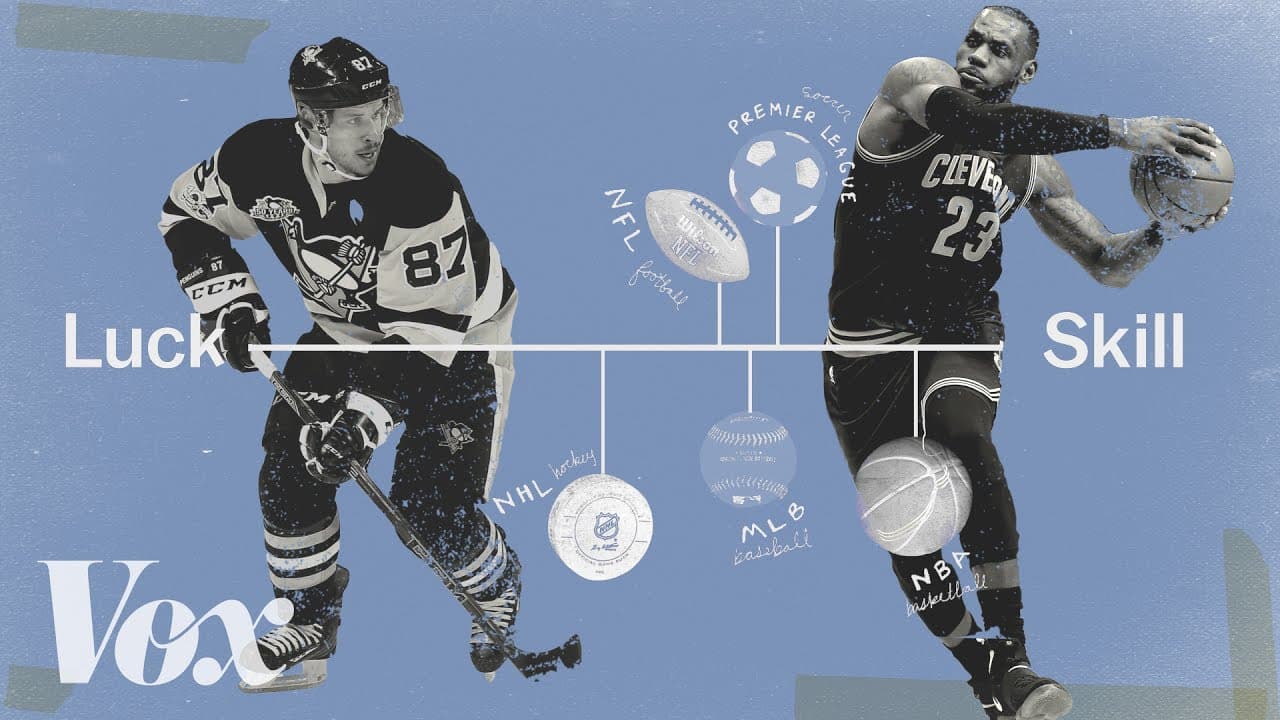
If you were to put sports and games on a continuum, where the outcomes reflect pure skill on the right side, and pure luck on the left side, where would the big team sports go? Somewhere in the middle right? But in what order? There’s actually a way to estimate that using statistics, and this is where they end up. “What you find is the NBA is the s... Read More
Key Insights
- Michael Mauboussin's study places NBA as the sport most influenced by skill, while NHL hockey is closest to being influenced by luck.
- Sample size, or the number of games in a season, affects how much skill is reflected in the standings; more games allow skill to emerge more clearly.
- Basketball's frequent scoring opportunities during games allow skill to be more apparent, unlike hockey where scoring is more fluid and less predictable.
- In team sports, the number of players and their interaction dynamics influence how much skill affects outcomes, with fewer players allowing skill to dominate more.
- Basketball rewards extreme physical attributes like height, which increases variance in skill levels and allows skill to assert itself more.
- In sports like tennis or swimming, individual performance is directly linked to outcomes, making skill a more significant factor than in team sports.
- Mauboussin uses a statistical method involving variance to determine the influence of skill and luck, comparing real-world results to hypothetical all-luck scenarios.
- The playoffs in some sports, like baseball, may not always ensure the best team wins, raising questions about what fans value in sports outcomes.
Install to Summarize YouTube Videos and Get Transcripts
Explore YouTube Video Summarizer or Get YouTube Transcript Extractor
Questions & Answers
Q: How does the sample size affect the influence of skill in sports?
The sample size, or the number of games played in a season, significantly affects the influence of skill in sports. More games allow for skill to emerge more clearly from the noise, as seen in sports like Major League Baseball with 162 games. Conversely, sports with fewer games, like the NFL with 16, have outcomes more influenced by luck due to the smaller sample size.
Q: Why does basketball have more apparent skill influence compared to hockey?
Basketball has more apparent skill influence due to its frequent scoring opportunities and structured play, with a shot clock forcing teams to take many shots. This creates numerous chances for skill to manifest. In contrast, hockey's fluid and less predictable nature, with no clear possession measurement, allows for more randomness, making luck a bigger factor.
Q: What role do player dynamics play in influencing sports outcomes?
Player dynamics, including the number of players and how they interact during games, play a crucial role in influencing sports outcomes. In individual sports, skill is directly linked to outcomes. However, in team sports, the distribution of possession and player involvement can dilute the impact of skill, as seen in hockey where even the best players need rest, limiting their influence.
Q: How do physical attributes affect skill variance in sports like basketball?
Physical attributes, such as height in basketball, affect skill variance by creating a smaller, more specialized talent pool. This leads to greater variance in skill levels because players with extreme physical traits, like height, may vary significantly in skill. Consequently, skill tends to assert itself more in basketball, as seen with tall players who might be less skilled still making it to the NBA.
Q: How does Mauboussin's statistical method assess skill and luck in sports?
Mauboussin's statistical method assesses skill and luck by comparing the variance of real-world sports outcomes to a hypothetical all-luck scenario. By calculating the variance of win-loss records and estimating the variance of luck, he determines the contribution of skill. This approach highlights how different sports balance skill and luck in their outcomes, providing insights into their nature.
Q: Why might baseball playoffs not ensure the best team wins?
Baseball playoffs might not ensure the best team wins because of the inherent randomness and variance in short series. Unlike the regular season, where skill can emerge over many games, playoffs are shorter, increasing the influence of luck. This randomness can lead to less predictable outcomes, where even less skilled teams might prevail due to the small sample size of games.
Q: What questions does the analysis raise about sports outcomes and fan preferences?
The analysis raises questions about whether fans prefer sports outcomes that measure skill as precisely as possible or those that offer excitement through unpredictability. It challenges the notion of what makes sports engaging, suggesting that the highs and lows, influenced by both skill and luck, contribute to the enjoyment and emotional investment of fans, reflecting the human condition.
Q: How do individual sports differ from team sports in terms of skill influence?
Individual sports differ from team sports in terms of skill influence by providing a direct link between an athlete's performance and the outcome. In sports like tennis or swimming, there are no team dynamics or shared possession, allowing skill to dominate. This contrasts with team sports, where interactions between players and strategic decisions can dilute the impact of individual skill on results.
Summary & Key Takeaways
-
Michael Mauboussin's research places sports on a skill-luck continuum, showing that NBA outcomes reflect skill more than other sports, while NHL hockey outcomes are more influenced by luck. The study uses statistical methods to assess how much skill and luck contribute to season standings in various sports.
-
Sample size, scoring opportunities, player dynamics, and physical attributes all contribute to how much skill or luck influences sports outcomes. Basketball's frequent scoring and physical demands highlight skill, whereas hockey's fluidity and randomness make luck a more significant factor.
-
Mauboussin's statistical approach compares real-world sports outcomes to hypothetical all-luck scenarios, revealing the extent of skill's influence. The analysis questions whether fans prefer precise skill measurement or the excitement of unpredictable outcomes in sports.
Read in Other Languages (beta)
Share This Summary 📚
Summarize YouTube Videos and Get Video Transcripts with 1-Click
Try YouTube Summary with ChatGPT & Claude or YouTube Transcript Generator
Explore More Summaries from Vox 📚




Summarize YouTube Videos and Get Video Transcripts with 1-Click
Try YouTube Summary with ChatGPT & Claude or YouTube Transcript Generator