Making line plots | Measurement and data | Early Math | Khan Academy
TL;DR
A fun video tutorial demonstrating how to create line plots using various examples, such as fairy wands, penguin heights, book heights, and arrow lengths.
Transcript
- Create a picture graph to show how many wands each fairy owns. So Glenda owns two wands, Tink owns three wands, Merry owns four wands, and Gracie owns five wands. And in our picture graph, each picture of a wand represents one wand, it is equal to one wand, it means one wand. All right, so Glenda has two wands. So let's see, I'll click one, two w... Read More
Key Insights
- 🖼️ Picture graphs can be used to represent data visually, making it easier to understand and analyze.
- 🫥 Line plots are a simple and effective way to display data and identify patterns or trends.
- 🫥 Line plots help in comparing the frequency of different measurements in a data set.
- 🫥 By creating line plots, it becomes easier to interpret and draw conclusions from the given data.
- 🫥 Line plots are a valuable tool in mathematical analysis, especially in statistics and data representation.
- 🫥 Line plots provide a clear visualization of the distribution of data.
- 🫥 Line plots can be used to track changes or progress over time.
Install to Summarize YouTube Videos and Get Transcripts
Explore YouTube Video Summarizer or Get YouTube Transcript Extractor
Questions & Answers
Q: How do you create a line plot?
To create a line plot, you need a number line. Then, for each data point, put a dot above the corresponding measurement on the number line.
Q: What does each dot represent on a line plot?
Each dot on a line plot represents one data point. It shows how many times a specific measurement appears in the data set.
Q: How do you interpret a line plot?
To interpret a line plot, look at the number of dots at each measurement. The higher the number of dots, the more frequently that measurement appears in the data set.
Q: Can line plots be created for different types of data?
Yes, line plots can be created for any type of data that can be measured or counted, such as heights, lengths, quantities, or frequencies.
Summary & Key Takeaways
-
The video starts by creating a picture graph to represent the number of wands each fairy owns: Glenda has 2 wands, Tink has 3 wands, Merry has 4 wands, and Gracie has 5 wands.
-
Next, the video demonstrates how to create a line plot of the heights of four penguins: 40 cm, 44 cm, 48 cm, and 48 cm.
-
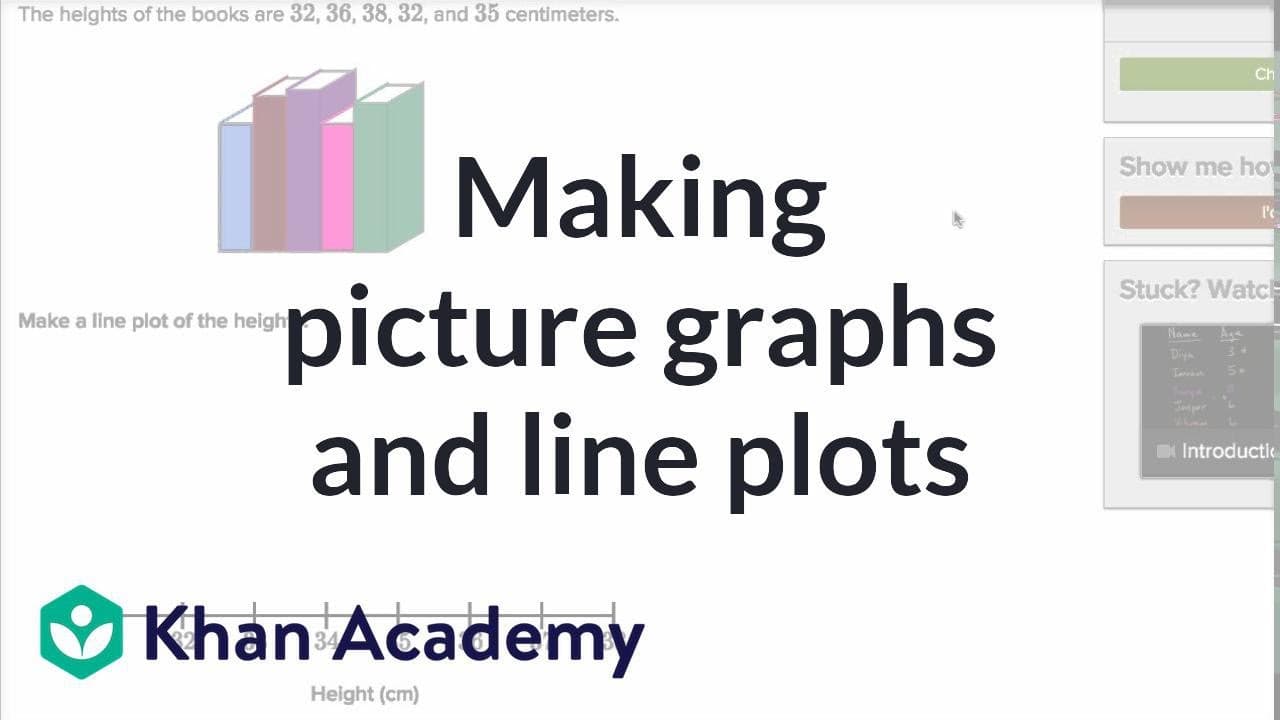
The video then shows how to make a line plot of the heights of five books: 32 cm, 36 cm, 38 cm, 32 cm, and 35 cm.
-
Finally, the video teaches how to create a line plot of the lengths of four arrows: 26 cm, 26 cm, 23 cm, and 25 cm.
Read in Other Languages (beta)
Share This Summary 📚
Summarize YouTube Videos and Get Video Transcripts with 1-Click
Try YouTube Summary with ChatGPT & Claude or YouTube Transcript Generator
Explore More Summaries from Khan Academy 📚



Summarize YouTube Videos and Get Video Transcripts with 1-Click
Try YouTube Summary with ChatGPT & Claude or YouTube Transcript Generator