Products
Features
YouTube Video Summarizer
Summarize YouTube videos
Web & PDF Highlighter
Highlight web pages & PDFs
Chat with PDF
Ask any PDF questions with AI
Ask AI Clone
Chat with your highlights & memories
Audio Transcriber
Transcribe audio files to text
Glasp Reader
Read and highlight articles
Kindle Highlight Export
Export your Kindle highlights
Idea Hatch
Hatch ideas from your highlights
Integrations
Obsidian Plugin
Notion Integration
Pocket Integration
Instapaper Integration
Medium Integration
Readwise Integration
Snipd Integration
Hypothesis Integration
Apps & Extensions
Chrome Extension
Safari Extension
Edge Add-ons
Firefox Add-ons
iOS App
Android App
Discover
Discover
Ideas
Discover new ideas and insights
Articles
Curated articles and insights
Books
Book recommendations by great minds
Posts
Essays and notes from readers
Quotes
Inspiring quotes collection
Videos
Curated videos and summaries
Explore Glasp
Glasp Newsletter
Weekly insights and updates
Glasp Talk
Interview series with great minds
Glasp Blog
Latest news and articles
Glasp Use Cases
Learn how others use Glasp
Build & Support
Glasp API
Access Glasp's API for developers
MCP Connector
Connect Glasp to Claude & ChatGPT
Community
Glasp Reddit Community
Students
Student discount and benefits
FAQs
Frequently Asked Questions
AboutPricing
DashboardLog inSign up

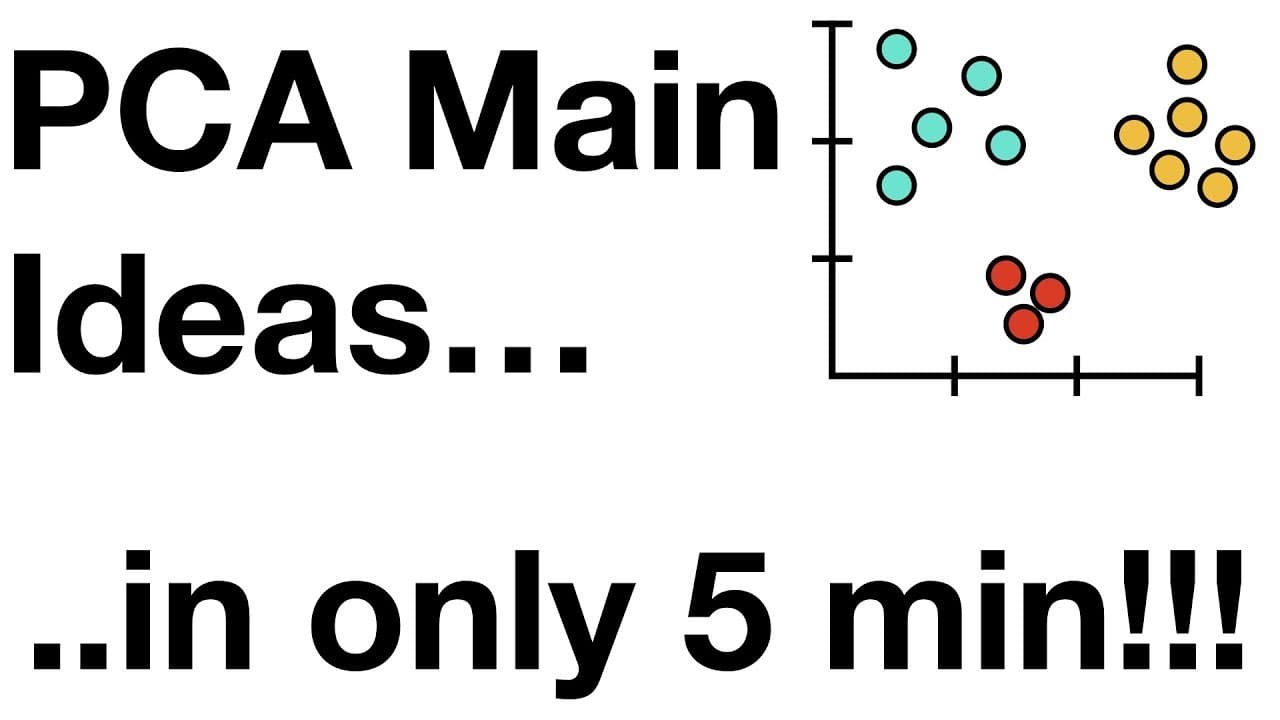
StatQuest: PCA main ideas in only 5 minutes!!!
1.2M views
•
December 4, 2017
by
StatQuest with Josh Starmer
YouTube video player
StatQuest: PCA main ideas in only 5 minutes!!!

TL;DR

Learn about Principal Component Analysis (PCA) in 5 minutes for data dimension reduction and interpretation.

Transcript

that quest is the best if you don't think so then we have different opinions hello I'm Josh stommer and welcome to stat quest today we're gonna be talking about the main ideas behind principle component analysis and we're going to cover those concepts in five minutes if you want more details than you get here be sure to check out my other PCA video... Read More

Key Insights

  • ✋ PCA helps visualize and interpret high-dimensional data quickly.
  • 😥 It identifies clusters of similar data points in a 2D graph.
  • 😜 The importance of differences in data is ranked by principal components.
  • ❓ PCA is one method among others for data dimension reduction and analysis.
  • ❓ Understanding PCA can reveal patterns and relationships in complex datasets.
  • 😥 Interpretation of PCA plots helps differentiate between distinct groups of data points.
  • 😜 Axis ranking in PCA plots reflects the variance explained by each component.

Install to Summarize YouTube Videos and Get Transcripts

Explore YouTube Video Summarizer or Get YouTube Transcript Extractor

Questions & Answers

Q: What is the main purpose of Principal Component Analysis (PCA)?

PCA is used to reduce high-dimensional data into lower dimensions for easier visualization and interpretation, helping identify patterns and relationships within the data.

Q: How does PCA help in identifying different types of cells or entities in data?

PCA plots data points based on similarities, forming clusters that represent distinct groups or categories, making it easier to differentiate between different types of entities.

Q: How are the axes in a PCA plot ranked in terms of importance?

The axes in a PCA plot are ranked by the amount of variance they explain in the data, with the first principal component (PC1) capturing the most significant variation followed by PC2, and so on.

Q: What are some other methods similar to PCA for data dimension reduction?

Other methods like heat maps, t-SNE plots, and multiple dimension scaling plots are variations of PCA used for dimension reduction and data analysis.

Summary & Key Takeaways

  • PCA helps identify differences in data by converting correlations into a 2D graph.

  • It reduces data dimensions for easy visualization and interpretation.

  • PCA plots show clusters of data points with similar characteristics.


Read in Other Languages (beta)

English

Share This Summary 📚

Summarize YouTube Videos and Get Video Transcripts with 1-Click

Download browser extensions on:

Try YouTube Summary with ChatGPT & Claude or YouTube Transcript Generator

Explore More Summaries from StatQuest with Josh Starmer 📚
Gradient Boost Part 2 (of 4): Regression Details thumbnail
Gradient Boost Part 2 (of 4): Regression Details
StatQuest with Josh Starmer
CatBoost Part 2: Building and Using Trees thumbnail
CatBoost Part 2: Building and Using Trees
StatQuest with Josh Starmer
ROC and AUC, Clearly Explained! thumbnail
ROC and AUC, Clearly Explained!
StatQuest with Josh Starmer
How Does the ReLU Activation Function Work in Neural Networks? thumbnail
How Does the ReLU Activation Function Work in Neural Networks?
StatQuest with Josh Starmer
What Is K-Means Clustering and How Does It Work? thumbnail
What Is K-Means Clustering and How Does It Work?
StatQuest with Josh Starmer
Regularization Part 3: Elastic Net Regression thumbnail
Regularization Part 3: Elastic Net Regression
StatQuest with Josh Starmer

Summarize YouTube Videos and Get Video Transcripts with 1-Click

Download browser extensions on:

Try YouTube Summary with ChatGPT & Claude or YouTube Transcript Generator

Apps & Extensions

  • Chrome Extension
  • Safari Extension
  • Edge Add-ons
  • Firefox Add-ons
  • iOS App
  • Android App

Key Features

  • YouTube Video Summarizer
  • Web & PDF Summarizer
  • Web & PDF Highlighter
  • Chat with PDF
  • Ask AI Clone
  • Audio Transcriber
  • Glasp Reader
  • Kindle Highlight Export
  • Idea Hatch

Integrations

  • Obsidian Plugin
  • Notion Integration
  • Pocket Integration
  • Instapaper Integration
  • Medium Integration
  • Readwise Integration
  • Snipd Integration
  • Hypothesis Integration

More Features

  • APIs
  • MCP Connector
  • Blog & Post
  • Embed Links
  • Image Highlight
  • Personality Test
  • Quote Shots

Company

  • About us
  • Blog
  • Community
  • FAQs
  • Job Board
  • Newsletter
  • Pricing
Terms

•

Privacy

•

Guidelines

© 2026 Glasp Inc. All rights reserved.