How to Convert Between Moles, Atoms, and Molecules
TL;DR
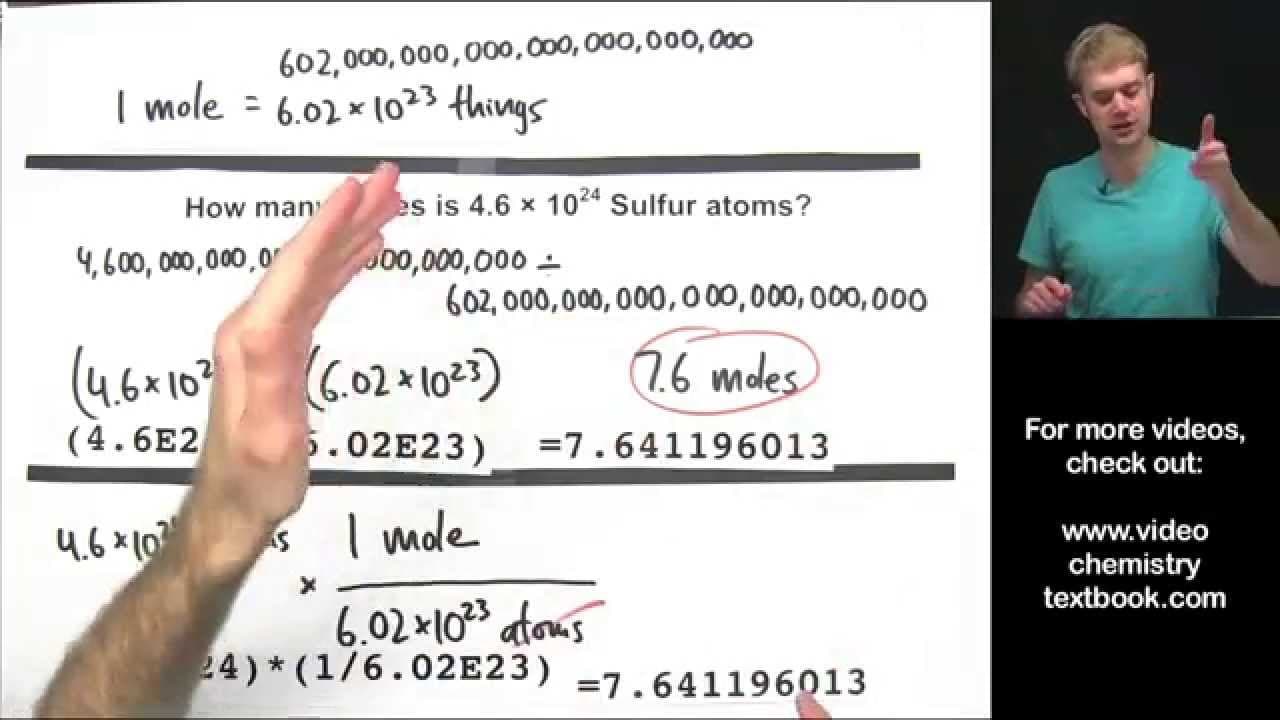
To convert between moles and atoms, multiply the number of moles by Avogadro's number (6.02 x 10^23). For the reverse conversion, divide the number of atoms by Avogadro's number to find the number of moles. Using scientific notation and significant figures is essential for accuracy in these calculations.
Transcript
In this video, we're going to learn how to convert back and forth between moles and the number of atoms or molecules we have. Now when we do conversions like this, atoms and molecules are sometimes both referred to as particles. A particle is just a word for any individual thing so a particle could be a jellybean or a coin or a paperclip or an atom... Read More
Key Insights
- 🫀 Atoms and molecules are referred to as particles, and they can be converted to moles using Avogadro's number.
- 🫀 When converting moles to atoms, multiply the moles by Avogadro's number to get the total number of atoms.
- 🌥️ Scientific notation is useful for managing large numbers in mole calculations.
- 🫀 Conversion factors can be used to cancel out units and convert between moles and atoms/molecules.
- 🛝 Rounding final answers in mole calculations is based on significant figures.
- 😒 The video provides alternative approaches to mole conversions, including a straightforward method and the use of conversion factors.
- ☺️ Avogadro's number (6.02 x 10^23) is a crucial constant in mole calculations.
Install to Summarize YouTube Videos and Get Transcripts
Explore YouTube Video Summarizer or Get YouTube Transcript Extractor
Questions & Answers
Q: How can we convert moles to atoms using a straightforward method?
To convert moles to atoms, multiply the number of moles by Avogadro's number (6.02 x 10^23). This gives you the total number of atoms in the given moles.
Q: What is the significance of using scientific notation in mole-to-atom conversions?
Scientific notation helps manage the large numbers involved in mole calculations. It simplifies lengthy numbers by representing them as a coefficient multiplied by a power of 10, making calculations easier.
Q: How do you round the final answer in mole-to-atom conversions?
Round the final answer based on the significant figures in the given quantity. Determine the number of significant figures in each term, and round the final answer to match the lowest number of significant figures.
Q: What are conversion factors, and how do they relate to mole conversions?
Conversion factors are ratios derived from chemical equations or relationships between different units. In mole conversions, conversion factors are used to cancel out units, allowing for a direct conversion between moles and atoms/molecules.
Summary & Key Takeaways
-
The video teaches how to convert between moles and atoms or molecules using a simple, intuitive method as well as conversion factors.
-
It explains the concept of moles and their similarity to dozens, and introduces Avogadro's number (6.02 x 10^23) as the number of things in one mole.
-
The video provides step-by-step instructions on how to perform the calculations using scientific notation and significant figures.
Read in Other Languages (beta)
Share This Summary 📚
Summarize YouTube Videos and Get Video Transcripts with 1-Click
Try YouTube Summary with ChatGPT & Claude or YouTube Transcript Generator
Explore More Summaries from Tyler DeWitt 📚

Summarize YouTube Videos and Get Video Transcripts with 1-Click
Try YouTube Summary with ChatGPT & Claude or YouTube Transcript Generator