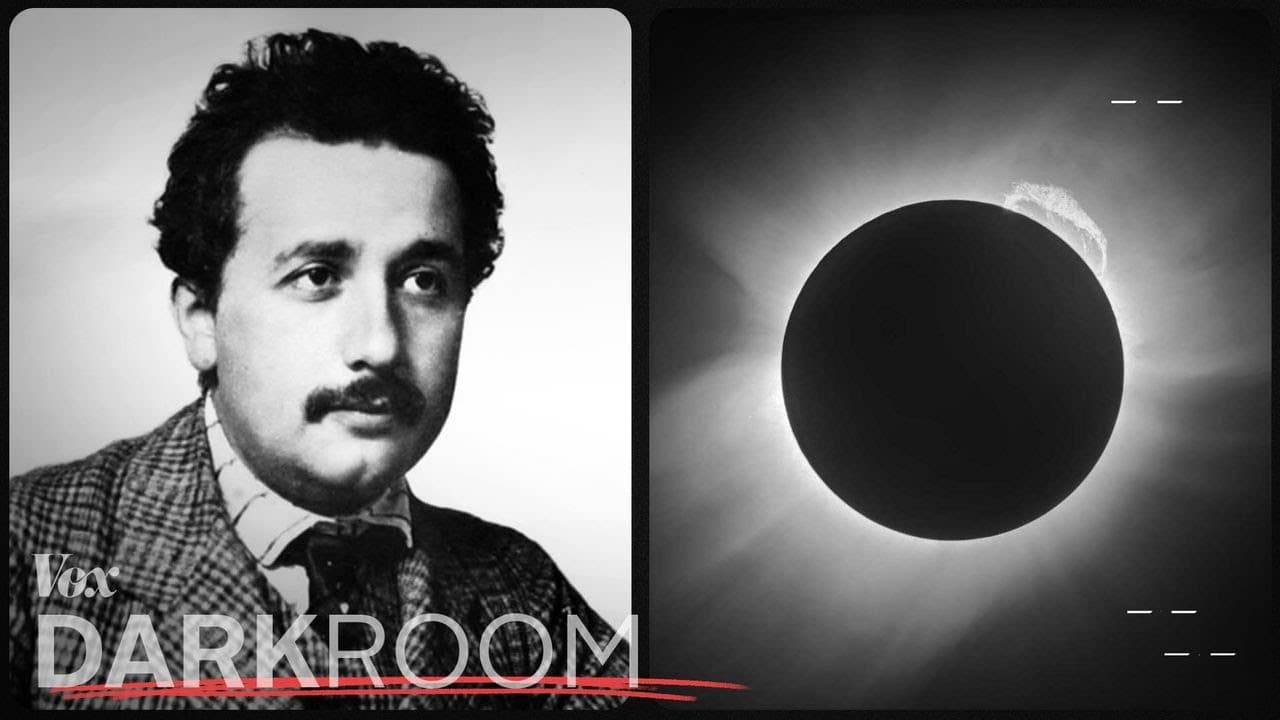
The eclipse photo that made Einstein famous
TL;DR
1919 eclipse photo validated Einstein's theory, redefining gravity.
Transcript
There’s only one way to see the stars while the sun is out. And that’s during a total solar eclipse. You have to be at right place at the right time. Under a clear sky. Standing somewhere along the narrow path where the moon aligns perfectly between the sun and the Earth. When the moon passes in front of the sun's disc, it darkens the sky just enou... Read More
Key Insights
- Einstein's general relativity redefined gravity as the curvature of space by massive objects, contrasting Newton's force-based view.
- The 1919 solar eclipse provided a unique opportunity to test Einstein's theory by observing starlight deflection.
- Arthur Eddington's expeditions to Principe and Brazil aimed to photograph star positions during the eclipse.
- The experiment showed that starlight deflected by the sun's gravity matched Einstein's predictions more closely than Newton's.
- The successful validation of general relativity elevated Einstein to international fame and changed our understanding of the universe.
- Post-1919, general relativity became a cornerstone for understanding complex cosmic phenomena, like black holes.
- Eddington's work demonstrated scientific collaboration across national boundaries even during post-war tensions.
- The 1919 eclipse experiment was a pivotal moment in astrophysics, influencing future research and technological advancements.
Install to Summarize YouTube Videos and Get Transcripts
Explore YouTube Video Summarizer or Get YouTube Transcript Extractor
Questions & Answers
Q: What was the significance of the 1919 solar eclipse in testing Einstein's theory?
The 1919 solar eclipse was significant because it provided a rare opportunity to test Einstein's theory of general relativity. During the eclipse, the sun's position allowed for the observation of starlight deflection, a key prediction of Einstein's theory. Arthur Eddington's expeditions captured photographs that demonstrated this deflection, confirming Einstein's revolutionary ideas about gravity.
Q: How did Einstein's view of gravity differ from Newton's?
Einstein's view of gravity, as described in his theory of general relativity, differed from Newton's in that it defined gravity not as a force but as the curvature of space caused by massive objects. This curvature affects the paths of objects and light, leading to phenomena like starlight deflection, which was observed during the 1919 solar eclipse, validating Einstein's theory over Newton's.
Q: What role did Arthur Eddington play in proving Einstein's theory?
Arthur Eddington played a crucial role in proving Einstein's theory of general relativity by organizing expeditions to observe the 1919 solar eclipse. His team photographed the positions of stars during the eclipse, showing their apparent shift due to the sun's gravitational influence. This evidence supported Einstein's predictions and helped validate his revolutionary ideas about gravity.
Q: Why was the 1919 eclipse experiment considered a pivotal moment in astrophysics?
The 1919 eclipse experiment was pivotal in astrophysics because it provided empirical evidence for Einstein's theory of general relativity, fundamentally changing our understanding of gravity and the universe. By demonstrating the deflection of starlight by the sun's gravity, the experiment confirmed that massive objects can curve space, influencing future research and technological advancements in the field.
Q: What impact did the validation of general relativity have on Einstein's career?
The validation of general relativity had a profound impact on Einstein's career, catapulting him from relative obscurity to international fame. The success of the 1919 eclipse experiment confirmed his revolutionary ideas about gravity, making him a household name and a pop culture icon. This recognition solidified his status as one of the most influential physicists in history.
Q: How did Eddington's work demonstrate scientific collaboration across national boundaries?
Eddington's work demonstrated scientific collaboration across national boundaries by conducting the 1919 eclipse experiment during a time of post-war tensions. Despite being from Britain, Eddington worked to prove the ideas of a German scientist, Einstein, highlighting the importance of scientific cooperation and the pursuit of knowledge beyond political and national differences.
Q: What advancements in astrophysics were influenced by the confirmation of general relativity?
The confirmation of general relativity influenced numerous advancements in astrophysics, including the understanding of black holes, gravitational waves, and the expansion of the universe. Einstein's theory provided a new framework for studying cosmic phenomena, leading to technological innovations and deeper insights into the fundamental nature of space, time, and gravity.
Q: Why was the 1919 eclipse experiment a turning point in the study of gravity?
The 1919 eclipse experiment was a turning point in the study of gravity because it provided the first empirical evidence supporting Einstein's theory of general relativity. By demonstrating that massive objects curve space and affect light paths, the experiment challenged Newton's long-standing view of gravity as a force, leading to a paradigm shift in our understanding of the cosmos.
Summary & Key Takeaways
-
In 1919, a solar eclipse allowed for the testing of Einstein's general relativity, which redefined gravity as a curvature of space. Arthur Eddington's expeditions captured photos showing starlight deflection, supporting Einstein's theory over Newton's. This success catapulted Einstein to fame and transformed our understanding of the universe.
-
Einstein's theory of general relativity, published in 1915, proposed that massive objects curve space, affecting the path of light. The 1919 eclipse provided evidence for this theory, as starlight appeared shifted due to the sun's gravity. Eddington's findings confirmed Einstein's predictions, marking a turning point in astrophysics.
-
The 1919 eclipse experiment, led by Eddington, was crucial in proving Einstein's revolutionary view of gravity. By photographing star positions during the eclipse, the experiment showed light bending near the sun, validating general relativity. Einstein's newfound fame highlighted the global impact of this scientific breakthrough.
Read in Other Languages (beta)
Share This Summary 📚
Summarize YouTube Videos and Get Video Transcripts with 1-Click
Try YouTube Summary with ChatGPT & Claude or YouTube Transcript Generator
Explore More Summaries from Vox 📚



Summarize YouTube Videos and Get Video Transcripts with 1-Click
Try YouTube Summary with ChatGPT & Claude or YouTube Transcript Generator